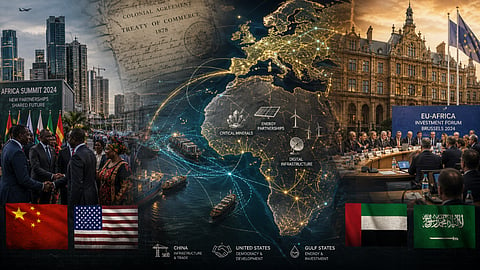
Key topics:Europe courts Africa amid shifting global alliances post-US shiftColonial legacy tensions complicate Europe-Africa partnershipsAfrica gains leverage as global powers compete for influence.Sign up for your early morning brew of the BizNews Insider to keep you up to speed with the content that matters. The newsletter will land in your inbox every morning on weekdays. Register here.Support South Africa's bastion of independent journalism, offering balanced insights on investments, business, and the political economy, by joining BizNews Premium. Register here.If you prefer WhatsApp for updates, sign up to the BizNews channel here..By Justice Malala.You can’t walk through an African capital these days without stumbling over a gaggle of visiting European politicians and business people. Similarly, European cities are abuzz with African leaders invited to town for bilateral meetings, summits, “relationship upgrades” and photo opportunities. Europe’s leaders are seeking new allies in the wake of uncertainty unleashed by US President Donald Trump’s isolationist America First policies. Yet, with colonial histories and sensitivities unresolved between many European and African states, plus a vastly altered geopolitical landscape that features countries from the Middle East and Asia jostling for influence, Europe’s new foray into Africa may not be easy to navigate.Diplomatic action between the two continents is frenetic. Five months ago, the seventh African Union–European Union Summit held in Angola produced a joint declaration focusing on a 25-year partnership. In February, Italy’s Prime Minister Giorgia Meloni and leaders of 14 African states signed deals on migration, energy, infrastructure and agriculture. In mid-April, South Africa’s President Cyril Ramaphosa joined Spanish leader Pedro Sánchez in Barcelona for a summit and signed bilateral agreements. The week before, he met his German counterpart to “upgrade their relations to a strategic partnership.” Last month, Kenya’s William Ruto agreed an “action plan” with Italy’s Meloni in Rome. .Read more:.Africa’s call to the G20: The new colonialism of the mind and a charter of values for a living economy.There’s more to come. In May, France’s President Emmanuel Macron and Ruto will co-host the inaugural Africa-France Summit 2026. An Africa-Turkey “partnership summit” is in the works for later this year. It makes sense for European leaders to pursue a diverse set of tie-ups with African and other so-called middle-power countries as the certainties of the post-World War II order become blurred. However, there needs to be substance and cooperation to make such collaborations work, rather than simply assembling African leaders to listen to a European head of state and then issue a conference declaration; South Africa says it won’t attend the May France-Africa summit in Kenya for these reasons.Mindsets will need to change. France’s decades-long dominance and influence in west Africa has ended following a wave of hostility centered on views that it had behaved — despite a new global context — as a colonial power. Its army, business interests and diplomacy have been criticized and expelled from Mali, Burkina Faso, Niger, Chad, Ivory Coast and Senegal. Hopefully, Macron’s pivot toward anglophone Africa will have to come with some reflection on what went wrong in the past and some humility in his new engagements. Forgetting that each African country is unique often leads to simplistic “one-size-fits-all” solutions, with negative consequences.Europe is also not alone in wooing Africa. There is competition aplenty. While the roles of China, the US and Russia are well documented, less scrutiny has fallen on Turkey, Brazil, the United Arab Emirates, Saudi Arabia and Qatar. The latter, for example, has been central to efforts to broker a peace deal in the Democratic Republic of Congo. The UAE, alongside the US, will fund the DRC’s new paramilitary unit to police its mines. Another problem is that too many of these summits follow the “Africa+1” formula, where a horde of Africa’s 55 leaders engage with a single state or global power. This happens most prominently every three years at the Forum on China-Africa Cooperation (FOCAC) meetings. Despite China’s massive diplomatic and economic surge in Africa, FOCAC has been criticized for allegedly facilitating a neo-colonial trade structure where Africa exports its raw materials and imports finished goods from China, hindering local industrialization and trapping the continent in a low-value-added position in the global supply chain. .Read more:.John Matisonn: SA gets closer to Europe as US tensions persist.The plethora of European leaders reaching out to Africa, particularly for its mineral resources, should be mindful of such criticisms. In November, Europe told Nigeria that its refined oil products weren’t good enough to supply its market. Billionaire Aliko Dangote didn’t mope about the slight; now, the UK and other countries are dependent on the 650,000 barrels a day his company refines for jet fuel. It’s an example of how African countries should pick and choose partnerships where they can gain an economic advantage, recognizing that the changing geopolitical backdrop puts them in a strong negotiating position..© 2026 Bloomberg L.P.