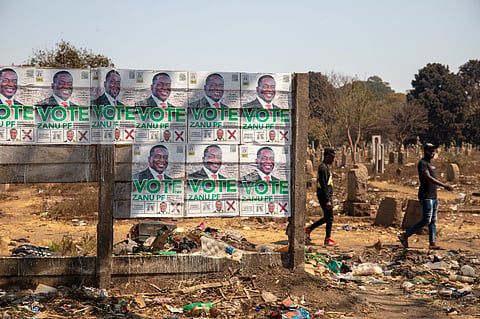
Key topics:Zanu-PF extends Mnangagwa’s term, sidelining VP Chiwenga’s ambitionsEconomic growth returns, boosted by lithium, gold, roads, and power plantsMedia, education, and debt challenges persist under Mnangagwa’s rule.Sign up for your early morning brew of the BizNews Insider to keep you up to speed with the content that matters. The newsletter will land in your inbox at 5:30am weekdays. Register here.Support South Africa’s bastion of independent journalism, offering balanced insights on investments, business, and the political economy, by joining BizNews Premium. Register here.If you prefer WhatsApp for updates, sign up to the BizNews channel here..By John Matisonn.Zimbabwean ruling Zanu-PF Party’s decision to extend 83 year old President Emmerson Mnangagwa’s term of office until he is 88 has left a dark cloud over the heir apparent, Vice President Constantino Chiwenga.The defeat of Chiwenga’s attempt to block the extension of Mngangagwa’s term at the party congress on the weekend has left a problem for Mnangagwa, since time is on Chiwenga’s side, unless Mngangagwa ousts him.Before the party congress, insiders in Harare had expected Chiwenga to make his move against Mnangagwa before his term is over, perhaps repeating the coup of 2017 against Mugabe. Then Defence Forces Chief General Chiwenga staged the coup against President Robert Mugabe that brought Mnangagwa to power, but eight years later the two men lead rival factions of the governing ZANU-PF, as Chiwenga, 69, has become impatient for his turn..Read more:.Mnangagwa’s diplomatic gambit: Is Zimbabwe showing SA how to deal with Washington?.Efforts to implement the two-year extension will require a constitutional amendment which is likely to be challenged in the courts.Under Mnangagwa, repression of political opponents and journalists has continued, but improvements in the economy are beginning to show.While 2024 GDP growth slowed to 1.7% in 2024, primarily due to a severe drought that affected agricultural and hydro-power output, the World Bank has projected 6% growth for 2025, supported by a good agricultural season, record-high gold prices, and strong remittance inflows. Long dormant infrastructure projects have brought vast improvement to the national road network, to the south to Beit Bridge and north to Victoria Falls and the Zambian border. Roads within Harare and Bulawayo have improved markedly, and housing construction in the elite Harare suburb of Borrowdale has been extensive.The first new electricity plants built since independence in 1980 are now on line, reducing electricity blackouts, and attempts to revive the railway services are under way. Zimbabwe’s flagship Hwange Power Station expansion has achieved its highest-ever electricity output since coming online last year, generating 498 million kilowatt hours (kWh) in August alone, according to project contractor Power China.The $1.5 billion expansion project, financed mainly through Chinese loans, added coal-fired Units 7 and 8 at Hwange, each with a capacity of 300MW. The additional 600MW was touted as a game changer in a country that has suffered rolling blackouts lasting up to 18 hours a day in recent years.The Kariba hydroelectric plant—traditionally a mainstay of supply—has been crippled by low water levels, leaving thermal plants like Hwange to shoulder the burden.Zimbabwe is now Africa’s biggest supplier of lithium, and the government’s pressure on mining companies to process locally has borne fruit. The government will ban export of lithium concentrate from 2027.China’s Zhejiang Huayou Cobalt has announced that it will start producing lithium sulphate during the first quarter of 2026 from its new $400 million plant.Lithium sulphate is an intermediate product which can be refined into a battery-grade material such as lithium hydroxide or lithium carbonate used in battery manufacturing.This company and other Chinese metals firms Sinomine, Chengxin Lithium Group, Yahua Group, and Tsingshan Holding dominate Zimbabwe’s lithium mining, producing concentrates and shipping them to China.Zimbabwe’s economy still has major obstacles to overcome. High and unsustainable public debt limits its access to international financing. Due to accumulation of external arrears and legacy debts, total public debt reached $23.2 billion in 2024 (72.9% of GDP). Zimbabwe has failed to service debt to the World Bank since 2000, and remains in arrears to the African Development Bank (AfDB) and the European Investment Bank (EIB).Meanwhile, Zimbabwe’s once admired education system has deteriorated. Parents report that many teachers who cannot come out on small salaries demand payment if their children are to receive attention. In many classrooms, children whose parents pay the teacher are placed in the front desks, while those who cannot afford to are left in the back of crowded classes and even ignored..Read more:.Zimbabwe urges Gold miners to boost output to back new ZiG currency.Zimbabwe’s Bill of Rights guarantees media freedom, but journalists face the risk of arrest, prosecution, or other forms of harassment. A number of people have been prosecuted for allegedly undermining authority or insulting the president.This year, the government has arrested and charged several high-profile journalists, including the editor of the Zimbabwe Independent, Faith Zaba, head of Heart and Soul Television, Blessed Mhlanga, as well as Alpha Media Holdings editor-in-chief, Kholwani Nyathi.Police arrested Mhlanga after his interview with Zanu PF member and war veteran, Blessed Geza, who accused Mnangagwa of corruption and urged him to step down. Mhlanga spent 72 days in pre-trial detention, where he alleges he was ill-treated by the police.In July, the Mnangagwa administration arrested Zaba on “insult” charges for publishing a satirical political column that mocked Mnangagwa’s tenure as the chair of the Southern African Development Community.