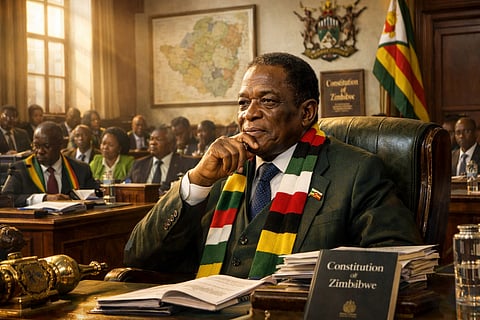
Key topics:Zimbabwe considers shifting presidential elections to a parliamentary systemIndirect election could boost accountability and stable governanceParliamentary model aligns with South Africa, Botswana, and Kenya.Sign up for your early morning brew of the BizNews Insider to keep you up to speed with the content that matters. The newsletter will land in your inbox every morning on weekdays. Register here.Support South Africa's bastion of independent journalism, offering balanced insights on investments, business, and the political economy, by joining BizNews Premium. Register here.If you prefer WhatsApp for updates, sign up to the BizNews channel here..By Kenneth Moeng Kgwadi*.Zimbabwe is at a crossroads in how it imagines presidential power. The Constitution of Zimbabwe Amendment (No. 3) Bill proposes a shift from direct presidential elections to a parliamentary system where the President is elected from and by the majority in Parliament. This change has been framed by opponents as a theft of the people’s will and a blow to “one man, one vote.” But the deeper truth is quite the opposite: the amendment offers Zimbabwe a chance to move from a raw, winner-take-all presidency to a more stable, accountable, and regionally consistent model of governance.The loudest objection to the move is that voters will no longer “tick a box” for President. That is emotionally powerful imagery, but it is analytically misleading. In a parliamentary‑linked system, voters still choose Members of Parliament (MPs) directly. The President then emerges from the party or coalition that commands the majority in that chamber. In effect, every vote for an MP becomes a vote for a presidential candidate. Power is not removed; it is redistributed into a more continuous, institutionalised channel.Critics act as if the ballot paper is the only authentic expression of democracy. In reality, democratic legitimacy is better measured by whether leaders can be held accountable, whether institutions function, and whether governments deliver on the ground. A presidential system that concentrates power in one office every five to seven years can produce dramatic, emotional elections, but also long stretches of accountability vacuum. A parliamentary‑linked system, by contrast, keeps the executive on a tighter leash, dependent on the confidence of elected representatives who themselves face the voters frequently..Read more:.Cathy Buckle: 90 days to stop the coup on Zimbabwe's constitution.If Zimbabwe is serious about learning from its neighbours, it must confront a simple fact: South Africa, Botswana, and Kenya, three of the region’s most enduring constitutional democracies, do not rely on direct presidential elections in the way Zimbabwe currently does. In South Africa, the President is elected by the National Assembly after a general election; in Botswana, the President is elected by a majority of the National Assembly, tied to parliamentary candidates. In all these cases, the will of the people is still decisive, but it is exercised through parties and MPs, not through a standalone presidential ballot.These are not weak or fragile democracies.South Africa has seen regular alternation of power, robust courts, and a fiercely independent media. Botswana has enjoyed decades of stable multiparty politics and macroeconomic discipline. Kenya, though it uses direct presidential elections, shares Zimbabwe’s constitutional DNA, Montesquieu‑style separation of powers, entrenched rights, and a Supreme Court, showing that the same institutions can function under different electoral designs. If those models are good enough for rights and checks and balances, why are they suddenly suspected for choosing a president?A direct‑election system often encourages a “five‑year mandate” mentality: the President proceeds as if every decision is backed by a once‑in‑a‑generation mandate, while Parliament fades into the background. In a parliamentary‑linked system, the President’s survival depends on retaining the support of the majority in Parliament. If they lose that support, a vote of no‑confidence can remove them without waiting for the next election. This does not weaken democracy; it deepens it by making accountability continuous, not cyclical.Zimbabwe has seen the dangers of excessive personalisation. When the President is seen as the only legitimate source of power, the legislature, the courts, and even the ruling party can become little more than instruments of that single office. A parliamentary system, by contrast, forces the President to negotiate, persuade, and compromise. It foregrounds coalition‑building over command‑and‑control, and it makes it harder for any one leader to treat the state as a personal project.Critics also ignore a practical governance problem: the tyranny of constant elections. In direct‑presidential systems, governments often spend more time campaigning than governing. Every policy decision is filtered through the lens of the next election, and long‑term planning withers. Bridges are begun but not finished; economic reforms are delayed because they might be unpopular this year. A parliamentary‑linked system, especially when paired with slightly longer terms, can ease that pressure by giving governments breathing space to implement complex, long‑term projects.Countries with parliamentary systems tend to prioritise negotiation and consensus. That does not mean politics vanishes; it means that politics happens inside institutions rather than on the streets. In societies where elections have historically been tense, if not violent, a system that encourages bargaining and coalition‑building can reduce the likelihood of political explosions. Zimbabwe, with its own history of election‑related tension, has much to gain from such stabilisation.The emotional appeal of “one man, one vote” is real. It has profound historical weight, especially in a country that emerged from a liberation struggle built on the promise of universal suffrage. But the phrase is not a technical blueprint. It is a moral statement: every citizen should have an equal voice. Whether that voice is best expressed through a direct presidential ballot or through a layered parliamentary system is a question of design, not a test of democracy itself.If the goal is to deepen democracy, then the question should be: What system best converts the will of the people into stable, accountable governance that actually delivers? A parliamentary‑linked system can do that by making representation more central, not by concentrating legitimacy in a single office. If Parliament is truly elected, transparent, and responsive, then the President chosen by that body is fully legitimate, because he or she is one remove from the people, not two.In the end, the Constitution Amendment Bill No. 3 is not really about whether Zimbabwe keeps direct presidential elections. It is about what kind of society Zimbabwe wants to be. Do they want a system where power is concentrated, personal, and periodic, or one where power is shared, institutional, and continuous? Do they want to mimic the instability of personally‑dominated presidencies, or do they want to learn from neighbours who have built constitutional democracy on the idea that power is safest when it is constantly checked and mediated?.Read more:.John Matisonn: Zimbabwe’s succession battle heats up .Supporting the indirect election of the President is not about surrendering sovereignty to Parliament. It is about recognising that in a complex, modern state, democracy is not exhausted in a single ballot. It is sustained in how institutions work, how leaders are held to account, and how ordinary citizens see their lives improve over time. Zimbabwe can keep its spirit of “one man, one vote” while choosing a structure that better turns that spirit into stable, accountable governance. The Constitution Amendment Bill No. 3 offers that choice. The question is whether Zimbabweans are willing to think deeply enough to take it..*Kgwadi is a political scientist and freelance writer. He holds a Master of Arts in African Studies.