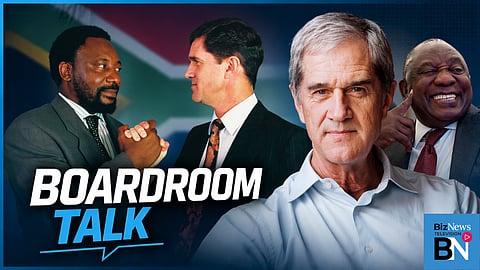
In this Boardroom Talk, BizNews editor Alec Hogg details how President Cyril Ramaphosa’s appointment of Roelf Meyer as South Africa’s envoy to Washington is one of the smartest decisions of his presidency. Hogg says Meyer’s credibility, history and stature could help thaw a badly damaged US-SA relationship, ease pressure around AGOA, and signal a long-overdue return to pragmatic, economically minded diplomacy.Sign up for your early morning brew of the BizNews Insider to keep you up to speed with the content that matters. The newsletter will land in your inbox every morning on weekdays. Register here.Support South Africa's bastion of independent journalism, offering balanced insights on investments, business, and the political economy, by joining BizNews Premium. Register here.If you prefer WhatsApp for updates, sign up to the BizNews channel here..Watch here.Listen here.Edited transcript of the Boardroom Talk.Welcome to Boardroom Talk.Big story today: we’re going to talk about a diplomatic train wreck in the United States that has finally been put back on track with a just brilliant appointment by Cyril Ramaphosa. It’s not often that we give the President of South Africa a double thumbs-up, but my goodness, this is one time we must.If you’ve been following the international media and picking up all the information that comes through to us on a real-time basis nowadays, you’ve got to be feeling a little bit despondent about our country’s place in the world. So often it feels like this is a geopolitical chessboard where we’re playing draughts — and not doing it very well either. Own goals, shooting ourselves in the foot — call it what you like.We have not been doing this terribly well, putting ideology way above the economic interests of a country that desperately needs economic growth and foreign investment to make that happen. But you’ve got to be able to step back and say: my goodness, when you have some good news, applaud it.And the appointment that came through last night by the ANC government of Roelf Meyer as the new ambassador to the United States has got to go down as one of the best decisions that Cyril Ramaphosa has made in his entire presidency since he stepped into the hot seat in 2018. My goodness, if you think about that, what’s it — seven years ago?Anyway, Roelf is 78 years old. I know him. I’ve met him. I haven’t spoken to him for quite some time. We’ve had various interviews with him through my colleague Linda van Tilburg, who actually knows Roelf far better. But Roelf was a regular participant in what we used to call the iBandla. This was a supper club that we had four times a year, and we would go away for a long weekend with partners.The supper club was restricted to chief executives and high-ranking government officials, and also a number of people who really shook the boat. I remember Sam Shilowa coming to a few, Tito Mboweni, Jacob Zuma twice, and Roelf was there at pretty much every event because he was a business leader. And that’s been the interesting part about this appointment that many people will forget.Roelf is a sensible individual. We know that. He served in the apartheid government as a very senior member of F.W. de Klerk’s cabinet. He was the man from the National Party side who negotiated with Cyril Ramaphosa and, only for those of us who were around at the time, pulled the country back from going right over the crevasse that waited on the other side.You have to remember things like Boipatong, where members of what were called the Third Force — but who knows — attacked and killed dozens of ANC women, children and men in a desperate massacre. That could have sparked anything.We had the assassination of Chris Hani on a Sunday morning when he went out to pick up his newspaper. A crazy guy, funded by who knows who, came along and shot him and destroyed the life of the man who was widely tipped to become the next president of South Africa.We had the farmers getting into their bakkies and old Mercedes-Benzes and driving into Bophuthatswana, as it then was, and indiscriminately shooting at people. That ended in chaos when the Bophuthatswana Defence Force fought back, and the pictures that went around the world were of fat-bellied, khaki-clad individuals lying next to a yellow Mercedes and, just before they were executed, begging for mercy.It was a crazy time, and those of us who were there remember it well. And between Roelf Meyer and Cyril Ramaphosa, they pulled a rabbit out of the hat. We went on to establish a democracy that, for most of the last 30-odd years, we believe has been a very good democracy. It has been sliding. The ANC, like any party that is in power for too long, starts taking the rest of us for granted.But that’s all changed now as well. And now we have a Government of National Unity, or at the very least we do not have a dominant governing party. And that, for democrats and for people who are prepared to look at the world in a different way, is a very, very good thing.But let’s get back to the appointment of Roelf Meyer. He is not part of a routine diplomatic reshuffle. We haven’t had an ambassador in the United States since the departure of Ibrahim Rasool — a firebrand, a man who was installed into that position, well, we believe, through Jacob Zuma and then endorsed heartily by Joe Biden. And it was pretty clear where his political sympathies lay. They were certainly not with those who were the new guard who had taken over in the United States.Rasool attacked Donald Trump from the word go. He said things that, if anybody had come into your house and said them, you would have tossed them out. And Trump and his merry men certainly didn’t take very long. We know that the straight-talking US Secretary of State, Marco Rubio, is a man who doesn’t mince his words when it comes to nations he views as hostile.Rasool had called Trump and those around him a supremacist movement. Damn stupid. Anyway, he was kicked out. And since then, things have been in freefall. The relationship between Pretoria and Washington has never been at a lower ebb. The fallout from that ideological attack — started, I guess, from South Africa’s side, but certainly not taken lying down by the Americans — has been, frankly, terrifying.We have a country that is tiny in the global scheme of things. Our GDP is about one-third of 1% of the global gross domestic product. It’s like a tiny village in a global nation. The United States, by contrast, is about 26%. So call it 75 times bigger than South Africa.South Africa is a developing nation. It’s like that little village that needs injections of fresh capital to create new jobs, create new businesses and develop. Well, we haven’t been doing that. And so we’re sitting on these extraordinary assets.As I discussed earlier in the week, the gas and oil opportunity that we have in South Africa is lying fallow, whereas to the north-west of us, Namibia is being described as the next Norway. Namibia has the same geology that we have all the way down the Cape West Coast. And that is being very well invested in with our neighbour, and not at all being looked at by South Africa.So enter Roelf Meyer.For first-level thinkers and the pundits who’ve already reacted, showing themselves to be exactly that — people who react purely on emotion and surface-level optics — they’ll look at Roelf Meyer and say: what the hell is Ramaphosa doing now? Scraping the bottom of the barrel? Why are you dragging a 78-year-old out of retirement and sending him off to Washington for one of the most important jobs you could possibly have?But if you apply what the great investor Howard Marks calls second-level thinking, that is where you see the sheer brilliance of the thinking that has gone through Pretoria this time around. And for that, we should be very thankful that the adults — the grown-ups — have entered, or re-entered, the room after an absence of a heck of a long time when it comes to foreign relations.Our Department of Foreign Affairs, for want of a better description, has been ideologically driven for so long that we have been backing the wrong horses time after time after time, including at the moment, and to the great detriment of South Africa. You don’t have to like what countries do in other parts of the world. You have to love what you do in your own nation. And to shoot yourself in the foot by showing support for a regime that you don’t really know that well — take Iran as an excellent example — is madness.As Iraj Abedian has unpacked for us — himself an Iranian, a former professor of economics at UCT, former head of economics at Standard Bank, an entrepreneur of great repute, and for a long time a trusted adviser to the ANC government — he has unpacked for us very clearly, in words of one syllable, what the Iranian regime is up to. And yet we in South Africa still back them. Craziness.But that’s perhaps ending. This appointment of Roelf Meyer tells us that, for the first time, the United States — which has been going on a tirade against our country based on the echo chambers of right-wingers who are giving them information that suits their cause, not what suits the nation’s cause — may finally be confronted with a different reality.And by that I mean, in the United States there is this perception that whites are being attacked, especially white farmers, all the time; that there is a genocidal approach towards these people. And we know that it is very dangerous to be a white farmer. And we know that, for political reasons, the ANC has been very slow in protecting these people. And we know that that needs to be addressed, of course.But that is not the reality of South Africa. Whites in South Africa are not being targeted and attacked and made to fear for their lives. There’s all kinds of anti-white or racist legislation which needs to be addressed, and indeed is being addressed — perhaps slowly, far too slowly for many of us. But the reality that exists on the ground in South Africa is easy to see when anyone visits this nation of ours.We are a country that pulls together. The opportunity that we have with the local elections coming up, and thereafter in the national election in 2029, is to show that we’re not racist and indeed that, when we work together like the Springboks under Rassie Erasmus, we can be as good as anyone in the world.But now go back to Roelf Meyer. He’ll be walking into rooms in Washington and the immediate narrative from the Republicans is going to be spiked. The guns are spiked. Consider these optics: how on earth does the MAGA lobby maintain the narrative that the South African government is orchestrating a racial purge when Pretoria’s envoy — the man sitting in the room — is a white Afrikaner?And a white Afrikaner chosen by the president himself. And not just any Afrikaner: the former constitutional affairs minister of the National Party government that enforced apartheid from 1948 until 1994, and the man who sat across the table from Cyril Ramaphosa at a time of great stress in our nation’s history to negotiate a peaceful settlement.Just by being there, just through his presence, Roelf Meyer will disarm that hostility. He’ll spike the guns, as I mentioned earlier, without speaking a single word. His physical presence will neutralise all those toxic talking points, all that jibber-jabber that has been keeping this antagonism alive, and lay the foundation for something better, something fruitful, something concrete that we can develop together.And as we well know, with the highest unemployment rate of any country that really measures it properly, South Africa desperately needs support, help and investment to get over the real issues that are afflicting so many in our country.We’ve already seen some dividends from this more rational approach, from this introduction of adults into the room. When Brent Bozell, the new US ambassador to South Africa, was at the business conference in March — only a month ago — he arrived with certain views. Obviously, he’d only been here for three weeks, and he was really angry about the “Kill the Boer” song, which had not been ruled hate speech by our courts, and he expressed himself accordingly.For many of us in South Africa, “Kill the Boer” is hate speech. Really, what else can you call it? But the fact that the US ambassador suggested that the court was wrong in not ruling that way sparked a whole diplomatic incident, which somebody somewhere had just been waiting for.Remember, they expelled our ambassador. Boy, were we going to give them a little bit of their own medicine here too. But that’s calmed down. Bozell has shown himself to be conservative, sure, and that isn’t easy for many people in the South African government to swallow. But he is a man of great rationality.He spent decades building up a business that analysed media. He knows how narrative can impact the facts. And he is calm, mature and a good listener. Now, I tell you all of that because I’ve met the man. I spent time with him when he came down to Hermanus to our conference. He came across, certainly in our conversation, as being someone who wanted to be successful in this role.He’s not another high-donor individual who is going to be rewarded with a plum ambassadorial post where he can swan around for the next three or four years. He is a doer. And he came here to repair the relationship between South Africa and the United States, certainly as much as he could do from the American perspective.When he met with Cyril Ramaphosa earlier this month to present his credentials, there was a notable difference in the hostility that had occurred before. And when he met with Roelf Meyer, which happened in the past month, he came out and said that it was a privilege to learn about Meyer’s work in creating South Africa’s democracy.If you listen closely to what he said about Meyer, and what happened in Pretoria when he presented his credentials, what we’re hearing from Bozell is the sound of ice melting. That’s unlike the ideologues who are still running DIRCO, and perhaps that’s an area that Ramaphosa, and indeed the whole Government of National Unity, need to be focusing greater attention on, because the damage these people have done to us — well-intentioned perhaps from their perspectives — is incalculable.And they still maintain that they’re right, and that their role is to tell the rest of the world how to conduct itself, when they’re coming from a position of extreme weakness. South Africa is not the moral beacon it was under Madiba’s presidency — anything but. And you don’t have to look very far to understand that reality.But let’s get back to Roelf Meyer. In July last year, nearly a year ago, he told the SABC — and I’m going to read this quote directly because it’s an important one:“We neglected our relationship with the US over a period of time. We have to get an aggressive relationship-building approach towards the United States as soon as possible.”Aggressive relationship-building — that’s what Meyer believes. And anyone who is able to apply second-level thinking will agree with that.My friends, that’s exactly what South African businesses struggling to keep going — let alone expand — need. Many South African businesses are exposed to the United States, or at the very least to US-owned companies, the 600 of them operating here, employing hundreds of thousands of people, bringing in enormously important products and software that are needed by any modern economy.Our businesses are trying to Trump-proof their operations. Now they might be able, with a Roelf Meyer in Washington, to start celebrating the good parts of the Republican administration. And the good parts are all related to Trump’s background as a businessman. And there you have Roelf Meyer, the businessman, on the other side of the table representing our interests.And that brings us to the “so what”.So what does this mean for you as a member of the business tribe, as an investor, as someone who wants to build South Africa, as someone who’s looking at a country that has undeniable potential, but with so many around you saying it has no future — and telling your children that as well, and your grandchildren? What does it mean for those of us who want to bring our families back home, who want to see a nation that is peaceful and growing?It means a lot. It means the adults are finally back in the room. It means that the two guys who did more than any other two people during the transition to democracy are working together to potentially reverse the biggest challenge we’ve had since the early 1990s, when they were very much involved.Roelf Meyer didn’t need to take this on. Ramaphosa could also have gone the easy, softer route by appointing some party hack who just wouldn’t rock the boat — some diplomatic reshuffle that would have made everybody within his party comfortable. But that’s not what happened here.What happened here was that there is a deliberate effort on behalf of our nation to reset the relationship with Washington. More than three decades later, Ramaphosa called in his old sparring partner to once again save South Africa from another cliff edge — this time an economic and diplomatic one.So for portfolios, what does it mean? Well, that’s relief regarding AGOA, the Africa Growth and Opportunity Act. We’re teetering on the brink. In fact, there are many in Washington who say: kick South Africa out. They have abused the rules of the Act. Keep the other Africans in, but not South Africa.And that would be very harmful for a huge part of our economy, from the automakers to agriculture through to our manufacturing base — and who knows, even tourism potentially.For those of us in the business community who prize rational optimism, it’s a moment to savour. It’s a moment to celebrate. It proves that when our leaders apply second-level thinking, amazing things can happen. We don’t always have to be shooting ourselves in the foot. We can act in the national interest and we can pull things back from the brink.Heavens, we know that example from our sporting prowess and from those times where we have worked together as a nation rather than for separate interests. It reminds us that we’ve got deep reserves of sensible leaders in our country. Yes, including some in the ANC.Well, that’s your Boardroom Talk for today. Thanks for being with us, and keep rational, keep optimistic, and know that you can find evidence to support it on BizNews.com or on the BizNewsTV channel.Once again, it’s been my privilege to share this Boardroom Talk with you. Until next time.