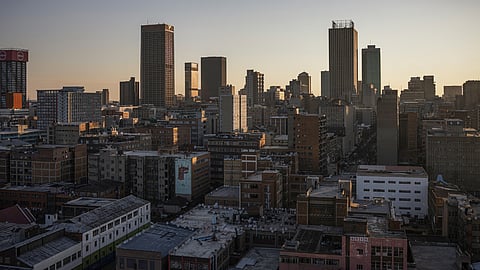
Johannesburg is facing a fiscal reckoning. With a R220 billion infrastructure backlog, soaring debt impairment costs, and local elections on the horizon, BizNews editor Alec Hogg digs into the city's own budget documents to ask the question no one wants to answer: can any incoming administration actually fix this?.By Alec Hogg.There's a document sitting in front of Johannesburg's bondholders right now that should, by any reasonable standard, make their blood run cold. Released through a nondescript pointer on SENS yesterday morning, it is part of the City's Medium-Term Budget for 2026/27. Dry. Official. Dense with tables. The sort of document designed, whether intentionally or not, to obscure rather than illuminate.So let me translate it for you.Johannesburg — Africa's richest city, the economic engine of the continent's most industrialised economy — is running on borrowed time. And, increasingly, borrowed money.The City's own Integrated Development Plan describes what it calls "a multi-dimensional crisis." That phrase, buried in bureaucratic language, is doing enormous work. Read past the planning-speak, and you find a city with a combined infrastructure renewal and maintenance backlog of R220 billion. Billion with a 'b' — 1,000 times a million.The roads agency alone accounts for just over half of this mountain of misappropriated allocations over decades. City Power: R44 billion. Johannesburg Water: R26 billion. These are not rounding errors. They are civilisational debts accumulated over decades of deferred maintenance, political patronage and institutional rot. It’s a study in how not to allocate resources, and in how, while compounding grows investments, in cases like this it becomes a killer. Ageing infrastructure accelerates non-technical electricity losses — currently running at roughly 27% of bulk purchases, nearly double what NERSA considers acceptable. Those losses cost the city billions in revenue it never collects. Which means less money for maintenance. Which means more infrastructure decay. Which means higher losses. Round and round it goes.Joburg's official unemployment rate sits at 33%, youth unemployment higher still. Only 41% of the city's population is economically active. Under half. Every year the city's ratepayers — an ever-shrinking band of residents and businesses who actually pay their bills — are being asked to carry an ever-heavier load for an ever-larger population that cannot. And you wonder why semigration is ballooning.The Metro’s budget starts from the wrong place. It assumes a collection rate of 86%. Which means 14 cents in every rand billed is automatically written off as uncollectable. Banks go bust when bad debts reach even half that level. Yet for Joburg, debt impairment is baked in as a massive line item — and keeps rising. These accepted bad debts now consume nearly 12% of the entire expenditure budget.The budget offered to bondholders is, in its own way, a masterpiece of official optimism. Revenue of R90.4 billion. A budgeted surplus of R2.1 billion. Capital expenditure of R8.8 billion. These numbers are not fictional. They are aspirational. The City is a price-taker on its two biggest input costs — Eskom and Rand Water — while being a price-setter for a population with a rapidly declining capacity to pay.Joburg's Green Drop score for water quality — once 86% in 2013/14 — has fallen to 73%. That is not a statistic. That is people drinking water of declining quality in a city that was, within living memory, a functioning modern metropolis.Steve Jobs used to say that focus is about saying no. Not to bad ideas — that's easy — but to good ideas that aren't the right ideas right now. The City of Johannesburg has the opposite problem. It says yes to everything and delivers almost nothing. Its IDP lists eleven strategic priorities. Eleven. Jobs would have torn that list to three and demanded that every rand flow toward them.Which inevitably brings us to the political question. Local government elections are imminent. The City's own budget documentation acknowledges this: "the coming MTEF will coincide with local government elections, and formation of a new administration, and this budget becomes the base for incoming administration." That sentence, slipped in almost apologetically, is the most consequential in the entire 500-page document.Could a change in political leadership — Helen Zille, the DA, a differently configured coalition — actually fix this?Zille and the DA have genuine runs on the board. Cape Town's relative functionality is not accidental. It reflects years of institutional investment, consequence management and the political will to enforce bylaws regardless of who is violating them. The Joburg IDP's own diagnosis is withering: "internal diagnostics identify political interference, corruption, and leadership failures as the primary obstacles to good governance." That is the ANC-led coalition administering a critique of itself. Damning precisely because it is self-aware — and yet unable to act on its own diagnosis.But institutions are not simply reset by elections. They are rebuilt over years, sometimes decades, of painstaking administrative work. The R220 billion infrastructure backlog does not disappear on polling day. The 27% energy loss rate does not drop because a new face occupies the Executive Mayor's chair.Warren Buffett's investment framework is instructive here. He looks for businesses with durable competitive advantages, honest management and predictable earnings. Joburg, as an investable proposition, fails on at least two of those three criteria right now. Capital expenditure of R3.5 billion is being funded from loans in 2026/27 alone. Cash at year-end is projected at just R2 billion. That is thin. Very thin.City Power's own cost-of-supply study makes the point almost poignantly: if energy losses were reduced from 27% to 15%, the city would unlock R3.5 billion in additional revenue annually — without raising a single tariff. That is not a technical aspiration. That is linked directly to political will applied to wire theft, illegal connections and infrastructure investment.So here is my honest assessment for BizNews members who think about cities the way we think about investments.The fundamentals of Joburg are genuinely compelling beneath the dysfunction. Location. Concentration of capital, talent and infrastructure that no other African city can match. The Gauteng city-region generates roughly 35% of South Africa's GDP. This is not a shrinking asset. It is a mismanaged one.The question is not whether Joburg can be fixed. It can. The question is whether the political will exists to say no to patronage, yes to consequence management, and to treat the R220 billion infrastructure backlog as the national emergency that it is.A change of administration is necessary — but not sufficient.What is sufficient is what it has always been: institutions that work, leaders who are honest, citizens who demand both.That answer lies — as it always does — not in the budget book, but on the ballot. Roll on November 4. *Alec Hogg is the founder and editor of BizNews .Sign up for your early morning brew of the BizNews Insider to keep you up to speed with the content that matters. The newsletter will land in your inbox every morning on weekdays. Register here.Support South Africa's bastion of independent journalism, offering balanced insights on investments, business, and the political economy, by joining BizNews Premium. Register here.If you prefer WhatsApp for updates, sign up to the BizNews channel here.