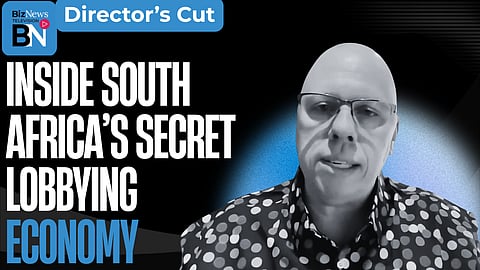
Trade expert Donald MacKay lifts the lid on how hidden lobbying, socialist economics, and political posturing are crippling South Africa’s competitiveness. In this Director’s Cut with Alec Hogg, he unpacks why our leaders keep doubling down on failed policies, how the scrap metal lobby beat out ArcelorMittal, and why the world’s worst ports could finally be turning a corner. A rare, no-spin look inside the quiet forces shaping South Africa’s economy and global trade future.Sign up for your early morning brew of the BizNews Insider to keep you up to speed with the content that matters. The newsletter will land in your inbox at 5:30am weekdays. Register here.Support South Africa’s bastion of independent journalism, offering balanced insights on investments, business, and the political economy, by joining BizNews Premium. Register here.If you prefer WhatsApp for updates, sign up to the BizNews channel here..Watch here.Listen here.BizNews Reporter.When Donald MacKay walks into a room, he doesn’t look like a man who’s spent decades navigating the dark corners of South Africa’s trade system. But as the founder of XA Global Trade Advisors, he’s been unpicking the complex web of tariffs, policies, and secret lobbying that quietly shape the nation’s economic future.“I started XA by accident,” he tells BizNews editor Alec Hogg. “I’d left Deloitte because I was miserable after Enron changed everything about the way we worked. There wasn’t a grand plan, I just knew I didn’t want to compromise.”That refusal to compromise would define his career. MacKay built a reputation as a straight-talker - one of the few willing to tell clients, corporates, and government when their economic logic didn’t add up. “We’re always honest with our clients, even when they don’t like what we have to say,” he says. “In South Africa, people are scared of offending the powerful, and good advice gets lost because of it.”It’s a policy problem that runs deep. South Africa, he says, has built a “lobby economy” - one where influence, not innovation, decides who wins.The cost of secret dealsMacKay doesn’t mince words. “We’ve become a lobby economy, and lobby economies don’t function well,” he says. “It’s a constant overriding of market signals to achieve political goals. That’s why we’re here - why the economy’s so concentrated, why the same big names keep winning.”One of his clearest examples is the scrap metal sector - a case study in how politics distorts markets. Around 2012, government introduced export restrictions under pressure from the steel lobby. What began as a “price preference system” - forcing exporters to sell locally at a 30% discount before exporting - soon escalated into full-blown protectionism.“Then Treasury added a 20% export duty,” MacKay explains. “The two measures were never meant to exist together. But secret lobbying made sure they did.”The result? A massive transfer of wealth from scrap generators — like factories and Transnet - to mini-mills that recycle scrap into steel. “It’s about R8.5 billion a year flowing from one side of the industry to another,” he says. “And the Industrial Development Corporation has R14 billion in exposure to those same mills.”The irony is that the policy was meant to protect the steel industry. Instead, it crippled ArcelorMittal’s Newcastle plant — a cornerstone of South African manufacturing. “We’ve inflated a steel bubble in a market already oversupplied,” MacKay says. “Now we’re about to see the IDC become the proud owner of Mittal. That’s what bad policy looks like.”Politics over productivityMacKay argues that the problem goes far beyond one sector. “South Africa’s economic system is heavily politicised,” he says. “The government keeps doubling down on socialist-style control instead of opening markets. You can’t fix unemployment one investigation or one merger condition at a time. Yet that’s exactly what’s happening.”He points to how competition authorities now demand that companies make public interest commitments — like hiring quotas or localisation funds — before approving mergers. “We’re trying to fix macroeconomic failure at a micro level,” he says. “That will never work. You end up with bureaucracy, not jobs.”Alec Hogg presses him on whether South Africa’s leaders even want to fix the system. MacKay pauses before answering. “I think most of them do,” he says. “I’ve met a lot of politicians, and I’ve never met anyone who genuinely wants to make the country worse. But the ANC is still a socialist party. In that worldview, the answer to every problem is more control. So even if the intentions are good, the results aren’t.”Misaligned foreign policySouth Africa’s political choices, MacKay says, are hurting its trade potential. “We’ve called ourselves non-aligned on Russia, but nobody believes that,” he says. “We export more to Eswatini than we do to Russia. We export more to Zimbabwe than to all BRICS countries except China and India combined. So why are we spending political capital on Iran or Cuba? It doesn’t make sense.”He believes the cost of these decisions — the investments that never arrive, the markets that quietly move on — is immense. “It’s hard to quantify because you’re measuring what doesn’t happen,” he says. “But the result is the same: South Africa becomes an unpredictable partner. Investors don’t like unpredictability.”The glimmers of hopeDespite the frustration, MacKay remains grounded. “I’ve chosen to live the rest of my life in South Africa because I want it to work,” he says. “I’m not a cynic. I’m frustrated, but I’m hopeful.”That hope, he says, comes from places like Transnet and the ports — long symbols of state dysfunction, but now showing signs of reform. “Durban port is literally the worst performing port in the world,” he says. “But bringing in a Filipino operator to manage it is a smart move. They’re credible. They know how to run ports. If this works, it could transform our competitiveness.”Hogg agrees — calling it a rare case of government “finally doing the right thing.” MacKay nods. “Exactly. There’s progress, even if it’s slow. We just need more of it. South Africa doesn’t have to be this hard. It just requires honesty, competence, and the courage to stop protecting bad ideas.”After two decades of fighting for fairer trade policy, MacKay hasn’t lost that courage. “I’m not in this to make friends,” he says. “I’m in this to make things work. We can’t afford another decade of getting it wrong.”