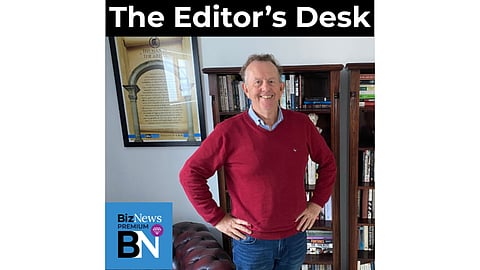
Alec Hogg reflects on three days in Cape Town for the national Budget — and comes away more upbeat: Treasury believes debt-service costs have peaked, there are tangible signs of public-sector “housekeeping” (including early exits and ghost workers), and exchange-control rules have been quietly eased for offshore investing. He also flags growing political heat in Johannesburg ahead of the mayoral contest, highlights a sharp Economist piece on Tony Robbins’ new funnel, and notes the WEF leadership shake-up after Børge Brende’s resignation..Don't miss out on future episodes of The Editor's Desk. Subscribe to BizNews Premium and get the podcast delivered to your inbox daily..Listen here.Edited transcript of today's Editor's Desk episode.Hello and welcome — I’m Alec Hogg. By now you’ve scanned the headlines on BizNews.com or caught the interviews on our channel, but the real story often lives in the margins: the context that doesn’t make the press release, and the whispers we pick up after the record button stops.Whether it’s the shifting sands of geopolitics or the political currents shaping our economy, that’s what we do here. We strip away the polish to tell you the backstory — and why it actually matters.This is the Editor’s Desk, exclusive analysis for our Premium members. It’s Friday, 27 February 2026. Let’s take a look behind the curtain.The first place to look is what I’ve been doing for the past three days: travelling to Cape Town for the national Budget. I’ve been doing this for a long time. Talking to Dawie Roodt the other day, he reminded me his first Budget — and he’s done 41 of them — was with Barend du Plessis.I remember Du Plessis well from my days as a young reporter. In the early 1980s, the IMF meeting in Washington was one of the few international gatherings South Africa could still attend — and as a journalist you didn’t often get to travel. It was a highlight of my young career when Financial Week sent me there.A dear friend of mine, Flip Meyer, was claustrophobic and wouldn’t use lifts. So we walked up 27 floors of stairs together to get to the South African delegation. Funny what sticks in your mind.My first Budget in Parliament, though, was actually Owen Horwood. Back then, there were no sophisticated “lock-ups” like today. You sat in the public gallery and took notes — and I remember MPs (all white, as it was then) carrying on and heckling. Again, funny what you remember.So why is the Budget so important? It’s the country’s financial results presentation — a snapshot of how the state is doing, and how it plans to spend.The state now absorbs around 26% of the economy — and I think it’s edging closer to 27%. The problem is: that side of the economy is largely unproductive. The rest of the economy pays taxes to fund it. So we need to watch closely how taxes are extracted, and how they’re allocated.I never forget: those MPs in red overalls and military fatigues — they are paid by us. They’re there to represent a constituency, yes, but they’re also being paid handsomely by taxpayers. At some point, we all need to keep that front of mind.Treasury reminds us of this. And Treasury produces incredible documentation. South Africa often has good laws on paper — we just don’t implement them properly. Meanwhile, we sometimes implement stupid rules that bureaucrats cling to because it keeps the paper-shuffling going.Those are exactly the things that frustrate any private-sector person: the waste created by poor decisions and badly designed rules. Sometimes public servants need to re-examine what they’re doing — not “because it’s always been done this way”, but because it genuinely makes sense.And that brings me to my overriding impression from the past few days in Cape Town: there is a new focus on exactly that point — and I’m delighted to see it.It was always going to happen, because even governments are subject to the laws of economics. You can’t keep spending on unproductive stuff indefinitely. Eventually, the people funding it — the taxpayers — push back.South Africa had an unusually long runway because we were well managed in the first decade of the new South Africa. There was fiscal discipline and an understanding of the debt trap: the more you borrow, the more interest you pay — and the more interest you pay, the less you have for uplifting people and investing in growth.When there was a boom, we didn’t just “hand out sweeties”; we used windfalls to repay debt. By 2008, after the commodity boom, debt-to-GDP fell to about 26%.Here’s the simple way to understand what that meant: in 2008, for every R100 of tax revenue, only R8.80 went to interest. Today, it’s about R21 in every R100.The big message that came through repeatedly this week is that Treasury now believes we’re at — or near — the peak. That R21-in-R100 interest burden is expected to start falling, releasing money for other priorities: supporting growth and strengthening the social wage.There were also, for the first time, concrete signals of action on the biggest long-term issue: the bloated public sector.I remember interviewing John Steenhuisen shortly after he became DA leader. I asked what would happen if, by some miracle, the DA took power and he became president. He said it would be incredibly difficult — because the public sector is so bloated.Treasury has said this for years. And it happened because, when the ANC came into power, it was time for comrades to get jobs — expertise often didn’t matter. Over time, the system entrenched itself, with unions making it exceptionally hard to lose a public-sector job.The result is a distorted wage bill, with large numbers of public servants earning very high salaries. That’s not a swipe at everyone — there are excellent public servants, and especially in recent years we’ve seen stronger younger cohorts coming through — but the overall system is too big and too expensive.In 2020, Tito Mboweni tried to start addressing this with early-retirement incentives — a kind of Hail Mary — but it didn’t really land. Many people nearing retirement weren’t eager to take packages, especially if they didn’t see comparable opportunities outside the state.This time around, we’re seeing actual movement: a few thousand have taken packages, and a few thousand more have been identified as “ghost workers” — people effectively on the books without being properly employed. That kind of housekeeping matters.Another quiet but significant “housekeeping” move: the discretionary amount South Africans can take offshore each year without prior exchange-control approval has been doubled to R2 million. A couple can now move R4 million a year within those rules.That effectively reduces a big chunk of friction around offshore investing for ordinary investors. It’s not necessarily good news for the JSE — because South Africans are increasingly aware that there are vastly more listed opportunities offshore, often in faster-growing economies.Put it all together and, when I came home, I felt something I haven’t felt in a while: the more I see South Africa’s realities reflected where it matters — in the numbers, not the narrative — the more excited I get about this country I’m besotted with. And I know many of you in the BizNews tribe feel the same.Three quick reads I want to point you to today:First, from the Common Sense team (Frans Cronje and colleagues): they highlight the DA’s by-election win in Johannesburg Ward 102 (Bryanston). DA candidate Bea Campbell-Cloete won with over 94% of the vote, creating a PR-seat vacancy that could allow Helen Zille to join the Johannesburg council.They also note fresh political spice: an ActionSA PR councillor and dozens of members/branch leaders have defected to the DA, accusing ActionSA of being run “from the top”. That’s particularly interesting with the BizNews Conference about 10 days away — because Zille and Herman Mashaba are both keynoting, and they’re the rival mayoral contenders for Johannesburg.Second, an Economist piece on Tony Robbins (Anthony Robbins) and his evolving business model — including a massive free-webinar funnel and the upsell mechanics around it. It’s a fascinating look at modern lead-generation at scale.Third, a sobering story on the World Economic Forum: CEO Børge Brende has resigned amid scrutiny over ties to Jeffrey Epstein, with WEF naming Alois Zwinggi as interim leader.That’s quite a lot to get your teeth into.I’m going to leave it there. Keep an eye on your Premium newsletter for links to our freshest published content. Thanks for trusting us with your time. I’m Alec Hogg — until Monday. Cheerio.