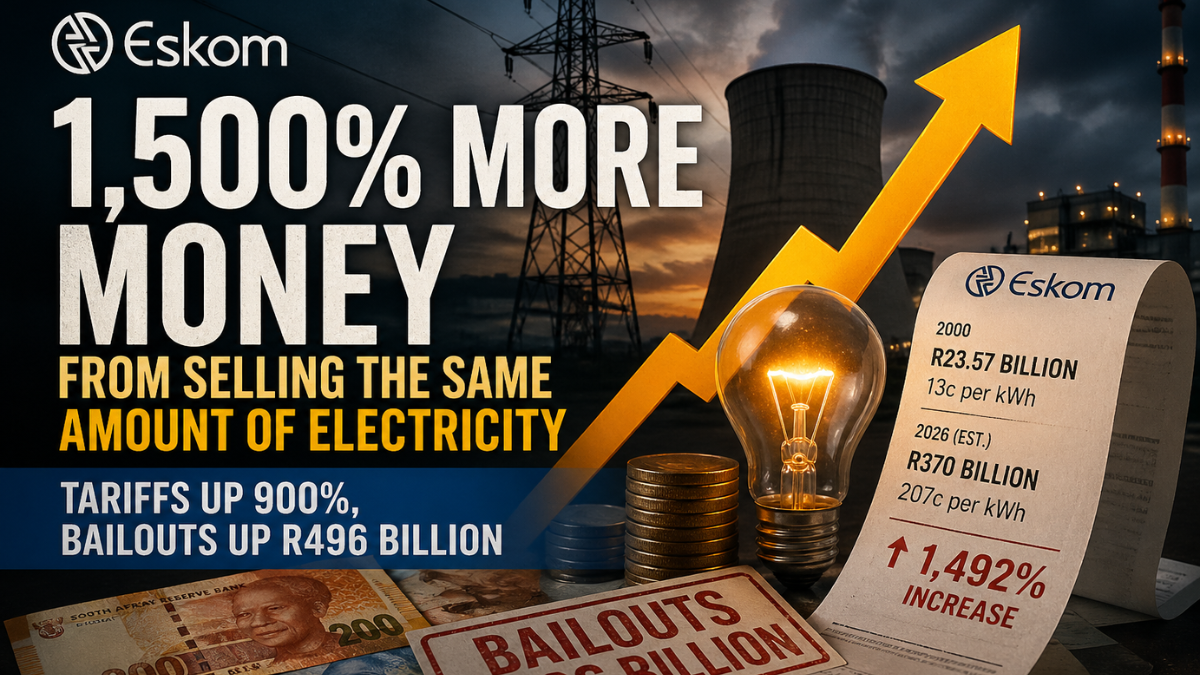
Key topics:Eskom revenue per kWh up ~1,492% since 2000 vs 285% inflationTariffs rose 900% but utility still needed R496bn bailoutsHigh costs driven by wages, inefficiency and alleged corruption.Sign up for your early morning brew of the BizNews Insider to keep you up to speed with the content that matters. The newsletter will land in your inbox every morning on weekdays. Register here.Support South Africa's bastion of independent journalism, offering balanced insights on investments, business, and the political economy, by joining BizNews Premium. Register here.If you prefer WhatsApp for updates, sign up to the BizNews channel here..By Hanno Labuschagne.Eskom chief executive officer Dan Marokane has defended the power utility making 1,500% more money from selling the same amount of electricity in its last financial year than it did in 2000.The power utility recently told Parliament its estimated electricity sales for the year ended 31 March should be about 179 terawatt-hours (TWh) — or roughly 179,000 gigawatt-hours (GWh).The last time the power utility sold less than 180,000 GWh of electricity over a year was 2000, when it sold 178,192 GWh.That year, its electricity revenue was R23.57 billion, meaning it made 13 cents per unit, which is measured in kilowatt-hours (kWh).For the 2026 financial year, Eskom estimated it would make R370 billion, working out to revenue of 207 cents per kWh.Therefore, Eskom’s revenue per kWh increased by about 15.92 times or 1,492%. Over the same period, inflation was about 285%..Read more:.Seems R240bn wasn’t enough – Eskom could need another big bailout.Had revenue per kWh risen accordingly, Eskom would have made only 50 cents per kWh in its 2026 financial year, and less than a quarter of its estimated revenue.Over the last two decades, Eskom increased electricity tariffs by more than 900%, but still required R496 billion in taxpayer bailouts to stay afloat.During the power utility’s winter system status outlook briefing on Wednesday, 22 April 2026, MyBroadband asked Eskom how it justified its increases.Marokane said that Eskom’s costs had moved and that the power utility repeatedly indicated some of these costs were not tied to inflationary increases.“About 50% of our costs are not moving at the rate of inflation, and those who are suppliers in the private sector — especially in primary energy — will be able to attest to that,” Marokane said.Eskom’s chief financial officer, Calib Cassim, previously made similar arguments, saying the power utility’s past tariff increases were inadequate to cover its costs.Prominent economists and energy experts have often criticised Eskom for maintaining its bloated and outdated operating model.The power utility’s finances have also been heavily impacted by severe corruption and irregular expenditure.Eskom spent over R1 million per employee in 2025.One particularly controversial component of Eskom’s costs has been its high average wage bill, driven by above-inflation wage increases and an oversized workforce.In a 2016 report, the World Bank estimated that Eskom was overstaffed by roughly 66% in 2014 compared to other utilities in Sub-Saharan Africa, based on power generation per capita.At that point, it had roughly 41,000 employees. The number had increased slightly to more than 42,000 in 2025.In the power utility’s 2025 financial year, its cost per employee was roughly R1.027 million. That is roughly 25 times — or 2,602% — greater than its R38,000 cost per employee in 1990.Over the same period, inflation was only 827%. Eskom has repeatedly granted employees in its union-represented bargaining unit — the largest by staff count — above-inflation increases.Between July 2018 and July 2026, the compounded increase in salaries worked out to roughly 64%. In all but one year, they received annual increases of 7% or 7.5%.In 2021, Eskom refused to capitulate to workers’ demands in wage negotiations and only increased salaries by 1.5%.When it tried to stick by its guns the following year, staff protests crippled power stations and plunged the country into stage 5 load-shedding.Eskom recently reached another three-year agreement for 7% annual salary increases for bargaining unit members, some of whom had originally sought a 15% raise.The bargaining unit’s salaries only paint a part of the picture. In addition to this unit, there are two other categories of Eskom workers. The most senior and best paid are executives and board members..Read more:.Wietze Post: Your electricity costs from 2026 to 2030 – the great divide.However, even after excluding the remuneration of high-level staff, the average cost per employee remains roughly R1.025 million.An analysis by MyBroadband showed that the top-level bargaining unit member earned roughly R974,976 per year, about R50,000 lower than the average cost per employee.One big unknown that remained was how much Eskom’s managerial staff, who were not in the bargaining unit, earned..This article was first published by MyBroadband and is republished with permission.