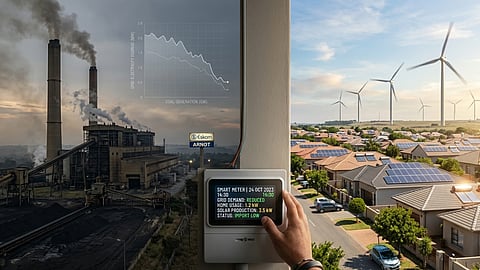
Key topics:Eskom’s residual electricity demand is steadily decliningRapid solar adoption is displacing grid-supplied powerRising costs and load shedding accelerate energy self-supply.Sign up for your early morning brew of the BizNews Insider to keep you up to speed with the content that matters. The newsletter will land in your inbox every morning on weekdays. Register here.Support South Africa's bastion of independent journalism, offering balanced insights on investments, business, and the political economy, by joining BizNews Premium. Register here.If you prefer WhatsApp for updates, sign up to the BizNews channel here..By Ir. Wietze Post*.Eskom is a strategically important company. It has served South Africa well since 1923. Nevertheless, South Africans are increasingly sourcing their electricity elsewhere, as discussed on 7 and 14 February 2025. The trend towards cheaper sources of electricity (than Eskom) is unstoppable.This six-part series updates the trends and forecasts I covered in my earlier articles. It focuses on the latest changes and insights.Official NTCSA hourly data shows that Eskom’s annual Residual Demand continues to drop. It fell from 211.96 TWh in 2021 to 191.38 TWh in 2025 (TWh: Tera-Watt-hour). The yearly difference is growing, and the decline sped up in 2025. Note that the data points are collated by consecutive calendar years (NTCSA= National Transmission Company of South Africa).In the first quarter of 2026, residual demand was 43.23 TWh. This is a 9.5% decrease from 47.75 TWh in the same period in 2025 (NTCSA hourly data). The previous largest drop was 6.3% from 2023 to 2024.Residual Demand is the hourly average of the electricity load. This is what Eskom's dispatchable resources supply. Solar, wind, and other generators are usually linked to a consumer. Their energy is used first by the consumer. If those generators are unable to fulfil the demand, Eskom has to fill the remaining gap. Hence, the residual, remaining, or "left-over" demand.“Dispatchable” means Eskom has backup generators. They are spinning on standby and ready to produce power at any time. The sum of all the hourly residual demands is the Total Energy Demand that Eskom supplies annually.South Africa faced serious load shedding in 2023. That drove a surge in solar installations during the year. Those solar installations displaced the need for some of Eskom’s demand. Thus the new solar plants led to reduced demand for Eskom’s energy in 2024. Likewise, solar installations sped up in 2025. This led to the lower demand for Eskom’s energy which we're seeing now..Read more:.Eskom’s solar clampdown backfires - costs rise, but demand refuses to die.We South Africans, ourselves, are chipping away at Eskom’s reason for existence. Every new solar and wind plant decreases the energy that Eskom is required to send out. Yet we’re doing so because we can generate electricity cheaper on our rooftops than Eskom and the municipalities can supply it.Daily maximum (hourly) residual demand is an example of the decreasing trend:- 2021: 34 029 MW (Mega-Watt);- 2024: 32 044 MW (-6%, over three years);- 2025: 31 153 MW (-3%, over one year).The chart below shows 14-day moving average data since 2021. It displays Eskom’s Daily Maximum Residual Demand. The lines highlight how demand in 2024 and 2025 was notably lower than in earlier years. Daily maximum demand has fallen further this year.The chart shows data from 2021 through 2026 in 14-month bands; for each year from January, through December, and to the end of February. Thus the tailend of a line corresponds to the beginning of the next year’s line. Note the vertical axis starts at 15000MW. It’s remarkable how much lower 2026 has started!.In 2025, South Africa increased its solar power capacity by 4.86 GW, as reported on the Nersa Registered Plants Dashboard. Total solar capacity has now passed 12 GW (Dec. 2024: 8GW), according to SAPVIA. This includes both rooftop and utility-scale systems. NERSA only requires registration for plants with a capacity of 100 kW or more. As most small systems are unregistered, their total capacity is estimated (NERSA= National Energy Regulator of South Africa; SAPVIA= South African Photovoltaic Industry Association).Solar power capacity is growing by 30%-50% p.a. During 2024, we installed about 3720MW. Compared with 2025’s addition (above), I expect South Africa will add more than 6300MW of solar capacity in 2026.Eskom's demand destruction appears to outweigh the impact of new solar and wind power. Demand might also be falling because of industrial plant closures. Besides, there may be more solar power plants than estimated. Another possibility is that of efficiency gains. Eskom’s rising electricity prices drives consumers to conserve energy. Besides, installing solar plants usually leads users to improve energy efficiency. Many want to use less power. Further, local generation reduces the need for energy from large power stations. So, the related transmission losses don’t occur either.The 2023 load-shedding crisis led to a big increase in solar adoption. The early adopters shared their joy at achieving energy independence. As a result, South Africans have continued to move away from Eskom.The end of load shedding in March 2024 was widely welcomed. Yet, past experience led many businesses to add rooftop solar and install batteries. Then, Eskom imposed nationwide load shedding from January 31 to February 2, 2025. Besides, Eskom imposed Stage 6 power cuts on February 23, 2025. Those load-shedding reminders encouraged many more to install a solar plant.Eskom's rising prices drives consumers to seek lower-cost options. As a result, businesses and homes choose rooftop solar. Public trust has eroded despite Eskom management’s best efforts..Read more:.South Africa’s energy shift: Off-gridding, solar mini-grids, and rising inequality.These matters will be discussed in more detail later in this series of articles.In summary, electricity consumption continues to grow. South Africans are becoming more self-sufficient. They need less power from Eskom. The data clearly shows Eskom’s diminishing role.This assessment is based on official data, not opinion. The decline in residual demand is not temporary. Rather, it signals the end of Eskom’s century-long dominance..*Ir. Wietze Post has broad research, engineering, and business experience. Wietze currently operates as a project leader. He has advised C&I and NPO renewable energy buyers for several years. The title of Ir is an abbreviation of 'Ingenieur', which is awarded to MSc graduates at technical/engineering universities in the Netherlands. Wietze's alma mater is Wageningen University. Wietze avidly follows energy developments around the world and in South Africa. In this series, he considers how global trends may play out in South Africa.