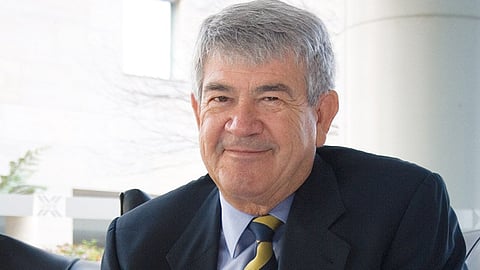
Key topics:Brian Gilbertson’s death and legacy as mining industry titanArchitect of 2001 BHP–Billiton merger creating global mining giantPost-BHP deals: Vedanta, BEE-focused Incwala, Pallinghurst.Sign up for your early morning brew of the BizNews Insider to keep you up to speed with the content that matters. The newsletter will land in your inbox at 5:30am weekdays. Register here.Support South Africa’s bastion of independent journalism, offering balanced insights on investments, business, and the political economy, by joining BizNews Premium. Register here.If you prefer WhatsApp for updates, sign up to the BizNews channel here..BizNews Reporter.There is a specific breed of South African business titan—tough, intellectual, and unafraid of the global stage—that seems to be slowly fading into history. Today, we mark the passing of one of the absolute giants of that era. Brian Gilbertson, the mastermind behind the creation of BHP Billiton and a man who fundamentally reshaped the global mining landscape, has died at the age of 82.Gilbertson passed away yesterday at his home in South Africa after a long illness.To understand Gilbertson’s legacy, you must look past the volatility of today’s resource markets and back to the turn of the millennium. It was a time when South African capital was desperate to find a home abroad, and local champions were looking for scale. Gilbertson didn't just look for scale; he engineered it.The 2001 merger between Billiton (with deep roots in South Africa through Gencor, created by Afrikaner capital hub Federale Mynbou) and the Australian icon Broken Hill Proprietary Company (BHP) was Gilbertson’s magnum opus. It wasn't merely a transaction; it was an industrial transformation that created the world’s largest mining company. For a brief, shining moment, a South African dealmaker sat atop the resources world, steering a colossus that would ride the coming commodities supercycle to dizzying heights.But as is so often the case with visionaries, the boardroom politics were as bruising as the rock face. Gilbertson resigned as BHP Billiton’s CEO in 2003, just two years after the merger. At the time, the market was fed the standard line of "irreconcilable differences."However, the details shared by his family offer the vindication that history often provides. Gilbertson had backed a merger between BHP and its massive rival, Rio Tinto—a deal that would have involved relocating the new group to London. It was a strategic play for total dominance. But the Australian directors opposed the move. Gilbertson was excluded from a board meeting—the ultimate vote of no confidence—and he walked away.Looking back, one wonders how different the mining world might look today had Gilbertson’s vision for a BHP-Rio Tinto combination prevailed.Most men would have retired to the golf course after such a high-profile exit. Gilbertson, however, was a dealmaker to his marrow. He pivoted immediately, taking the chairmanship of Indian mining group Vedanta Resources. In late 2003, he led Vedanta to a London stock listing, demonstrating that his ability to attract global capital remained undiminished.He also kept his hand firmly on the South African tiller. In 2004, he helped launch Incwala Resources, a platinum venture aimed at advancing Black Economic Empowerment. It was a move that showed his understanding that for mining to survive in the post-apartheid era, it had to be inclusive.Later, he launched Pallinghurst Resources. The name itself was a nod to his roots—named after the street in the upscale Johannesburg neighbourhood of Westcliff where he used to live. It was a classic investment vehicle, putting capital into emeralds, platinum, manganese, and iron ore. He even added a touch of glamour to the portfolio with the Faberge jewellery brand, before stepping down as chairman in 2021.Brian Gilbertson understood value. He understood that digging stuff out of the ground was only half the job; the other half was structuring the capital to make it pay.He is survived by his wife Rensche, his sons Quinton and Sean—who have carved out their own significant paths in the business world—and five grandchildren.South Africa has lost a true captain of industry, an icon who appeared to belong to a different era.. He was a reminder of a time when Johannesburg wasn't just a mining town, but a launchpad for global conquest.Rest in peace, Brian.