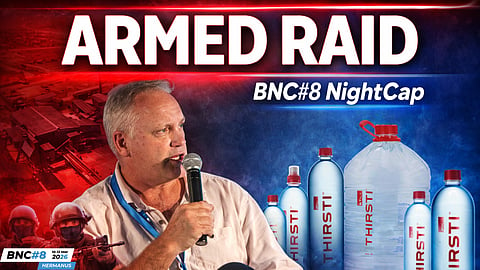
From police with rifles storming a rural sawmill to building a fast-growing water empire, Rob Hoatson pulls back the curtain on doing business in South Africa. In this Nightcap, he exposes state overreach, shares lessons from scaling Thirsti, and explains why failure in government often creates opportunity for entrepreneurs willing to act..Sign up for your early morning brew of the BizNews Insider to keep you up to speed with the content that matters. The newsletter will land in your inbox every morning on weekdays. Register here.Support South Africa's bastion of independent journalism, offering balanced insights on investments, business, and the political economy, by joining BizNews Premium. Register here.If you prefer WhatsApp for updates, sign up to the BizNews channel here..Watch here:.Listen here:.By BizNews Reporter.00:13Well, the whole world seems to know the Hoatsons now because if you've been paying attention, Normandien Farms, which is their company, was invaded by police with automatic weapons, parliamentarians, people from the Department of Labour, people from COSATU. And it's been quite horrific, actually. Yeah, it was not a nice experience, particularly for our management on the day. It was unannounced. They just rolled in and overran our security, made sweeping demands, would not listen to the management, trespassed, and broke every law imaginable. 01:15They shut the sawmill down because they found somebody without a dust mask on in a "clean zone". Just absolute abuse of power and politicking. You know, these are people that are voted into Parliament to make the laws in our country and they were behaving like thugs in private businesses. Our business is a family business. We—Thirsti, we'll get to the Thirsti story—but Thirsti is only 10 years old. It was started by my dad and we are four brothers. My dad is now retired, but we employ about 3,500 people in the most rural areas in South Africa. I'm talking about towns like Piet Retief, Barberton, Tulbagh, and Normandien, which is outside Newcastle. 02:13The last thing that you expect as a rural employer of that many people—remember in those areas, one job supports about 10 to 12 people—is to be treated like we were treated by the government and by those departments. So, you know, as Frans Cronje always says, you've got to win in the court of public opinion, and you did a great job last week letting that story fly, and it's very, very clear what the view is. And then the second phase is that we have to—you know, you get what you accept. You get what you accept and we just absolutely cannot accept this type of behaviour and conduct. 02:43So there's going to be a legal challenge from us; papers are being prepared and members of Parliament are being charged, police are being charged, and the Department of Labour is being charged. What those charges do and how they hold up, well, that depends on our court system. But we—and not just us—since then we've had so many calls and stories and emails from people, and this seems to be much more common than one would believe in South Africa, where these officials just raid private businesses like this. And it's nonsense. And if we don't do something about it, are we going to get more of it? 03:41So thank you for what you did last week in letting that story go. I'm indebted to Juliet Basson as well from the Patriotic Alliance, because initially I thought she was part of the problem—which I suppose as an outsider you look at this and say, "What is this MP doing breaking through security and threatening?" And remember, by the way, you guys are beef farmers as well. We farm cattle. Our main business is actually the timber business, where we have five sawmills in the business where we grow and process timber for the South African construction industry. That's the main business, actually. 04:11And then we run cattle, we run sheep, and we produce nuts. We are an agri-industrial business, so we do a lot of different things across the business. But yeah, this particular attack—and we can call it that because that's what it was—it was at one of the sawmills in the Normandien operation. It's about seven or eight kilometres away from the Thirsti bottling plant. The way that Juliet Basson explained it was that this parliamentary oversight grouping had gone to Newcastle to go and see the Chinese textile factories, who apparently were not looking after the employees well. 05:07And after doing all of that, they had a meeting in a boardroom where somebody accused you guys of using sjamboks and... Where does that come from? It's absolutely absurd. This was a "whistleblower". Yeah, it's absolutely absurd. It turns out, in subsequent conversations with Juliet Basson, that the whistleblower was the chairman of the portfolio committee. Now, how he knows that, I don't know. But hang on, he's not even from the area; he's from the North West. But there's a huge amount of... so firstly, when the Department of Labour conducts their business, in what world do they arrive with the unions in tow, with all these other departments in tow, and with the police in tow? 06:07We push back very hard against the unions as well. We don't believe that they add value. And certainly, as a large rural employer, we are very, very acutely aware of our responsibilities in terms of our staff, and we take them very seriously. And so the unions have been trying to get into us for a long time on that particular site. There are other sites across the country where we are unionised, but on this particular site, we are not. And the lady who's in charge of the Department of Labour in Newcastle is the sister of the COSATU union organiser. 06:37And so it's not the first time that the department has done this, where they come with a gang of unrelated people and then come in under the guise of the Department of Labour. So certainly, the trust has been properly broken and we intend to interdict them. But how did the police arrive there with automatic weapons? What was that? So when the Parliamentary Oversight Committee operates, they are supposed to have security with them. But there were colonels involved, there were captains involved. There were plainclothes policemen armed with rifles—with automatic rifles. 07:36Armed plainclothes police threatening arrest. They had their weapons drawn with their fingers on the triggers pointed at our managers, saying, "If you don't let us in, we're going to arrest you." I mean, it's just absurd. It's just ridiculous. So with that experience—with what you've been through—and it's very sharp and it's very fresh, what did you make of what you heard today, and particularly from Piet le Roux, who to me—I mean, I love Piet, I think he's fantastic—but I felt he was a bit closer to the bone for me. 08:04Alec, you know, the truth is we need to stand up in this country, and we've heard it. We're not a corporate; we're a private business, we're a medium-sized private business. As I said, we operate very widely in South Africa, but we have long since realised that if you don't stand up, you will be simply washed away or blown away. So I love Piet and I love what Sakeliga does. We're involved with them and we have to push back very, very hard against all of this stuff that is just absolutely ridiculous and unconstitutional in this government. 08:42So you would presumably subscribe to what Frans Cronje says, which is that the strategy of socialists is to push the bayonet in until it hits steel. Keep pushing until you hit steel. And you guys were a bit of steel this last week as well. And then they back off a little bit. But you talk about expropriation without compensation; you talk about all of these policies. And for us, this is possibly them just pushing the boundaries. We've had some internal discussions and some of the thought is: if they ever come to take the land, maybe they'll come in this format and in this way. 09:32Yeah, it was not a nice experience for our staff. I was overseas at the time, but it's taught us a lot and I can tell you we will be better prepared next time. So what are you going to do? I ask this because we had at this conference, I think it was about five years ago—when were the KZN riots? 2021—we had the owner of the shopping centres, it's privately owned, and he came and gave us the story of what happened at the shopping centres and how it was military precision. The guys came in, they knew what they were shooting at, they were shooting live ammunition from the beginning, and he said they shot back, because that was the only way to do it. It was almost like a war that was going on there. Since then, they've put in quite a lot of different fences, etc. Are you doing anything like that? 10:27Yeah, we are. We're securing our property even more than we did previously. And obviously, you know, when 20 or 30 police arrive and threaten arrest, the attitude from now on is going to be: "We're not letting you in. If you want to arrest us, arrest us." And then secondly, if they do get in—and there's no other way to describe it, it was such a circus that for the circus to continue, you need to participate and you need to start accommodating them while they're in your space—in future, we will just simply pull the main switch and leave the premises. 11:29"Listen, we're not participating in this nonsense. Thank you, but goodbye. Everyone, you can go home for the day. Goodbye." And leave. Leave the security there to look after the premises. It's absolute. We've written to the Speaker of Parliament; we actually received the response today. And what did it say? "Under this rule, you've got to make this complaint to this person," just a very technical three-page response. We're assessing it and we will respond accordingly, but there's going to be follow-through from us legally. There has to be. 11:58I'm sure that a two-prong approach is obviously to tell the story—which, as I said, you did an outstanding job doing—but secondly, you have got to take them on legally. Well, we told the story because it was a good story to tell. I mean, it's not like it was sponsored content or anything like that. I can assure you it is very, very interesting. And of course, it's from my hometown, Newcastle. You know, if you're not going to talk about Newcastle, who's going to talk about Newcastle? Not too many. How's it going there since the ArcelorMittal story? 12:25It's tough for the town, but the people are resilient. And I think we will find a way. It's never nice when businesses on that scale close, and there is quite a big knock-on effect: the engineering businesses in town, the accommodation businesses in town—business of that scale that closes has a major impact. Is there any hope that someone might buy them or buy the product? There's a lot of talk. Again, my personal opinion: no, but we'll see. There's also been a lack of investment there for a long time. 12:51And so to get it on a par with other businesses—the Chinese in terms of the cost of production—logistics is a major issue. Railing the iron ore in from Sishen, electricity has been a challenge in terms of cost—we heard about that today. So that's what you need for steel: iron ore and electricity. So unfortunately, it's a tough one. And when you're competing with the Chinese, who spend 4% of their GDP by their own admission on subsidising their industry—how dumb was the West? If you think about how dumb we were to tolerate this for as long as we have? 13:49Exactly. So it is very, very unfortunate. We're going to have to, as a country, wake up. And it's about policy. We're going to have to start with policy change to protect these businesses and protect these jobs; otherwise, it's just not going to turn north. It's going to keep going south. So tell me your story. Were you born in Newcastle? No, so I was born in a very small town in southern Natal called Harding. Nobody's probably even heard of it. 14:18Schooled at Maritzburg College and then off to Stellenbosch. And we bought the farms up there in 2001—timber farms to feed our timber processing business. And I was sort of 25 or 26 at the time. And my dad said to me, "There's an opportunity up there, so why don't you go up there and move up there and see if you can make a go of it?" I packed my bags and off we went. What was it like being a 25-year-old in that town? It was quite nice. We had a good time. We had a lot of fun. 15:16And unfortunately, one of the things that's happened in the "New South Africa" is our rural communities have fallen apart. But back then, it was absolutely amazing. I don't think I have to tell you too much about life in those rural towns growing up. So we had a lot of fun. It was tough from a business point of view because we were just trying to get on our feet. For the first three years on the farm, the office was a caravan, actually. We couldn't afford to build offices. 15:45So it was hard yards in the beginning, but those are always the best memories and the best days. And so my first job was to build the sawmill on the farm and get that going. Then we started our beef business. And then in about 2014 or 2015, I was driving on the farm on a Sunday afternoon and I bumped into this lady who was there to visit her sister. She was in her bakkie, leaving the farm. And on the back of her bakkie, she had two 25-litre drums of water. 16:13And I stopped her and I said, "Hello ma'am, how are you? Who are you and what are you doing here?" And she said, "No, I've just come to visit my sister." And I said, "Well, what's that on the back of your bakkie?" She said, "No, no, there's a magnificent spring here. And every time I come and visit her, I fill up the water and I take it home and I drink it, and it tastes incredible." And I said, "You must be joking. There's nothing wrong with the water in the taps; it's just fine." She said, "No, no, this water tastes really, really amazing." 16:43And the truth is that, as an entrepreneur, you just need a spark. You just need one thing to make you start thinking. And so that was the spark—this lady collecting water on my farm. And I started reading about water. I started reading about bottled water. The first time I saw bottled water was probably 30 years ago, and I thought it was the world's biggest joke. Why would anyone pay for something that falls out of the sky for free, or that you can just get out of a tap? 17:13And there were two foundations which really made me think. The first was globally: the drive and the awakening of people in terms of health and wellness, and how people are drinking fewer sodas and less sugar, and what it does to us, and how healthy water is and how much water we need to drink. And I thought, "Well, that's good and that's interesting." And the second that astounded me as I began to read and read was the South African water situation. Now we're talking about 10 or 11 years ago. 18:12In 1994, in South Africa, we had about 35 million people. We're now 30-plus years into the new dispensation. We've got—the South African government will tell you—62 to 64 million people. The cellphone companies will tell you we've got 75 million people in this country, including the illegals. In that time—in those 30 years—we have built no major dams in South Africa. What massive dams have been built? So what storage—what water storage—has been affected in this country to cater for a population that's more than doubled? Zero. 18:42The only thing we've done is changed the names of the dams. The second thing is water processing and water purification, which is the responsibility of the municipalities. All we've done there is we've added and added and added people onto the network. Not only have we not grown the processing side, but we haven't maintained it either. So we are now feeding more people with far less capacity that's maintained in a far worse manner than it was before. So that's the second part of it, which is a disaster. 19:11And then the third part of it is water reticulation. Once that water has been processed and cleaned, delivering it to homes, houses, and factories across the cities. Now, it has a useful life of 25 to 30 or 35 years. It's finished. That's why half the water is leaking away. And so nationally, Alec, if you look at the numbers, we’re more than 1.2 trillion behind on water infrastructure in this country. And I know there was talk today about the Americans coming to fix it, but I think water is so decentralised. 20:10Eskom was a hell of a job to fix and end load shedding, but that's quite centralised. You've got, I don't know, 15 or 20 power plants. How many water processing plants? How much pipework? How many kilometres of reticulation across the whole country? And so the truth is, when you live in a city and you live in a flat and there's no water for four weeks, what do you do? You go to the local Checkers or you go to the local Spar or you go to the local Pick n Pay and you buy bottled water. 20:39And so I thought to myself, "Well, this is an incredible opportunity." And the more I read, the more I saw businesses that were created out of the state's incompetence. Every responsibility that the state has, there are incredible businesses which have been built in the last 20 to 30 years. My business partner, Tsepo Motlewe, has followed that principle to a T and he's just bought Flasafé because he reckons that's one of the ultimate. Think about the responsibilities of the state: security—look at our private security in South Africa, it's the biggest in the world. 21:39It's double the police force or triple the police force. Private education—we're going to hear from Curro tomorrow night. Healthcare—look at our private healthcare system. Water, energy—the list goes on and on. These are, and I think Piet said it this afternoon: find a way to make money on the way down and on the way up. So where you have a failing state, that creates an opportunity for us who want to get in and do something about it. And I get that, and I don't think there's any question that in theory it's great. 22:05But I farmed for a while in Mooi River and we had a beautiful spring as well. We had fantastic water, but I don't own Thirsti. What got you saying, "Okay, it's an opportunity, but I'm going to make it work"? So obviously we'd built a timber business with some resources over the 20 or 30 years that we had been together as a family business—my brothers, myself, and my dad. 22:35And so the other interesting thing about Newcastle or Normandien where we are is it's actually in the middle of nowhere, but it's the "middle". From a logistics point of view, if you think about it: we're three and a half hours to Durban, three and a half hours to Joburg, three and a half hours to Nelspruit, and three and a half hours to Bloemfontein. That's 80% of South Africa's consumer market. So we've got a great source, we've got a great location, and to be honest, I always wanted to get my hands on a consumer-facing brand and I thought it would be fun to give it a go. 23:05And so I put together this plan over two or three months after all the reading, and I went to my family and I said—guys, we're quite an entrepreneurial family, to be honest. My dad is actually a diesel mechanic; that was his training—and he started our business. And so we grew up watching that, and you know, more is caught than taught. So after doing some thinking, I went to my family and said, "Guys, I'd like to build a water plant on the farm at Normandien—a water bottling facility—and I need some bucks to do it." 24:05My old man said to me, "Fine. How many customers have you got?" Zero. "So you've obviously got no orders?" I said, zero. He said, "How much do you want?" I said, you know, this is the type of business that you have to scale. And it took a few interesting family discussions, but within a month or two, we'd agreed to it as a start. And the truth is that once the family had said "go", then everybody was completely behind me and it's never been any different since. 24:30So we had to gather some skills, which we didn't have, and it took us 10 or 12 months to build the plant. When you make these types of decisions, you never bet the house, and it's also calculated—based on what you know and what you see in the world around you and what you read and what you're able to get from other people when you talk to them. So we built the factory and, come the end of 2015 or beginning of 2016, I had me and two amazing ladies sit around the table and come up with a brand and a name. 25:29We couldn't believe that nobody had used that name at the time—Thirsti. I thought you got it from my friend Dave Smith, who's from Newcastle. His nickname was Thirsti from his university days. He wasn't thirsty for water, probably. It sounds like he was thirsty for something else. I know the Smiths from Newcastle; they don't drink much water. So we built the factory and now you've got a factory producing this brand. Now it's time to start selling the brand. 25:59Boy, did I underestimate that properly. My first meeting took three months to secure with one of the retailers in South Africa—no names mentioned, one of the big retailers. I walked in the door—I'd had three months to psych myself up for this meeting—and the meeting was over in less than a minute. The guy said to me, "What are you selling?" I pulled out this amazing red water brand and he said to me, "Oh no, not another water brand. Please, F-off, stop wasting my time." 26:29And that was the beginning and the end of the meeting. So that was probably the toughest moment. Fair enough, you can go to the bank and borrow money, but you've gone to your family and you've built this plant and now you have dreams of these retailers welcoming you with open arms—and that's not the reception that you get. That's where the rubber meets the road. And what did the family say? I didn't tell them. I had to solve this problem before I started opening my mouth. 27:11So the very next day, I went and bought two 8-tonne trucks and employed a lovely sales lady. And we decided if we can't go straight into the big retailers, we're going to go to each and every Spar. Spar is a franchise that's owned independently, and we're going to build a relationship with each Spar owner. One store at a time, we're going to win these guys over. And so we did that. KZN is quite strong in the Spar space, and that's where we started. One at a time, slowly, slowly. 27:39What kind of profit margins did you have? Horrific in the beginning; absolutely horrific. Just "Take it and sell it, please. We'll pay you. Take it and sell it." Yeah, we lost money for the first year and obviously I had some time to learn more about the business and it needed another substantial investment. You were a bit of the black sheep of the family. For a while I wasn't the most popular son. It felt a little bit like the prodigal son. Did you ever think of giving up or selling the business? Never, ever. Never. 28:36But you're taking on Coca-Cola; you're taking on the giants in this water. They gave us a few gifts along the way without even knowing it. People say that BEE is so terrible in South Africa. Well, they had a plant in Paulpietersburg, which was quite close to us. And at the same time we were building our plant, they built a massive new plant in Heidelberg and they decided to implement some of their policies and they left an entire management team in Paulpietersburg—and I got to hear of this. 29:03Technical skills, management skills... and so I went and got the entire team and brought them and said, "Forget the big red guys, come join the little red guys." So thank you very much for that. BEE has been great for us. What a win. It was a massive win because you're talking to a forester, you're talking to a timber guy who now wants to get involved in the water and who knows nothing about it. And so that was like a gift. Did they move from Paulpietersburg to Newcastle? That's quite a long way. That's 150-odd kilometres. Closer than Heidelberg. 30:00And some of those guys are still with us today; some of them have retired. They have been incredible and they started with us. When we started that business, we had 11 people. We now have up to four plants and about 700 people in the business. So it's been an incredible journey with those guys from day one. Now I've visited your Tulbagh plant. So all the water that we drink today presumably hasn't come from Normandien? No, that plant now—obviously from a regional perspective—if you look at South Africa, 80% of the people live on the eastern half, and 20% in the southern and western Cape. 30:30So logistically, you've got to have a multi-plant strategy to play nationally in this space. And so as we grew, we had to build and develop new plants. And because we're sitting in the Western Cape, the product from here would come from the Western Cape facility. Now you spoke a bit about the quality of the water. Can you unpack that for us? Jeanette's put in a water filter system—we have very good water in Hermanus, apparently—but the water filter system, when it gets changed every six weeks, is black. 31:23And this is "good" water. I'd hate to think what PE or Durban looks like. I can show you; it's horrific. If you knew what was in the municipal water systems—particularly in Johannesburg, Durban, Bloemfontein—you would be horrified. You wouldn't feed it to your worst enemy. Really. Why are we allowed to drink it then if it's not that good? Why do a lot of things happen in this country? But surely you'd think somebody would go and do a little investigation, but I guess the state is not really in their interest. Are there any quality standards? 32:05There are standards. And we heard this afternoon about how many of the municipalities are dysfunctional. If the state can't look after education, policing, and healthcare, why do you think they're going to look after water? Let's get back to the quality of water then. I can talk to you for days about the science of it, but really our water is spring water, which is a fundamental difference between what we call "prepared" water and spring water. Spring water comes from an underground source next to mountains. 32:46Our farms are all against mountains—like the Drakensberg or the Western Cape mountains—and as that water filters through those mountains, it's exposed to the minerals that are in the rock. It picks up certain minerality, certain characteristics, certain taste, and a certain pH. It's a natural product, but it's driven by the flavour and the taste. The minerals are driven by the rock structure through which that water filters itself before you extract it from an underground source. 33:16And so we do have a great source at Normandien, an incredible source out of the northern Drakensberg. And we had to do a lot of work to find... you never get an exact match. So our Western Cape source is actually a 96% mineral match, which was incredible that we were able to achieve that. How long did it take you to find? It took me two and a half years. I looked at over a hundred different properties until I found what I was looking for. That's what we want: to deliver your customer a consistent product wherever, as far as possible. 33:46Do they have water competitions around the world? "This is the purest water"? Yeah, there's... again, water is also—it's not just water—but taste is very difficult to define with data points. It's very much a personal preference. Your tastes are your tastes. We have a unique taste, and other waters have a different taste. It's like a fingerprint; everyone has a different fingerprint. But people generally have an affinity to a palette for water, which comes from the area in which they were born, actually. That's interesting. 34:31Natural is better; you need these minerals in your body. Ours has a naturally high pH and we get so much feedback from customers across the country saying, "Major gut issues—started drinking your water on instruction of my doctor; my gout's gone. I have major heartburn issues; I drink it—it's gone." We don't claim medical benefits, but there are undeniably health benefits from drinking natural water. And also you know that you're drinking something that does not come through a municipal system that is entirely contaminated. 35:30Rob, these are amazing... and thank you again. Jeanette said, "Hey man, why don't you—met this guy a couple of weeks ago—why don't you ask him if he could give us water or sell us water or something?" And you did more than that; you put together a bottle, so thank you. Sponsorships have been a hugely important part of two things, really: sponsorships and then getting involved in times of crisis have been hugely important parts of how we've built the business and the brand. 36:28Firstly, in terms of crisis: whenever there's a crisis in South Africa, the first thing that people call for is water. Whether there's a flood, a fire, a drought, or a riot, people call for water, and so we've made it our business to step up and give. The principle of "sowing and reaping" has really stood us in good stead in that regard. But it's a long way for a forester to be sponsoring the Springboks. Part of the journey, I suppose. The Springboks were an incredible win for us post-COVID. 36:56All of the big brands in South Africa were just bailing from every single sponsorship that they could. Our strategy is: when everyone else is getting out, that's when you must get in. That's when you must climb in, boots and all. And so we did. We were able to get the Comrades Marathon, the Springboks, and the Proteas. We got the Bulls, the Sharks, and a couple of the PSL football teams. Are you unhappy about any of those sponsorships? I'm really not at liberty to say. It's fantastic to see our teams doing well. 37:50The simple truth is that everybody in the country—any single person—has a phone number and you can phone them. The very worst they can do is say, "No, sorry." And if you can handle that, then give them a call because the potential upside is far, far more. And so that's what happened with the Springboks. I phoned them and said, "Hey, we see you don't have a water sponsor. Would you like one?" And they said, "Absolutely, come and see us." Within two weeks, it was done. And we went off to France with them, won the World Cup—it was an incredible journey with them. 38:19Normandien water or Western Cape water to France? No, no, we didn't take any water to France. We just obviously were part of the setup there. Subsequently to that, subsequently to them winning the Second World Cup, obviously all the big corporations with US dollars came running back. So unfortunately that particular sponsorship came to an end just straight on the numbers. Mean, the... 38:49The cost price was scaled by 30 times. The sponsorship values after the second World Cup, when wrist went through the roof. So unfortunately, yeah, Big Red came back to visit. So what's next? Will you say Big Red, Little Red? How much Little Red are you to Big Red? And who's Big Red, by the way? Coca-Cola. Coca-Cola, okay. 39:19Coca-Cola is a global business. They're 130 years old. We focused on the water category in South Africa, the bottled water category. In that category, we're number two, actually. They now are number three in that category, in the water category. So not in soft drinks. That's their main space. So what's next? We, you know, we... 39:48continue to grow, we've grown the business sort of between 35 and 45 % per year since we started it. How many years is that? 10. That's unbelievable. When you're a smaller business, it's easy. But it's still unbelievable. As you begin to scale, Alec, you're not, it's not like a software business where you just have more, more hits and more, you're producing products. So you have to, you have to produce 40 % more. 40:16product on an annual basis. It's an interesting challenge. started an internet business and we listed this internet business. And a fund manager came to see me and he said, what rate are you going to grow it? 30 % a year forever. He said, no way. And he was right. It was maybe two or three years and then it started falling very rapidly. So this is an extraordinary story if you've managed to do that for 10 years and future similar growth rate. 40:46So this is what I love about being in Africa and being in South Africa in particular is that we sit, if you look at the world population, China's already turned, they're on the way down. India turns mid 2030s. Europe shrinking. America pretty flat. In the 1960s, Africa was 8 or 9 % of the global population. 41:12By the end of the century, we're gonna have two and a half to three billion people in Sub-Saharan Africa. Remember, India and China are 1.2 billion. So those people, all of them, they need to eat and they need to drink. And we'd like to be part of the solution and to produce and provide great products and nutritional products and healthy products for them. 41:41Is it listed in Prospect maybe? A listing? Yeah, is the family not that keen? No, no, absolutely not. We have a private family business. We have some minority partners in the business. But for me, working with my family is one of the greatest privileges of my life, actually. And we've been able to work out how we do this together. And for me, if you get family business right, 42:10It's one of the most powerful forces for good in any country. If you look at America in the last 150 years, 65 % of the American economy is family business. You're likely to get, after this video gets published, somebody from hell knocking on your door. Remember what Peter Major said? He's been in corporate finance hell. I'm pretty sure that there's going to be some clever, clever helper who's going to fund 42:39a reason to perhaps convince you differently? Alec, we've had a few approaches in the past. The truth is we love what we do. We're playing a role in rural South Africa creating jobs. And we're having great fun doing what we're doing. So we have no intention of making any changes. We want to keep growing the business. We look for other opportunities. 43:07The situation we're faced with in our business is not that we're without opportunities. We have so much opportunity. just, have to pick, we have to pick the best ones that are suited to us and then allocate the capital accordingly. And yeah, we know we're not naive to the challenges in South Africa, but we absolutely love where you've got to blossom, I think, who said it? You've got to blossom where you planted and where you find yourself. 43:35and whatever you find in your hand, you've got to do the best with that, you know? What a great chat. Thank you. Rob Hoatson from Thirsti.