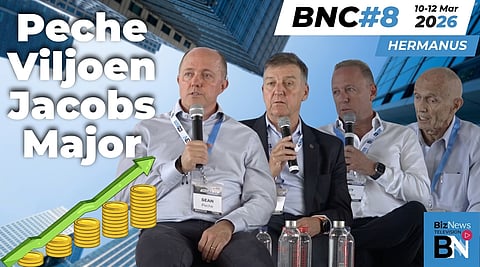
In a wide-ranging BNC#8 panel discussion, Piet Viljoen, Cy Jacobs, Peter Major and Sean Peche unpack where they still see opportunity after a strong run in South African assets, with ideas ranging from small- and mid-caps to copper and selected offshore shares. The quartet also debated crypto, AI’s role in investing, gold’s trajectory and the importance of culture, discipline and flexibility in navigating an increasingly uncertain market..Sign up for your early morning brew of the BizNews Insider to keep you up to speed with the content that matters. The newsletter will land in your inbox every morning on weekdays. Register here.Support South Africa's bastion of independent journalism, offering balanced insights on investments, business, and the political economy, by joining BizNews Premium. Register here.If you prefer WhatsApp for updates, sign up to the BizNews channel here..Watch here.Listen here.Edited transcript of the panel discussion.Alec Hogg [00:00]Let’s go. Starting with who wants to win the toss. Cy, you’ve got the best short?Cy Jacobs [00:07]I’m definitely not going to talk Tesla because it just hasn’t come unstuck yet, but it’s got no earnings. So I’m not sure what my best short would be at the moment. I think there’s a whole lot of US-listed companies that are trying to pretend they’re in quantum computing or nuclear energy that have no earnings and no prospect of making any money. And we’ve been short a few of those, like EOS Energy or Oklo.It’s probably names that nobody here will be familiar with, so I think I’d better find a familiar short. I’m not sure what it is. I might have to come back to that.On the long side, as I said when I spoke, I do like big tech again. So the likes of Amazon on a reasonable multiple. And had you asked me yesterday, I would have said our favourite technology stock globally is actually Tencent. And it’s up 8% today, on the back of it also launching a new AR thing, which I also read at four o’clock this morning. So I think it’s good news for all South African investors because, obviously, Naspers is up 7% or 8% today.Alec Hogg [01:19]Allow me, just for those who aren’t plugged into the markets: when we say “short”, that means something that’s going to go down. So last year, famously, Cy said his big short was Elon Musk’s Tesla. So he doesn’t like Tesla. And you must know, if Cy’s done his work, at some point in time it’s probably going to work out. But “short” means you don’t own that. In fact, the way that hedge funds make money is that they sell the stock in that company that they don’t own because they think it’s so overvalued.“Long” is the one that we can all go and buy because that we understand.Okay, Piet, for you. Short and long. So Pete or Piet? Pete or Piet? Should we go with Piet?Piet Viljoen [02:07]That would be me.So, a word of caution: I am not an advocate of shorting anything, ever. So whatever I say now is not investment advice. But in principle, I guess I would short something like Lululemon, which sells super-expensive gym gear to over-leveraged consumers, which I think is a dangerous combination. So I’d stay away from that one.On the long side, I think China, generally, is a long. So if you look at China, Tencent would be a thing. And I think my favourite stock, as I’ve written about many times, and which is very much aligned with the whole AI environment, is a stock called Texas Pacific Land, which owns land in West Texas that has massive energy reservoirs. And they also do transport of water, because when you frack, you produce four barrels of water for every barrel of oil and gas you take out, and that water has to go somewhere. And Texas Pacific helps the oil companies, the drillers, remove that water.And the next step is to start building data centres where the energy is and where the water is and where the people aren’t. And that’s West Texas. So Texas Pacific Land would be my long.Alec Hogg [03:33]Isn’t this interesting? They’ve given you four stocks and they’re all overseas shares. Ten years ago, we wouldn’t have had a clue what to do overseas. Today you’ve got Shift. I hope you guys have all got Shift accounts and have invested through it. It is phenomenal. And, by the way, I can tell you from BizNews personal experience, their costs are incredible when you want to transfer currencies. The banks used to really nail you on the currencies when you tried to invest overseas. Not through Shift. Not any more.But it’s interesting, isn’t it, that we’ve become global investors. We always said when we started BizNews — what’s it, 13 years ago now, nearly — the idea was for the global citizen. And then it seemed crazy. The Johannesburg Stock Exchange, where we had our first offices, said to us that we had to pay them to publish their share prices. And I got bedonnered. I said, this is crazy. It’s like asking Pick n Pay to charge you for a price sheet before you go into Pick n Pay, or even Checkers.And so we then said, okay, let’s have a look at what happens internationally. And Shift — well, not Shift, but the predecessor — the late Mr … said, “Why don’t we start a portfolio?” And that was that Webtrader portfolio that we started all that time back. And now the guys talk international stocks and you know what they’re talking about.Sean Peche [05:08]So, Alec, we don’t short shares. Many years ago, when I started out in my career, I worked at Decillion Fund Management. They ran a hedge fund. And I worked quite a lot on the shorting side and had quite a lot of success there. But what I learned is one interesting thing, which is that it’s a bit like — and Piet might like this because it’s got guns involved — you want to shoot a wounded buck, not a charging rhino.So, in other words, if you wanted to short Palantir and it’s on its way to some crazy level, you can get carried out. You rather want to short the one limping along. So be careful of that.I would probably short US utilities right now for a couple of reasons. One is they have a huge amount of debt, which they amassed by investing in solar and investing in wind farms and that kind of thing. They have low returns on capital. Now you’ve got this huge amount of debt. They’ve been very popular in terms of the AI trade. People have been buying these utilities thinking, well, that’s a bet on power. And if inflation is sticky and interest rates don’t fall, you’re going to get a little caught there. And they’re expensive, certainly on an enterprise value basis. So that would probably be on the short side.On the long side, we always like to look for the innocent bystanders. I wrote about this in our fact sheet. And those are the stocks that have been getting hammered because they’re in the wrong neighbourhood. So one of the areas that has been falling in recent weeks has been software companies, because everyone says, well, hang on, you can go and get Claude, and you can programme Claude to create your own customer relationship management software. You don’t need to pay hundreds of billions for a Salesforce or a ServiceNow — those kinds of things.And so lots of companies got hit because of that. One company which we’ve got in our portfolio is Expedia, because the interesting thing is you want those companies which have got cost bases where they can use AI to lower the costs. So they’re able to use AI to lower costs, and it’s on a 10% free cash flow yield, and it’s been caught up in the wrong neighbourhood, and they can buy back stock, and margin upside is quite considerable based on where they can go. So those would probably be mine.Alec Hogg [07:40]Patrick, is Patrick around? I haven’t got any questions yet, Patrick. Okay, don’t forget, your job is to filter them.On to you, Peter Major, otherwise known as Bit.Peter Major [07:51]Okay, I’m going to need some help here. Anybody not know who Galileo is? Anybody know who Galileo is? Yeah, good.I’m kind of a student of Galileo, and he took all the equations that the Greeks had formulated and he refined them. And he lived for 85 years, and we wouldn’t be here today without Galileo. But when he died, a man named Isaac Newton took over. He further clarified and defined all the mathematical formulas that the world worked on. We built cars, ships — everything we’ve done is based on Newtonian physics.And I think Newtonian physics and finance are linked. I don’t think they can be separated.A hundred and fifty years after Newton died was a guy named Einstein. Einstein actually improved on Newton. We didn’t think it was possible. But Newtonian physics is only good if you’re on Earth. Once you leave Earth, once you’ve gone ballistic, you’ve left the Earth’s gravitational field, you’ve got to apply Einstein physics. Now, when Einstein died, they had to replace him. That’s me. I was born two weeks after he died.I believe that I’m on Earth. I believe in Newtonian physics. I believe in reversion to the mean. Everything I did in investments, it eventually reverts to the mean. The few times it didn’t, as long as I had enough funds behind me, it didn’t matter.Now the gold price has gone ballistic. It’s left gravitational Earth. It’s two standard deviations out like nothing else. I’ve called her. I’m making a bet, though, that it’s going to come back, that gravity — even though it’s way outside the Earth’s gravitational pull — will slowly pull it in, just like the Mir space station.So I am not going long gold. And if you’re not going long something, that means you’re shorting it. And we all know that shares move in multiples of what the underlying is. So if gold is going to go flat, those shares are going to go down because gravity pulls on them harder. They have working costs that are going up at double or triple inflation.So which three gold shares would I short? I’d start with the big ones that are ex-growth: Newmont and Barrick. They haven’t grown in one or two decades. They’re too big to grow. And probably AngloGold a third, because I don’t know if we can buy a Newmont or Barrick here. So, yeah, I’d be shorting those two, maybe AngloGold. Doesn’t mean they’re coming down, but relative. I’d counter it with copper, maybe Orion. It’s never been at a bigger gap.Alec Hogg [10:48]Orion — here we go. It’s all there.Question from Mark Taylor for Peter Major: Peter touched on the highlights of the past. What are the prospects for a resurgence in the South African mining sector, in a minute and a half?Peter Major [11:05]You cut me short by six minutes, because I like ending my presentations on a good note.The prospects are not great as long as the ANC is in office. We have beautiful examples ahead of us. Just look at the DRC and Zambia. I can overlay their graph. They increased copper production in the ’40s, ’50s, ’60s, ’70s, then they got nationalised. Copper fell, fell, fell, fell until the end of the millennium.And what happened at the end of the millennium, 1998, ’99? They kicked the bums out of office — regime change — and they put in a new policy. Both those countries are like this now. Their copper production’s gone from almost nothing, 50,000 tons a year. Zambia’s pushing a million, and the DRC three and a half million tons, second in the world. The countries are still a disaster. Just having policy change.So all we need to do is remove BEE. We don’t even have to give the mines back. We can stay with nationalised mines. Just get rid of BEE and that’ll open up investments in the mines.Alec Hogg [12:08]Michael Ash has a question for the panel as a whole. If the Iran conflict realigns global energy markets and geopolitical blocs, how does the ANC reconcile its political alignment with Tehran with the reality that South Africa’s growth, foreign direct investment and access to global capital markets depend largely on Western economies that view Iran as an adversary?Well, I think that’s kind of for Iraj, but if any of you guys want to have a go.Piet Viljoen [12:36]I can have a go. I think the ANC lives in an irrational world, and they can’t reconcile what they say in the morning with what they say in the evening. So: impossible.Cy Jacobs [12:47]I think there may be a change if Patrice Motsepe runs for head of the ANC. So I think time is running out for that allegiance with this regime. That’s my view.Alec Hogg [12:58]Patrice Motsepé has been very strongly supported, or punted, by Frans Cronje. If you guys were going long or short on that idea …Peter Major [13:11]Alec, I’ll tell you about disinformation. I walked into a fish and chip shop two weeks ago just to get fish and chips and a beer. I got accosted by two guys. They said they saw me on your programme. One of them, white guy, says he’s special adviser to Patrice Motsepe. And he’s asking me questions. I said, no, no, I’ve got a question for you. You’re trying to mug me. I don’t know who you are. I’ve got a question for you: is Patrice going to run or not?He said, “Pete, he’s not going to run. It’s all fake news.” I said, “How do you know?” He shows me his phone. He’s got so many phone calls with Patrice. He says, “I’ve been on 75 private jet flights with him.” Now, if Patrice is here, he’s going to know who I’m talking about.But would I bet money on a drunk that accosted me in a fish and chip shop? I don’t know. But the guy’s pretty convincing. So I’m reading the news. It’s like investing — it’s 50-50. I don’t know.Cy Jacobs [14:07]There’s already a media page out on him running for presidency of the ANC, trying to raise money on a campaign. So I think it’s real.Alec Hogg [14:17]What about Polymarket? Is there a Polymarket on this? Polymarkets are big in America. You can bet on just about anything. Surely there’d be a Polymarket that someone has started. You know? Haven’t paid attention?Okay, let’s go to Derek Brattseth, I think is the correct pronunciation — and in conjunction with this question, which … oh, this is Michael Taylor’s question. Which of South Africa’s resource companies are well placed and have the desired commodities to participate in the data-centre and robotics build-out? So if we’re looking at data centres — and Elon’s going to put one in space, but it won’t be part of Tesla — and robotics, what are the South African companies that are going to produce the products that are going to be useful there?Sean, I guess not your game. Peter, you again? Peter — oh, what’s that?Cy Jacobs [15:17]Well, I think for us it’s not a South African company, but it is listed on the South African market, and that is Glencore. Its major assets going forward are in copper. And copper is obviously very sought after in the building of those data centres. It happens to be our largest commodity exposure in our fund and, in fact, is our largest holding currently across the 361 hedge fund, for example. So we’re very bullish on Glencore.I’m sure Peter will talk on more small-caps, but we like that.Peter Major [15:49]Look, data centres and mining — big gap. I can’t really fill it, Alec. But if you say what mining company in South Africa has taken advantage of technology, without a doubt it’s Northam Platinum. Paul Dunne is an incredible guy and he has modernised financially, mechanically, labour relations, across the board.If I say the most modern high-tech mine in South Africa — in Africa — it’s Kibali in the DRC. What Mark Bristow did in the DRC, and we know that is wilder than chaos up there, and yet Kibali is so automated, so modern, and it’s all underground. So those are the technology leaders in mining.But, yeah, as far as the data centre — how do I connect the two? Cy is right. Hopefully they need a lot more copper, and we can go back to producing a quarter of a million tons a year instead of 50,000 tons a year.Alec Hogg [16:48]And Glencore’s the one. Right — and even Pete nods his head there.From Monty Zim — Monty from Zim — question for the panel. The Chinese scourge is already wreaking havoc in textiles, the motor industry, mining, especially north of South Africa. He knows, he lives in Zimbabwe. Once you lose primary industry in South Africa, unemployment soars. Is there the political will to control, or better, stop this trend?Again, we’ve got lots of economists who are going to be talking later. Dawie Roodt would possibly be better, and politicians. But any of you guys want to have a go at that? No? Pass? Right.As artificial intelligence becomes increasingly capable of producing high-quality financial analysis and investment guidance, what aspects of your expertise do you believe will remain uniquely human? Here we go, Sean.Sean Peche [17:46]So I don’t know who asked that question, but they are pretty impressive. You see the power of Claude with Excel spreadsheets. But we can use that to our advantage. I think if you’re a momentum investor, it’s going to be easy to be replaced by AI. But if you are trying to sift through the carnage in software space, trying to find the value and the diamonds in the dust, I think it’s probably going to be a little less easy to be replaced by AI.So that’s what we do. We try and find these out-of-favour stocks that are unjustifiably out of favour, we think, where the odds are on our side. And that’s not what most of the market does. And when you’re doing the large language models and training, you’re basically training on what has historically worked. And so I think we’d be okay.But we can use it to our advantage to speed up the research process and take advantage of those opportunities faster.Alec Hogg [18:48]Piet?Piet Viljoen [18:49]I think at the heart of it, people want to interact with other people. They don’t want to interact with machines. Anybody who has ever phoned a call-help centre and spoken to a machine will know it’s highly frustrating and you don’t get to where you want to be, even though all the information is there.I think large language models and AI will be a massive tool for productivity for human beings. But at the end of the day, there still needs to be a conduit between the machine and other people, and that conduit has to be a person. That’s what people would prefer. I think the market for that will grow a lot.Cy Jacobs [19:31]Yeah, we’re using AI quite a lot, and I think it’s used mostly in the research space just to do things a lot quicker. I think it’s been a phenomenal tool. But I think at the end of the day, making a decision with what the result comes from AI is still going to be a very human decision. And I think it’s very difficult for you to rely on AI to make that decision.And we’ve seen various biases as well across different products, whether it be Grok or OpenAI, and you can ask them the same questions, give them the same information, and you can get totally different outcomes. So I’m not convinced that, in an asset management decision, you would use an AI tool to come to the ultimate conclusion.Peter Major [20:13]Boy, if we just start going towards AI, Alec, we can add so much productivity to our mines. Some of the graphs I wanted to show — one of them shows the tons per man moved by our gold mines. Now we know this is 2026, right? When you look at pictures of mines, you see dump trucks, LHDs, mechanised drill rigs — it looks really good.Even with all that new machinery today, we are moving the same tons per man that we were moving in 1935. Now that’s 80 years ago. Do you know how we were mining 80 years ago? Shovels, picks, coco pans. So how could our miners 80 years ago, mining with their hands, move more tons than we’re mining today with all these machines? Because we’re not using them correctly. And everybody’s arguing what’s wrong, what’s right.And I find you do have to monitor AI, like Piet Viljoen says. AI is similar to the ANC. You need an adult supervisor there. You can’t leave them on their own. So yes, mining engineers, experienced mining engineers, need to oversee it. But it allows you to go through so many probabilities so quickly. It gives you so many options that a real experienced mining engineer can pick out: that one makes sense, yes, we haven’t tried that.The scope for productivity in this country is so huge, Alec. It’s got to be the easiest way to go.Alec Hogg [21:50]Kerry asks: can you speak to what’s going on inside South Africa’s investment institutions? Does the culture in these organisations support the careful and responsible management of our retirement savings? Sean Peche, you had a full go at the guys on performance fees at one point. Would you like to pick up this question?Sean Peche [22:11]The problem is I’ve been quite removed from the culture for a long time. So I think the other guys are better placed, within the industry.Alec Hogg [22:22]But none of you guys actually hire other people from the industry? Or do you? Piet? Cy?Piet Viljoen [22:29]We try not to.Cy Jacobs [22:31]We also try not to.Alec Hogg [22:34]Sorry, Kerry. Okay, unintentional.Piet Viljoen [22:38]Sorry, I do think the question touches on an important point. I think a lot of people are worried when they invest in a fund: what happens if that person who’s managing the fund moves on to another firm or moves elsewhere, and so on? And I think there should be less focus on the specific person managing a fund and more focus on the culture of the firm in which that person works.I think one should spend a lot more time thinking about that, because people die and they move on and they switch jobs, but the culture of the firm stays intact. A lot of us here used to work at Allan Gray. The culture is the same, no other people are the same any more. It’s like the ship of Theseus. It sails from one end of the ocean to another end of the ocean and they repair it the whole way along, and by the time it reaches the other end of the ocean not one piece of wood in that ship is the same as it started out on. And the same with the investment firm, except for the culture.So if you’re analysing where to invest, thinking about where to invest, focus less on the people managing the money than the culture of the firm. I think that’s much more important.Cy Jacobs [23:42]I would actually disagree with that. I would actually say focus on the team and the people managing the money. Yes, it comes with culture — obviously that’s important — but, like, we are 361. We own our track record. We started with the same team. We’ve added on to that team, and we’re still the same core team 20 years later.If I was giving money to an asset manager and I gave it to Piet and his team, I wouldn’t want someone else managing it because it hasn’t got Piet. I think, for us, the team is our most important asset and the people that we’ve cultivated within the team. In my mind, I would not swap for any other team in any business, no other investment business in the country. So I think that, to me, is the strength.Alec Hogg [24:25]But isn’t that the case with all businesses? When you have interns who’ve grown through with you, where you grow your own timber, where they understand the culture in that organisation, they tend to be a better organisation because if they aren’t, the organisation won’t be there any longer. So it’s an interesting point.I mean, Sean, you guys — you’ve got a really strong sidekick, which I suppose would have been quite a decision for you to bring Andrew in.Sean Peche [25:00]Yeah, it was a very easy decision. And we sing from the same song sheet, so there’s no disagreements.Andrew Lapping was the former CIO, Chief Investment Officer, at Allan Gray Limited, and he retired and left South Africa. And a year after that, I one day said to him, “Andrew, why don’t you join us? You’ve had money in our fund for years. We sing from the same song sheet, share the same philosophy.” And it’s been a game changer for us. And he’s a top, top guy.Alec Hogg [25:30]And I know your story is well known, Cy, but with Piet, the team that’s around you have also been there for a while.Piet Viljoen [25:39]Yeah, my business partner, Jan Fincke, and myself have been together for almost 20 years now. So we’ve been working together a long time and we built a certain culture within the firm.I’m not going to live forever. And neither is he. And I don’t think Cy will live forever either. But somebody’s got to look after the money. And I think it’s the culture that will do it, not the person.Alec Hogg [26:00]Yeah, but you’re wrong there, because Pete’s going to be reincarnated again.Peter Major [26:04]Hey, I’ve got this game plan. I’m going to live forever, and so far so good.Alec Hogg [26:11]I was interested to hear Cy talking about investing in the US, and I’d like you to elaborate on that, if you wouldn’t mind. But let’s start with Sean, because you’ve been very negative on the US for a long time. Are you starting to see value?Sean Peche [26:24]In certain pockets, but there’s quite a culture of greed. We were looking at some of these software companies and the stock-based compensation — the value of shares given to management — is just off the charts.If you look at a company like ServiceNow, their net income over the last four quarters is 1.7 billion. The value given to the management team is two billion. But then they spend the cash buying those options back from management. So actually, even after the fall, it’s still only on a one-and-a-half percent free cash flow yield if you take into account the value of that. The numbers are just crazy.There’s been this culture of greed, and I think that’s going to take time to work through the system. I think one has to be careful. I totally agree with Cy’s observation on the Walmarts and the Costcos and those perceived-as-safe companies. You’re paying crazy prices for very little growth.Cy Jacobs [27:28]Yeah, I think I’m on the same page as Sean. Those companies that have this stock-based compensation are a problem. And, as Sean has said, you have to look and sift through all those US companies. And there has been some very bad behaviour in US markets.And the truth is, you’ve got a massive — it’s different to any other market in the world — you have a massive retail base and you have this feeding frenzy of media that support a lot of these companies. So, as I say, most of them are actually probably shorts rather than longs.But I think we’ve been through an interesting 18 months of research here where the dollar has weakened significantly against other currencies. So the US has become more competitive. And as a result, there are certain companies, after de-rating, say, 30% in dollars and losing 10% to 15% in currency, that look 50% cheaper than they did 18 months ago. So I think there are some nice opportunities there.And, as I said, I’d rather be there than in Europe. But again, I’d rather be in commodities than probably all of it for now.Alec Hogg [28:32]Devin Schuetz has got a very interesting question. He says: what personal characteristic do you attribute most to your investment success? Pete?Peter — not Piet. Peter.Peter Major [28:46]Major.Particular characteristic? Look, you’ve got to be schizophrenic. You’ve got to be really, really greedy, but you really want to stay alive and not lose all your money.And I want to jump back real close to your other question, quick. We saw the small caps, Alec. They were going up with the big caps in the new millennium — ’03, ’04, ’05, ’06, ’07, ’08. But when the global financial crisis hit, it knocked everybody down. Anglos and Rio were down 90%. Everybody got caned. But the big companies came back up and the little small-cap mining companies didn’t. And they’ve just been treading water.And there’s been a lot of value in it until lately — literally last year. So, yeah, I’m a bottom-feeder, I’m a value investor, and I want to try and get something at a 50%, 60%, 70%, 80% discount. But I always keep in the back of my mind: this thing is a mousetrap. It might have a bigger piece of cheese, but you’re still putting your head in a mousetrap.Major’s always got three ways of getting out of it. I won’t buy anything unless I’ve got three ways that I’m going to cover myself. So, yeah, it’s greed plus paranoia.Alec Hogg [30:04]And your personal attribute — your charm.Peter Major [30:07]I don’t have any.Cy Jacobs [30:12]I think the thing that sits with me the most is actually just flexibility. I wake up on a single day and whatever I thought yesterday, I’ve got to reconsider today. So for me, it’s not about a long-term prediction on something. I’ve got to analyse the facts on the day and think, what would I do today? So I’m just different in that regard.Piet Viljoen [30:34]I guess if I had to think what my investment superpower is, it would probably be to remain unemotional in the face of wild swings in share prices up and down at any particular point in time, and being able just not to be influenced by that.Sean Peche [30:51]Yeah, I like Cy’s flexibility, and I’d probably go with consistency. So: this is my approach, this is what we’re doing. Independence. I don’t really worry about what other people are doing. If we underperform, we underperform, but this is how we think, what we think makes sense. This is our approach and we’re going to do it through thick and thin.But you want to have humility to always be asking yourself: I could be wrong. And I like the mousetrap example that Peter mentioned because, when these stocks are down, sometimes they’re down for a very good reason and you’ve got to be careful that you’re not going to get caught in that mousetrap.Peter Major [31:27]If I can beg forgiveness, I do have one.What I said is correct. On the mining houses I worked for, the key word was sustainability. That’s great, Pete — is it sustainable? Okay, you got your crew to produce this many tons by changing things. Is it sustainable? So, yeah, investing means holding for a while. You want sustainability. You don’t want one-offs. They’ve got to convince you what they’re doing is sustainable, and that’s a good investment.Alec Hogg [32:02]The industry still uses volatility as a measure of risk — Sharpe and Sortino ratios. Okay, don’t just stay with me on this one. However, Piet Viljoen is right: risk is the probability of permanent capital loss. And you’ve often said that, Piet, that that’s the first thing. Number one: don’t lose money. Warren Buffett says, rule number two, never forget number one.So why has the industry stuck with measuring standard deviations of returns 60 years on? It’s from Sydney Place.Piet Viljoen [32:35]So, yeah, that’s a good question. And you all know the answer as well as I do. The industry will measure what they can measure and manage themselves according to that. I don’t think sustainability is measurable, at least not over a short period like five or seven years. So it won’t be measured and won’t be publicised.Volatilities and standard deviations of returns can be measured, and so they will be measured and published.Sean Peche [33:06]Yeah, I worked with a clever guy — well, lots of very clever guys at Orbis — but the one guy in particular, Jimmy, he used to say to clients when they asked about volatility, he’d say, “If you lose 1% a month every month, that’s low volatility, but that’s not a good outcome.” And I thought that was a very good point.So standard deviation — well, we all want positive volatility, we just don’t want negative volatility. And Sortino ratio brings into account only negative volatility. But also there’s this measure called upside capture and downside capture, and you can get it off Morningstar. And effectively what it does is it says, in positive months when the market is positive, what percentage of return did you capture on average? And in negative months, what percentage of that negative return did you capture?And what you want is not to capture all the upside, but to capture less of the downside. The problem is there’s only so many months. And if the month ended a couple of days later — like if February ended a few days later — it’d be a different story. Your upside capture and downside capture would be different. So you’ve got to look at those things with a little bit of caution — certainly standard deviation.Alec Hogg [34:15]Okay, so we’ve now serviced the financial advisers and the financial gurus. They all know about Sortino ratios, etc. Most of us, not so much.But what we do know is that we did very well in the Shift portfolio, and this is from Hank Dase, and cashed in just before Trump hit Iran. So, gents, what do we do with the cash now? We’ve had 17.5% return compounded for four years. We’ve got money in the bank. Where do we put it?Peter Major, let’s start with you.Peter Major [34:48]This is really a stock-picker’s market. I don’t see any big trends here that look safe. Maybe cash. Yeah, I’m afraid of bonds, property I’m kind of neutral on, but it’s just changed from last year. If we missed last year, we missed it. I’m not going to jump in now. These were huge runs we had on the South African side, and we thought America was expensive last year, and it still added 25%.So, yeah, I’m holding. And I’m old, so I don’t want to hold too long, but I’m not going to risk. Stock-pickers. There are so many shares out there that I think are worth going into. That’s why I’ve dumped a lot of my money into mines in America that I think can produce silver at 20 an ounce and could produce gold at 15 an ounce. It’s not listed, but I feel safer putting it in something that I know has a big margin than somebody else managing my money on something that’s already run.Cy Jacobs [35:51]Yeah, I think pretty much the same as well. I mentioned it today in my talk that the South African market specifically has run pretty hard. Property bond yields have come in, financial shares have run. And I think wherever you look globally, that’s actually been the case.The South African market, measured by the MSCI Emerging Markets Africa portion, actually did 74% last year in US dollars. People don’t really know how well South Africa really did. I think, coming off that base, it’s very difficult. As Peter said, gold at 5,500 had an amount of seriously hot money. And if there weren’t enough central banks in the world to justify a price of 5,500 with the amount of reserves that they built up in gold, so it’s hard …I would probably say commodities, but again it’s mining houses that are in general commodities, potentially like copper, like Glencore. But it’s a very difficult market to own a large amount of equities. If you look at our hedge funds today, we’re at the low point. From about November, December, a few months ago, we had started dropping our net equity continually — selling South African banks, selling property companies, selling resources, including gold, not at the top, selling PGMs — and really just waiting now to see maybe where we come out on the other side of this war.But I wouldn’t be too aggressive yet. I think the time has come for topping up a few positions, but we’re coming off a very low equity position.Alec Hogg [37:27]Peter, I remember you once telling us that if you ate hamburgers, then you’d go to Steers on Wacky Wednesdays to get two hamburgers. But from what I’m hearing from these two guys, it’s almost like those hamburgers are now — you’re not getting two for one, you’re getting a half for one.Piet Viljoen [37:45]Yeah, I think what you mean is when the price of hamburgers comes down, you welcome it because you can buy more hamburgers with the same amount of money. And the stock market — people don’t think that way. They think when prices come down it’s a warning sign to get out. But you’re just getting more for the same amount of money.I think that’s the point you’re making. I haven’t done a trade in the Cockroach Fund now for two weeks, and I don’t intend making a trade in the next week or two, not that I can see at this point in time. So it’s hard for me to say what to do right now.I would just take that money and allocate it the way it is allocated at the moment. I would have some rand cash, some dollar cash. I’d have emerging market bonds with a specific focus on countries like Brazil, South Africa and Mexico, with high real interest rates. I would have MSCI ACWI, the All Country World Index, which includes emerging markets. MSCI World doesn’t include emerging markets. So I’d have that as my indexed equity exposure.And I would add to that some South African small- and mid-cap companies. I think the market has run very hard, as Cy said — 75% up in dollar terms — but those are gold companies, PGM companies, large-cap miners and banks and large-cap property stocks. The small caps have not re-rated by very much at all. And you are still buying fantastically good businesses on PEs of four, five and six. And the economy is doing better. If commodities are going up, the economy will do better despite the best efforts of the ANC. The economy will do better.So I think there’s still a pocket of opportunity there in these massively undervalued smaller mid-caps. And then I would definitely include 25% in real assets. I would include gold in there, land, Texas Pacific Land. I would include cryptocurrencies in there because I do think that, over the next 20 years, you’re going to see more inflation and not less inflation.Sean Peche [39:42]I would be globally diversified. I think trying to figure out which way this is going to go is very tricky right now.So, for example, there’s a lot of money in Dubai. A lot of family offices moved there, etc. Sovereign wealth funds. And I think what worries me is they are not favourably disposed towards America right now. And I think before this, I was seeing overseas UK wealth managers, Swiss family offices — they’re all trying to figure out how do we reduce our exposure to the States.And if you think that North America is 72% of the world index, if they just went to 65%, that’s 7% — that’s the Asia weighting. And so if they start just to reduce the US a little bit and move that money abroad, you’re going to see a big move in those stocks.Now, this recent mayhem has created some opportunities. So we have been taking advantage of that. In every crisis, there’s an opportunity. You’ve just got to keep your head and focus on looking for it rather than chasing your tail and figuring out how to reduce the pain.So I’m not sure this is going to be an immediate bounce-back. And I think that this could be the opportunity where some of that selling actually finds its way into other markets.But small caps and medium-sized companies bounce around a bit more in the storm. A sailboat in a hurricane is going to bounce around more than a cruise ship. So you want to take advantage of those. But it’s going to be harder for the individual investor, I think, because you watch Netflix, you buy Netflix shares; you order from Amazon, you buy Amazon shares — quite tangible. How do you know that these smaller companies in Asia, that we’re not in touch with on a daily basis, are going to be the right ones? They’re going to be harder to find for the individual investor.Alec Hogg [41:35]I would have thought by now — and the point that you spoke about with Dubai — that crypto would be going through the ceiling. You’ve got people in the Middle East who presumably are feeling a lot less safe than they were — very wealthy people, including the Guptas — than they were just a little while ago. And have they been buying crypto? Interesting. So I know you wanted to cover crypto in your talk and you never got there.Cy Jacobs [42:03]I’m not a crypto bull. So sorry for all those people who are crypto bulls. I understand its function. I think it’s a product that’s very, very difficult to value.Even take the top end of the chain, Bitcoin. What is a single Bitcoin worth? It doesn’t have a business. It doesn’t have a stream of dividends, even though Michael Saylor will tell you you can create dividends out of Bitcoin based on its historic performance and by borrowing money can agree to pay you a yield. I think that’s the biggest Ponzi scheme I’ve ever heard about.And, by the way, I shorted that stock, MSTR, when it was trading at 3.2 times its NAV. It now trades at approximately NAV. So it was basically a 75% profit just because it was the stupidest concept ever. And with all that extra buying that Michael Saylor has created, Bitcoin in that time has almost gone down 50%.So I think it’s a very difficult asset, and I’m quite surprised a lot of people actually like it. They follow Warren Buffett and Charlie Munger and now Ray Dalio and Chamath and all these people who are climbing on the bandwagon of actually not liking it and saying, you know, what really makes Bitcoin go up tomorrow is finding somebody who’s prepared to pay more for this asset than you are. That’s all. That’s the only way Bitcoin goes up. It’s got no actual valuation metric you can apply to it.So besides the scarcity, which is some computerised model created again, which is not efficient in power, I find it very difficult to invest in it. I understand why it’s come down. And I think terrorist regimes and bad actors have used it to move money around the world.So when Trump got inaugurated, I think there was massive support for cryptocurrencies. And I think they were by businessmen who benefited a lot by funding his campaign and pushed it hard. But what you see now, after the campaign’s over and the presidency’s fully into the later term, is I think there are a lot of questions being asked about cryptocurrency. Does the actual technology last? Can AI maybe filter and work things out and predict where things are going? I just don’t trust the whole thing.So for me it’s a no. But if somebody wants to put 1% or 2% of their funds or assets in, and it does get rammed to the moon, I think good luck. So I always say to people, don’t listen to me and not have anything in it. But having a lot of your money in crypto, for me, I can’t really see the benefit.Piet Viljoen [44:46]Okay, Boomer.Peter Major [44:50]Fifteen seconds.Look, I don’t like Bitcoin mainly because I don’t understand it. In the little bit I understand, I don’t believe in it. I want something tangible. But something we’ve seen the last couple of months, when you’ve got Tether and some of these Bitcoiners buying gold, and all of a sudden I realise, you’d better pay attention here, Pete, because if they’re buying two, three tons of gold a week, you know somebody’s smart there. They’re taking all that money going into Bitcoin, which is crazy money, but they’re putting it into gold. It’s just definitely like another central bank or two boosting gold.So yeah, Bitcoin on its own, no thanks. But hey, I kind of like what they’re doing.Piet Viljoen [45:28]So I think when you start out to think about what is a real asset or a hard asset, real assets are defined specifically by their lack of fundamental earning power or earning stream. If you think about gold, silver, land, these things do not earn any type of income stream. The value is defined by their scarcity. Bitcoin is programmed to be scarce. So to the extent that it will be scarce, there will be some value placed on it. What that value is, one doesn’t know.I think what’s happened over the past while with Bitcoin and other cryptocurrencies is there was massive speculation. Bad actors like Saylor took money from people under false pretences or misguided pretences. And it created a massive speculative bubble, which pushed the price of Bitcoin up to unsustainably high levels. The market is now busy correcting and it will find its feet at some point. Who knows when that is and who knows at what price that is.So I think that’s what’s happening now. I don’t think that Bitcoin is necessarily a conduit for terrorist organisations and kidnappers and bad actors to funnel funds from one place to another because, remember, a cryptocurrency sits on a blockchain, which is a permanent record of any transaction, and you can go and examine that permanent record and see where the money came from and where it went. It’s actually a lot safer to use than cash, by the way.And finally, I think the way I look at Bitcoin and other cryptocurrencies is it’s part of an aggressively diversified portfolio. I don’t think, if you say you’re buying Bitcoin, you are hoping it goes to the moon. I’m saying it plays a role in an aggressively diversified portfolio which, under certain eventualities, will give you returns which might be uncorrelated with other assets and help your portfolio do better.And so I am completely open to the idea that Bitcoin is a fraud and it’s never going to work. I am not convinced either way. I’m not a Bitcoin evangelist, a Bitcoin bull, or however else you want to classify it. All I’m saying is that it deserves a role in a well-diversified portfolio because of its fundamental underlying characteristic of scarcity.Sean Peche [48:08]Alec, I’m on the same page as Cy. And I know we’ve spoken in previous conversations, and I’ve come under quite a bit of heat about my negative views on Bitcoin. And I do think — I think the last time we spoke and you asked me about it — I said, think about how much better it could get for Bitcoin. You’ve had the president in favour of it, you’ve had ETFs and all the rest, the money flowing in, and yet the price can’t go higher.And so I quite like looking at price and saying: what is that telling me about the supply-and-demand relationship? And right now it’s telling you that the money has been flowing out of Bitcoin. At a time when you thought, well, hang on a second, the dollar was weak, and this was supposed to be a hedge against a weak dollar. Well, you saw the money flowing into gold. So I don’t see any merit in holding Bitcoin.Alec Hogg [48:59]I’ve got two more questions for you, and I’d love you all to have a go at both of them.The first one is from Krista Force. Great question. In my lifetime, so many of the leading companies are no more, and this tendency seems to be escalating. Are there any forever stocks?Piet Viljoen [49:19]Well, seeing that I am busy putting together a portfolio of what I call forever stocks, I think so. “Forever” is a long time, I mean — it’s extrapolation. But I do think if you can put together a portfolio of equities that have the following characteristics: number one, good-quality company; number two, globally diversified business, so it’s dependent on any one geography which might or might not collapse; number three, it is a business that has been around a long time — in other words, it has the attribute of being Lindy. I think Taleb coined the term Lindy. The longer something tangible has been around, the odds are the longer it will be around in the future. So that’s the third one.And the fourth one: a decent price-to-value relationship. Sorry, and there’s a fifth one. The fifth one is a strong culture within the firm. I always come back to this culture thing because I think that is one of the main drivers of outcomes in businesses — not only fund management, but also any other business.So if you put together a portfolio of stocks like that, I think it’ll do fine. You’ll probably do better than the index. And the most important thing is you won’t have to second-guess and buy and sell and buy and sell the whole time, because every time you buy and sell something, you introduce the potential for having made a mistake in having to do it over again. You introduce frictional costs in the portfolio, which in this world are quite significant.So you reduce all of that. And if you can reduce your costs and reduce the possibility of making mistakes, I think you’re already way ahead of the game, even if you don’t pick the best odds.Alec Hogg [51:00]But you didn’t tell us any names.Piet Viljoen [51:04]So the names that I have at the moment — the first five that are in the fund right now — Berkshire Hathaway is number one. Number two is Nestlé. Number three is Walt Disney. Number four is a firm called DSM-Firmenich, which is a flavours company. And number five is sort of bubbling under right now, which is Mastercard.Cy Jacobs [51:36]I don’t believe in the concept. So I think had we looked at it five or 10 years ago, you might have said Mercedes-Benz or BMW, LVMH — I’m not convinced what will happen in the next decade. Even the global brands that we associate with forever — the McDonald’s or whatever — maybe a Chinese brand comes around that is funded by government that serves you a better burger at a lower price. I don’t know.So all I’m saying is I don’t think there’s such a thing as forever. I mean, I hope there is — it would make investing a lot easier — but I’m just not convinced that you can tell in the future what’s going to happen. And technology is changing so fast. So even today’s businesses that are the greatest businesses, we don’t know what will be the greatest businesses in the world.Piet Viljoen [52:25]I think this raises a very important point. There are many ways to skin the cat. There isn’t only one investment answer. You can see from the interaction here: Cy does things in a certain way and does that very well. I do things in a different way and Sean does things in a different way. Each of us has our own way of approaching things, and it’s successful in their terms. So, one over three.Peter Major [52:45]Alec, can I say something? The first rule in fund management is know your client. First rule. You’ve got to know everything about him because that’s how you’re going to invest this money. So I want to know who asked that question. Does he really think he’s going to live forever? So why is he looking for forever investments? I’m the only guy that’s going to live forever.So what he should be doing is watching the Tour de France, because nobody beats the peloton, because they’re always shifting to a better rider. So when you buy the index, you’re buying the peloton. Sure, every now and then Lance might pull ahead and beat it. But had that race just gone on a little bit longer, the peloton would have won.And you’re assuming you’re going to live forever, so you only want to buy the peloton. Why are you taking the risk? You must be managing somebody else’s money and you’re just charging fees for moving around.Alec Hogg [53:34]Shame! It wasn’t him, Pete!Sean Peche [53:39]Yeah, Alec, I’m now again on the same page as Cy. I think the world is moving too fast. And if you use a simple example with when Warren Buffett bought Gillette and he said, well, there’s only two companies. You wake up in the morning and there’s facial hair on, and you should use one of two products to shave it off. And then YouTube arrived and people could launch products, and Dollar Shave Club was launched for a $4,500 video. It broke the previous barriers to entry. With television advertising you needed millions for the Super Bowl.So things are changing. You need to be very aware of those changes. And I’d rather not box myself into a corner.Alec Hogg [54:21]Let’s give them a hand. Thank you.