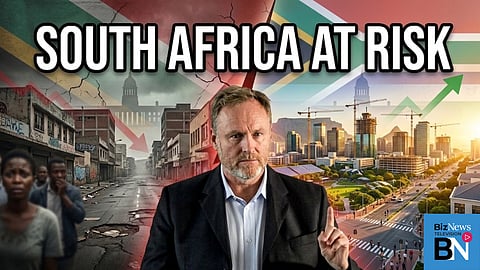
South Africa’s future hinges on one simple truth: jobs come from growth, and growth comes from political choices. This sharp discussion unpacks how policy, ideology, and global alignment are choking investment and costing livelihoods. Inside the ANC, paralysis, fear, and patronage block reform - despite clear evidence of what works. Yet there’s hope: ordinary South Africans remain pragmatic and solutions-driven. Shift the mindset, unlock investment, and growth can follow. The path forward exists - but it demands courage, clarity, and decisive change now..Sign up for your early morning brew of the BizNews Insider to keep you up to speed with the content that matters. The newsletter will land in your inbox at 5:30am weekdays. Register here.Support South Africa’s bastion of independent journalism, offering balanced insights on investments, business, and the political economy, by joining BizNews Premium. Register here.If you prefer WhatsApp for updates, sign up to the BizNews channel here..Watch here.Listen here.Edited transcript of the Q&A.Alec Hogg 00:20:35 - 00:49:27I'm making so many notes, John. So, let's just start off with the the whole joining the dots issue. Something that I've tried to add, in almost every session here because it's so clear when you do look at things in the way that you have the way you unpacked it for us. But how does one join the dots between.00:49:31 - 01:23:08Jobs are the greatest priority. South Africans want jobs. Our relationship with the international community is not creating those jobs in fact, it is destroying jobs and potentially destroying many of them. So how does one start joining that dot those dots with the people who tell you through your surveys, the jobs that are important? John EndresSo I think the causal mechanism really is politics.01:23:12 - 01:42:15And that's that's what links all of these things together. And at the September BizNews Investment Conference, I spoke about the choice facing the ANC, which is the choice of bending or breaking and bending means relaxing some of the policies that are preventing growth from happening. If they don't do that. It's the voters who are going to break the ANC.01:42:19 - 02:05:40And that's effectively what's happening right now. So I think we're still seeing the the ANC continue to decline in polls. And that will continue for as long as the economy is not growing. So our argument is very much an argument from self-interest with saying you like, you don't have to be in a free marketeer or a classical liberal, but you do need to choose the policies that are going to make the economy grow, because that's in your interest.02:05:44 - 02:29:17If you, as the ANC, want to survive, if you don't want to be broken by the voters, you've got to do this. And the choice is yours because you can not do it. But then you're going to get wiped out. Alec HoggBut it appears to me that it's so far gone that there are people within the ANC, maybe those in control of the ANC, who say, well, we don't care.02:29:24 - 02:58:21Let's take what we can while we can. John EndresNow that kind of seems to be what's happening at the moment is my impression. So I think there are people like that in the ANC. I think there are also people who are almost paralyzed because they don't know what to do. So there may be some people in the ANC who agree with many of our proposals would like to see them implemented, but fear facing their party colleagues and the criticisms that they would get from their party colleagues if they would openly endorsed these kinds of positions.02:58:25 - 03:37:13Now, imagine being in the ANC and saying like, I think we should scrap BEE. That's very hard to do. You know, you're going to be ostracized, have probably rotten tomatoes thrown at you. You're also going to be afraid of the EFF or MK and their political messaging, their response to a message like that from you. And I think that's what's causing this paralysis, where people inside the ANC, even if they understand the need to make a change, feel unable to move on it because they feel hemmed in by their party colleagues, by existing loyalties, by vested interests, by rigid networks of patronage and relationship that make it hard to move.Alec Hogg 03:37:17 - 03:58:42A dear friend of mine who passed a couple of years ago works in the bank. He worked in the banking industry and he said, I feel often like we are a bunch of dinosaurs and we're eating grass, and we look up and we can see the meteors coming. Are we going to see that it's going to smack us?03:58:46 - 04:25:19But we know there's nothing we can do about it, so let's just keep on eating grass. John EndresSo that's a hugely important, factor. And we have this campaign called what SA Can be. I was in Cape Town earlier in the year, and I asked my Uber driver, who was a South African, to imagine ten years from now if everything goes as well as it possibly can.04:25:23 - 04:44:44What will the country look like and what will his life look like if things go really well? And he sat thinking and considering. And in the end he said, there's no way this can happen. Like he refused to give me an answer. He said, there's just it just cannot be done. He referred to the Madlanga Commission. He said, look at the stuff coming out of the criminal justice system.04:44:48 - 05:04:49Look at our education system. Look at the violence and crime that we face in the townships. There's no hope for us. And I think that is a really big risk, because when when everybody thinks that and says, like, there's no hope, no chance, no, but unity, then that is what we're going to get. That's going to be the outcome if it's going to go to decline and to terminal decline.05:05:03 - 05:31:10And so part of what we're trying to do with what is a can be campaign is to say, firstly, you should imagine a better future for yourself ten years from now. And you should also not consider that to be completely unrealistic. Unfeasible, crazy talk, because there's a way you can get there. There's a path that leads from today to this point in time, ten years in the future where that is a good future.05:31:14 - 05:50:43But it depends on making the right choices now. And those right choices are described in these blueprint for growth papers. In the freedom Builds and in the policy work that we do. So what we're trying to do is shift the public mindset towards a more positive vision, connect that to the idea of economic growth, and describes how to get that economic growth.05:50:47 - 06:17:13And we are seeing some successes. Right. So we're seeing, formal mentions of economic growth in public communication coming out of the government and out of the ANC itself. At this stage, often we think it's still lip service. So it's seen as something that's floating around as a vague idea, economic growth, probably a nice thing to have. But it's not really seriously considered as something that you can produce and that you have to take very seriously if you want to get it.06:17:17 - 06:36:12And just one more anecdote on that. I got interviewed on a podcast, by Mike Sham on the state of the nation podcast, and he said to me, people don't if they haven't experienced that, they don't know what it's like to live in a high growth environment. He says he grew up in the 1980s in South Africa.06:36:16 - 06:54:18There was no growth and that was normal. And then he entered the labor market, started working, and then between 2004 and 2007, for the first time, and the economy was growing at about 5%. It was a high growth environment. He said. He couldn't believe it.06:54:22 - 07:21:36But for most young people in South Africa today, they've never experienced that. They've only ever experienced stagnation and decline and the gradual breakdown of infrastructure and, and institutions. So to, to reverse that, is really important, but I think can also be extremely powerful. You know, once people start seeing the benefits and what that is really like and how motivating it can be to be in a high growth environment, I think that can spark more, moves towards higher growth.Alec Hogg 07:21:40 - 07:55:27That's really scary because if you think about the markets as an example, if you've only been in a bull market on the stock market, you're going to be looking at things in a very skewed way. And when the bear grabs you, it will be pretty disastrous. Now, if you're talking about a whole society that don't know what it's like to have economic growth, I suppose it's hard for them to have hope because they don't know what hope looks like.John Endres 07:55:31 - 08:11:43That's right. I think many people know what the result is that they want. So that is what we see in our polling. People say that, you know, we want jobs and we want the government to deliver services the way it's meant to. We want to see crime being tackled. But they're not necessarily too clear on how to get that.08:11:47 - 08:38:05However, I think that when we ask questions about values and priorities, people reveal themselves to be, quite rational and sane in how they think about the world around them. They do think in terms of value for money. They do think in terms of meritocracy that you think and actually in many cases in colourblind terms, where they say, you know, all this talk by politicians about racism and race is just a distraction like that.08:38:06 - 08:55:23They're doing that for their own benefit, but it's not what drives us. And so there I would maybe take some a different view to some of the other speakers who said that South Africans are so uneducated that they can't figure out what's good for them. I don't think that's true. I think they, you know, they might not know the the detailed intricacies.08:55:27 - 09:12:14For a while, but, I think it'll be better if we talk about policy and politics and the economy. But yeah, the point is that all South Africans, I think, you know, due to the rational, you know, they have to budget in their personal lives. They have to make sure that they get value for money in their personal purchases.09:12:18 - 09:31:18And they know that that's how it has to work at the state level as well. And I think that's that's where the building, that causal link is not that difficult. I'm so glad to hear you. Alec HoggI'm so glad to hear you say that, because my experience on a global scale is exactly that. So let me tell you about Muhammad Yunus.09:31:18 - 09:56:21I get to Davos one year, always used to go back to the same hotel, three star hotel called Concordia. Pay an absolute fortune. But they, they they looked after me. They're the couple and the one you're Muhammad Yunus was the the founder of Grameen Bank. So I had the chance to sit with him at breakfast and occasionally in the evenings and have a good chat with him about what Grameen Bank did.09:56:25 - 10:23:42And he said they got the poorest of the poor in Bangladesh, the poorest of the poor, but like Agas and he gave these young, these not young, these women loans, and they took those loans and they bought things like sewing machines or to pay off sewing machines. And he said the repayment level was extremely high. They knew exactly what they were doing from the financial point of view.10:23:46 - 10:58:17And he said, this belief, this arrogant belief that exists among some people, that because someone hasn't got money, they are stupid is awful. He said that he also was asked by India to assist once they saw what was going on in in Bangladesh with Grameen Bank and the same kind of thing in India as well. This is a man who won the Nobel Peace Prize for bringing loans to poor people.10:58:21 - 11:31:13He is a man who's revolutionised Bangladesh. And when they had the recent Bangladeshi revolution where the the kids were being shot by the regime and being replaced by those behind them, they asked him to lead the drafting of the new constitution. So it shows you that people really did it, but sometimes they aren't given that opportunity. And what you're saying is aligned with what Muhammad Yunus said.11:31:21 - 11:58:20And certainly the the information that I've heard from many others who work at the bottom end of the of the pyramid. John EndresYeah. And there's something important I want to add to that, which is that I think we also sometimes overestimate how well sophisticated audiences understand the impact of certain pieces of legislation or policy. And there's a great example that came out of research by Gabriel Crouser, who's, and IRR fellow and leads the IRR legal, which is on our legal division.11:58:24 - 12:23:43And he looked at the police's employment data, and we've heard from in Cameroon, we heard from Rory Steyn. There's about 180,000 people working in the police. Out of those 180,000 people, 60,000 are in positions where they cannot be promoted because of their race and gender. Out of those 60,000 who cannot be promoted because of their race and gender, about 36,000 are black men.12:23:47 - 12:49:26So now we tend to think of BEE as an anti-white policy, which is what gets Elon Musk all worked up and President Trump as well. But in the police service, the group most affected BEE unemployment, well, employment equity in this case is black men. So how does this work? Imagine that you're at a sort of seniority level eight and the police service, and you're hoping to get promoted to level nine one level up.12:49:30 - 13:14:35But there's an overrepresentation of your race and gender at that level. That means you cannot be appointed to that level usually. And they're the people most affected by that are black men. And the consequence of this is that imagine that you're a young black man saying, I want to join the police force, and I'm going to map out a career for myself like Rory did and, you know, rise to the top because I care about law enforcement.13:14:35 - 13:33:26I want to fight crime. I want to bring my talent to this task, to this job, to this mission. But then you look at this employment chart and you see if I getting at level one, I won't be able to get to level two because there's an overrepresentation of black men. Even if I somehow make it, I can't get to level three because there's an over presentation.13:33:26 - 14:03:42I can't get to four, five, six, seven, maybe eight because there's an overrepresentation. And then like, how do you recruit? Like how must the police attract the best people if they're saying, if you're a black man, don't bother applying at the lower levels. There's no space for you to progress up the ranks at the top management level. Just to add to your outrage, which I think you are beginning to build up at the top management level, there's a target number for each of the eight race gender pairs.14:03:42 - 14:36:41So those eight pairs are black, white, coloured, Indian, male, female. So 4x2 trans to age, race, gender pairs, if you are a colored woman or a white woman, the target for you is zero. And this means that if you imagine, you know a coloured girl somewhere who is highly talented, with great integrity, a great moral sense wants to fight crime, you know, studies all the literature, all the books, goes through university with the highest marks, goes overseas to become the best cop that you've ever seen.14:36:45 - 15:05:19This person cannot be appointed to your top management level in the police because she is female and colored. Alec HoggYeah, I, I, you know, this whole the whole race thing is such bullshit and it's so engineered by people with agendas. It just it, it, it saddens and sickens me that the nezz did to us what they did. And the ANC is continuing to do to us what the nezz did.15:05:19 - 15:25:05And it's it's surely by now we would have woken up and it's, you know, kind of sobered up to the stop drinking the bloody Kool-Aid. Yeah. John EndresWell, even News24 is waking up, so maybe there's hope. But there's something I would like to add to that, Alec, which is the, the notion that, why do they do this and that the reason they do this is because they've got this idea of demographic representivity .15:25:09 - 15:49:42And this notion is that whatever your race, gender concentration is in the general population, that must be reflected in all the states, institutions and private companies as well. So if you know, black women are 37% of the total population, then black women must be 37% of employees at every level of the police, basically. And that is a very bad form of transformation.15:49:46 - 16:09:39But I would also argue that we do actually want transformation. I think one of the other speakers mentioned that what we want is real transformation, and real transformation is not based on demographic or positivity. It's based on creating jobs, on high fixed investment, on fast economic growth, which expands opportunities for everyone. And that is the kind of real transformation that we should be pushing for.16:09:45 - 16:36:33So if you're in a corporate environment and you get old, you know, you criticize transformation at your peril because the state is going to go after you say, I'm for transformation, but I'm for real transformation. I'm not for fake transformation. This doesn't work. Alec HoggWhy would you, just post on the on the BNC#8 group, please? The the point that you made on how we should be standing for.16:36:37 - 16:58:06Because I would like to do that in future. We get so many people approaching us and saying from corporates, what's your BEE position and what's your, what's your ranking and that kind of thing. And I would love to love to go back and say, this is the way we feel about BEE rather than following what everybody else follows.John Endres 16:58:06 - 17:15:37And also like not speaking up about this lets the government get away with pretending that it's broadly supported and endorsed. And of course, corporate South Africa does say we fully support transformation, but it would be useful for them to say, well, we'd support it because we're forced to, but it's not good for us or for the country. Alec HoggIndeed.17:15:41 - 17:43:41Okay, quite a few questions coming through. Yes. One from John Mark, who says frontrunner highlights the percentage of GDP flowing out of our country via online betting and the gambling industry. He suggests it is the poorest and most vulnerable that are gambling their grant money away. We could save 1% of GDP by outlawing gambling. What does the IRR think about this?John Endres 17:43:45 - 18:02:39So we don't have a house position on it, but I would say the consensus is that we are very critical of that. And we think this is a very bad development. So we we read stories about, for example, NSFAS money. So and, well, state money to study at university, being used for online gambling and being lost, as well as social grants.18:02:43 - 18:31:04And this is, a very devastating, I think, destruction of value. It is also a betrayal, I think, of the implicit social contract behind taxpayers paying money to the state to be given to people who are indigent and don't have other means of supporting themselves for that money to be lost like that and to flow to overseas online gambling or betting markets.Alec HoggWell, to go and sponsor an English Premiership side.18:31:16 - 19:04:36I mean, isn't that just absurd? Hollywood Bits is making so much money out of online gambling in South Africa that it can sponsor an English Premiership team that costs who knows how many millions. And it it does talk to what Shaun Summers is starting to say. It's affecting retail spending. There is there's something wrong here who's benefiting apart from clearly the obvious beneficiaries.19:04:36 - 19:30:01But who in the in the chain would be a beneficiary of the fact that we do have this debilitating law? John EndresYeah. I don't know if this is a result of, a sort of a, a gap in our regulation that these companies are able to grow so fast. But it it's certainly very striking and very eye catching that they are and problematic.Alec Hogg 19:30:05 - 19:58:00Have you done any research on it, any any numbers on it ?John EndresI'd love to see the numbers as well because we, we, we don't know the breakdown of gamblers. We don't know the amount of losses. And that would be quite important to know. Alec HoggI once served on the Board of Phumelela because I was very involved in the horse racing industry, and my colleagues in the Owners and Trainers Association put me onto their board.19:58:00 - 20:44:17And from there I became a member of the board. And the hoops I had to go through to be allowed to serve on the board were extreme. The what they called probity. It was they wanted to know pretty much everything about where I was now look at about my my financial affairs, etc. when I think about that, what I had to go with probity and what I was required to do to be a member of the board, because the gambling laws at that stage anyway, was so strong, you would have thought that there would be at least some thought was some some, some reflection given to how licenses were granted, because back then you were...20:44:17 - 21:11:32not allowed to bet on anything overseas to try and keep the local industry, casinos, etcetera alive. It appears as though all of that is kind of gone by the wayside. And it would be lovely to to get some definitive information on that. I'm talking quite a long time ago.John EndresAnd I guess it's also with the development of internet, the internet and IT technology that online gambling becomes much easier.21:11:34 - 21:41:37So you can have a server, you know, sitting in Malaysia or Russia, you know, or you a South African gambling organisation, if your assets all overseas and your payments go overseas, you regulated maybe by a different entity. Alec HoggQuestion. From Sean, Sean McLaughlin he says, does it do you agree that South Africa could be the most dynamic economy in the world, given its economic diversity?21:41:37 - 21:49:17And does it do you think South Africa's politics could one day driverless?John Endres 21:49:21 - 22:08:16Yeah. I don't know if the most dynamic, but I think amongst the most dynamic. Yes. In a way a bit like Iran maybe, as, as we would we were hearing earlier in the case of South Africa, I think it is possible to trigger an investment frenzy over the country because of its existing assets.22:08:28 - 22:29:02And I think at the moment there's a sort of a filter of pessimism overlaying the view on South Africa, which is not unjustified. But if you were able to remove some of those structural factors that caused that filter to be there, I think South Africa could very rapidly attract very significant amounts of inflows. And to so here's a few numbers for you to think.22:29:02 - 22:51:26About 15% of GDP is about 1 trillion rand, which is, fixed capital formation. So if you wanted to double that to get to 30% of GDP, you'd have to spend 2 trillion rand. So an extra 1 trillion rand sounds like a very big number. But South African corporates are sitting on 1.8 trillion rand in cash reserves, which are not deploying because they're worried about property rights and crime and regulation and so on.22:51:26 - 23:12:41So there is one pot of money.Alec Hogg1.8 trillion rand sitting there, not being invested because of government policy that is making them nervous to invest it. John EndresYes, exactly. If you're a foreign investor, you're looking at the South African companies sitting on that cash pile saying, why are these guys not not investing? And you get nervous, right? So that's important.23:12:45 - 23:42:11Then we had another number, I think, from Magnus, about the 1.6 trillion rand that's been moved offshore by South Africans because they're worried about the policy environment. So that's already, what, 3.4 million, a trillion rand. Then we heard from Anthony Ginsberg that there's $1 trillion interested in being deployed to South Africa. And suddenly you're seeing all these very large sums sitting in the wings, basically waiting, waiting for the opportunity for the conditions to be right to come in.23:42:23 - 24:13:22And again, there's 1 trillion rand increment per year to get to the 30% fixed capital formation rate. That's $50 billion, bit more with the current exchange rate. Now, you know, $78 billion. It's not that huge by American standards. So if the South African government went to President Trump and instead of negotiating about, you know, some sanitary regulations that he's not interested in, so go to him and say, President Trump, we want to make the biggest deal in the history of Africa with you, the biggest investment deal in the history of Africa.24:13:22 - 24:29:34Here's what we want to do and be bold. You know, get the guy excited about the country. I think that massive amounts of investment could be unlocked very quickly. Alec HoggSo what's what's holding that back? Sorry.24:29:38 - 24:58:15What's stopping it? John EndresIt's the politics. So right now the the ANC is not able to see or seize that opportunity. I think it is still very beholden to its foreign policy direction. It's not able to shift away from its opposition to the United States and its alignment with China, Russia and Iran. Plus, also, the way it's conceives of the economy is as an entity that has to be managed and controlled and intervened.24:58:15 - 25:23:22And to function despite all the evidence. That is still the mindset. So I think before we're going to see those brakes on the economy being lifted, it's going to take a change in mindsets, insufficient parts of the ANC or the removal of the ANC from the levers of power which the voters have the power to do. And I think are going to do if the ANC doesn't change course.Alec Hogg 25:23:26 - 25:36:19We saw the reaction to the US ambassador's comment and what they were really cross about was that he said, I don't care what the courts say.25:36:23 - 26:14:04Kill the boer is hate speech. Now, I'm not sure how many people in this room would say kill the boer is not hate speech. And it doesn't matter how many courts make that ruling, I'm still entitled to that opinion, as is every citizen in South Africa. But it shows how far we've gone, how far we are down. This rabbit hole that because of something along those lines, you're putting the whole relationship with potentially a really good friend at risk.John Endres 26:14:08 - 26:44:45Yeah. And then there's, there's there's a certain element of what feels like self-sabotage involved in this. Because we have many opportunities not to make mistakes, but we use none of them. So every, every time we have an opportunity to make a mistake, we make it, with a Kill the boer song. I think, you know, there's a very obvious solution for how the government could solve this conundrum, which is that it does not need to say, we do not agree with the Constitutional Court ruling, and, you know, we're going to do whatever.26:44:49 - 27:17:16There's a separation of powers. The Constitutional Court has ruled the ruling stands, but the government or the ANC could very easily say why we respect the ruling and the Constitutional Court. We criticise and disapprove of the singing of the song. And we we urge South African politicians not to sing it. And I think that that would probably be enough to satisfy the Americans that would say, okay, they've got institutions, they respect institutional independence, but they don't think it's a good idea and they are criticising it publicly.Alec Hogg 27:17:20 - 27:52:27So we're coming to the end of this conversation and I think everybody here wants to leave with some hope. How can you what can you give us from the. Reams of research that you do from the huge amount of, of information that that comes through the IRR on a continuous basis, that lets us say to the cynics and the naysayers, South Africa is worth fighting for.27:52:31 - 28:19:27South Africa can move into a better future. John EndresWell, I think the thing that you should put your, your, your faith and confidence in as your fellow South African, because you cannot fix the situation against your fellow South Africans, but your fellow South Africans are mostly very reasonable and rational and what we need to see happening is the politics begin to reflect their preferences.28:19:31 - 28:44:21And I think, you know, that's where Prince Mashele, I think, is really onto something, because I think he's tapping into that deep vein of rationality, sensibility, shared identity, South African spirit. That's unites many South Africans. And, I think he's got a chance of being quite successful with that. If he, if he, if he does that well, because there's, there's certainly something there to to be tapped into.28:44:25 - 29:09:46That is for me the, the encouraging, optimistic message I'm going to give you, your fellow South Africans are not bloodthirsty, crazed revolutionaries. They're ordinary people like you and me, and they want to make the country succeed as much as you and I do. And we must help them do that. You know, we each got our role to play, and, you can support organisations like the IOL or Alta or solidarity or the DA.29:10:00 - 29:37:11There's lots of organizations doing good work out there. The free market foundation Sakeliga, and get involved, you know, speak up and be visible, participate in the political process to help guide developments towards that better outcome. Alec HoggWhat percentage of South Africans, because it has been mentioned at this conference, or identify as sounds very woke Christian?John Endres 29:37:15 - 30:02:33I don't know. So the statistic I have in my head is between 80 and 90%. But it's not verifiably sourced or cited. Alec HoggI remember reading in one of your books, it was 86%, which is a huge number. And if you if from what you've told us, we have a...30:02:37 - 30:36:21International affairs department that has taken a particular line. Helen Zille has told us through this the, initially that the ANC fought tooth and nail to keep that that is certainly not aligned with what 86% of South Africans believe. And that what you've told us as well, on the the tsunami of investment capital that could come into the country, is the biggest stumbling block to more and more jobs.30:36:21 - 30:55:24Not it's not too difficult to join those dots. How does one do that? Or am I simplifying it? John EndresNo. Do you do it in the way that I've done this, in this presentation? And that is what we do. Like we publish over a thousand opinion pieces per year. We get cited in the media hundreds of times per year.30:55:24 - 31:15:26We got multiple social media posts. And all of this is designed to do one thing, which is to explain how the world works, how South Africans think, how to make the economy grow. And this is not quick work. So this was going to be another topic of my speech that I think many people hear entrepreneurs, Investors are very action focused.31:15:26 - 31:33:08They said like, what are you going to do? How long is it going to take? But this is a long process. We've been added since 1929, effectively almost a hundred years. But, you know, Chris Van de Merwe, was saying as well, you know, you have to go one step at a time. Now, you can't skip steps like there's not a short, quick solution to this.31:33:20 - 31:59:23You've got to grind away. And that's that's what we're doing. Alec HoggAnd maybe just to close that off, Doctor Chris Van de Merwe from Curro was saying, how do you build the business from, a back room to 189 schools with 500,000 pupils? He says one step at a time and perhaps that's the message that we need to take home from today.31:59:23 - 32:01:33Thank you John.Alec HoggThank you.