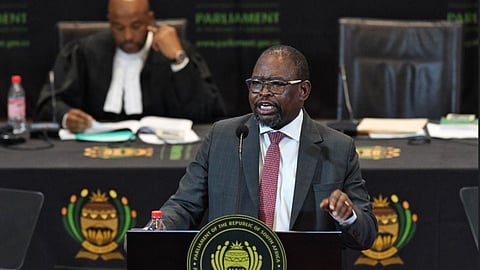
Key topics:Godongwana cuts taxes, adjusts brackets, avoids R20bn hikeDebt stabilises; fiscal deficit narrows; economic growth improvesSavings, small business incentives, and municipal reforms introduced.Sign up for your early morning brew of the BizNews Insider to keep you up to speed with the content that matters. The newsletter will land in your inbox at 5:30am weekdays. Register here.Support South Africa’s bastion of independent journalism, offering balanced insights on investments, business, and the political economy, by joining BizNews Premium. Register here.If you prefer WhatsApp for updates, sign up to the BizNews channel here..By Alec Hogg .Greetings to the BizNews tribe. It’s almost 2pm on Wednesday, February 25, 2026, and I’m sitting in the depths of the Parliamentary lockup. The refreshments were exactly as you’d expect— strictly functional—but the atmosphere is more upbeat than I can remember. It’s hard to put your finger on the precise reason. Maybe it’s partly the impressive new broom at Treasury (Duncan Pieterse runs a highly professional, transparent and engaged show); the optimism that comes from real live green shoots in an economy that has struggled for so long; and confidence that comes from seeing housekeeping hygiene back, witness tax thresholds and limits being adjusted - some ignored for decades. ignored). Putting it all together and the result is that today, Finance Minister Enoch Godongwana delivered what can only be described as a pragmatic, pro-growth masterclass. Something a long-time veteran of these Budget exercises wondered would ever return.For years, we’ve been accustomed to bracing ourselves for the worst: rising debt, missed targets, and the inevitable squeezing of the already beleaguered middle class through silly ignoring the destructive impact of tax bracket creep. But this year, the narrative has fundamentally shifted. Godongwana stepped up to the podium and declared an important turning point in the management of our public finances. Fulfilling a promise given in 2023. And for once, the numbers actually back up the rhetoric..The Big Macro Picture: Back from the Brink.Let’s start with the headline grabber: for the first time in 17 years, South Africa’s debt will stabilise and is projected to fall in the coming years. Let that sink in. After nearly two decades of a runaway debt spiral, the adults in the room have finally wrestled the beast to the ground.The consolidated budget deficit has narrowed to a respectable 4.5% of GDP in the fiscal year just passed; this year, dropping to 4% in the 12 months to end February 2027. Gross debt has peaked, we’re told, at 78.9% before tapering off to 76.5% by 2029. And this time there are good reasons to believe it.The markets and global watchdogs have already noticed this renewed resilience. South Africa has been officially removed from the FATF grey list , and we’ve secured our first credit rating upgrade in 16 years. Something else worth reflecting on for a moment.Domestically, while economic growth is still sluggish, it is improving. Real economic growth is projected at 1.6% for 2026 - well above what economists anticipated a few months ago - and, finally, in line with population growth. So after a decade and a half, we’ve stopped going backwards. I’d like to believe the 2% target in two years’ time is safe. And conservative. .Edward Kieswetter’s Swan Song: The Tax Reprieve.If there is a hero in this year’s budget, it’s the South African Revenue Service (SARS). Minister Godongwana gave a glowing tribute to outgoing SARS Commissioner Edward Kieswetter in the lockup presser and again in the Budget speech. He reminded that took over at SARS when it was on its knees after being ravaged by State Capture - where the Gupta/Zuma deployed Tom Moyane and the odious Bain Consulting engineered industrial scale pillaging. Kieswetter will be taking his leave at the end of April, following seven years of service that his former boss at SARS, the late Pravin Gordhan, would loudly applaud. As even the journalists did in the lockup presser - something I’d never previously witnessed (journal are taught to never join the clapping as this compromises their independence). The outgoing SARS Commissioner He leaves behind an institution that has quite literally saved the fiscus. Because of an incredibly efficient tax administration, gross tax revenue for 2025/26 was revised upward by a somewhere between R21.3bn and R28.8bn - Treasury’s documents and Godonwana’s speech are at odds about this. What they do agree on is the bonus was driven by higher-than-expected VAT, corporate income tax, and dividends tax.One of the positive consequences of this over-collection is the biggest surprise of the day: Government is entirely withdrawing the R20 billion in tax increases provisionally tabled in the May 2025 Budget. You read that right. No new major tax hikes to fund the shortfall, and personal income tax brackets and rebates are being adjusted fully (downwards - at a cost to the discuss of R11bn) in line with inflation..A Massive Nod to Savers and Entrepreneurs.For the BizNews community, the Minister’s focus on savings and small business will be music to the ears. Acknowledging that our national savings rate is dismally low, Godongwana has introduced some incentives, again, the first in ages:The tax-free annual investment limit has been hiked from R36,000 to R46,000.The limit for tax-free retirement fund deductions has been raised from R350,000 to R430,000.Small businesses also received a much-needed lifeline. In a charming moment, Godongwana cited a "Tip for the Budget" from Renette Oosthuizen, a small business owner in Gauteng. She asked for a review of the VAT threshold. The Minister listened: the compulsory VAT registration threshold is jumping from R1 million to R2.3 million. Furthermore, the capital gains tax exemption for older persons selling a small business rises from R1.8 million to R2.7 million..Cutting the Fat: Rooting out Inefficiencies.A budget isn’t just about what you raise; it’s about how you spend. The Minister announced R12 billion in targeted savings over the medium term.A prime example of this newfound ruthlessness is the South African Social Security Agency (SASSA). By upgrading biometric and income verification processes, SASSA identified and terminated nearly 35,000 incorrect or fraudulent grants. That single cleanup operation yielded R3 billion in savings. Additionally, the underperforming Public Transport Network Grant is being slashed by R8.4 billion over three years..Fixing the Municipal Mess.Perhaps the most critical structural reform highlighted in the lockup pertains to local government. The audit outcomes are a disaster: 63% of municipalities are in financial distress.Godongwana pointed out the absurdity of current municipal cross-subsidisation. For example, Johannesburg collects R11.9 bn in water revenue but only allocates R1.3 bn to Joburg Water for capital expenditure , leading to a staggering R64 bn maintenance backlog.To stop this rot, National Treasury is allocating R27.7 bn to a performance-linked reform for metro trading services (water, electricity, sanitation). This forces municipalities to ring-fence utility revenue and reinvest it directly into maintaining those specific services. Fail to meet the operational targets, and your budget gets cut. It’s tough love, but it’s the only way to save our cities..Sin Taxes and Crypto.Of course, no budget is complete without the traditional sin tax hikes, which are increasing strictly in line with inflation. A 340ml can of beer goes up by 8 cents , and a pack of 20 cigarettes rises to R23.58 and a bottle of win increases 16c. The general fuel levy will also see a sub-inflation hike of 9 cents per litre for petrol.On the modern finance front, Treasury is taking steps to regulate the digital economy, and will shortly publish draft regulations to include crypto assets within our cross-border capital flow management regime. Social media influencers, too, are going to be drawn into the tax net. Kieswetter says they should already be declaring revenue earned, but there’s still work to be done on the actual definition of these ‘influencers’. .The Bottom Line.Sitting here in the lockup, digesting this document, it’s hard not to feel a sense of rational optimism. As would any thoughtful patriot - the credo a Cape Town doctor proposed for our tribe members a year back which was readily adopted. The Minister is holding the line on fiscal discipline while rewarding the taxpayers and entrepreneurs who keep this economy afloat. That’s a huge shift from the past practice of business bashing. It is, as Godongwana rightly noted, proof that steady structural reform and responsible public finances are the only path to a bedrock for a prosperous South Africa.We’ve dodged another R20 billion tax bullet, fiscal drag is back, our debt is finally stabilising, and Treasury is holding rogue municipalities accountable. It’s a good day for SA Inc.