
Meikles – Zim icon ready to apply hard learnt lessons into Africa
https://www.youtube.com/watch?v=t35o7BPvF3E
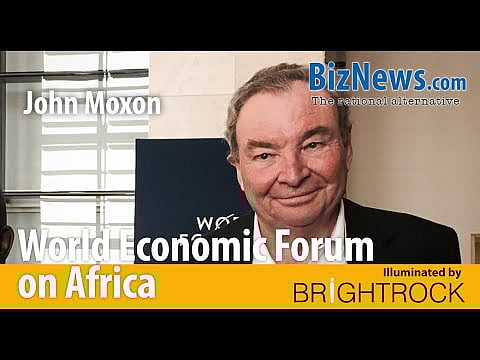
The Zimbabwe based Meikles group has aired its grievance with the government but says there are still difficulties over the debt that is owed. Talking to Alec Hogg at the World Economic Forum for Africa, the group's top duo, John Moxon and Thabani Mpofu, also said they are looking to expand into countries like Zambia. The two also talked the FIFA scandal, which has shown the endemic nature of corruption.
We're at the World Economic Forum and the top duo at Meikles, John Moxon, whose family have been involved in the company for how many years?
Since 1892.
And you're most recent acquisition, Thabani Mpofu, who's joined the business only a year ago.
In March, last year.
It's interesting that Meikles has, not long ago it was in confrontation with government. Now, you've got Thabani joining in. Are things getting better there in Zimbabwe or the relationship between business and Government?
Thabani is not in Government. He wasn't in Government. He's was a lawyer, a prosecutor in fact. Our relationship with Government yes, is a lot better.
Because you did… You went to court not long ago.
We still have difficulties with Government, over the debt they owe us, in terms of recovery, but we're not in court right now. It's all been handled by negotiation.
Thabani, from your perspective, how are you seeing the business environment in Zimbabwe? There are two different ways of interpreting it. South African companies are expanding aggressively into Africa, but not into Zim. Are they making a mistake?
Well it is interesting that you should mention that because we're in partnership with Pick 'n Pay, for our TM Supermarkets brand, and I would describe their presence in that arena is aggressive. Looking at the business environment, we've got reason to be very optimistic. We have been invited to participate and they've been nominated here for the global growth companies, which is a sign that the world is, indeed watching Zimbabwe and that there is optimism. Which is not only in Zimbabwe but elsewhere as well, so I think that South African companies should take a closer look, a more pragmatic approach, and see what they can do in Zimbabwe.
So look past the current difficulties?
Yes. Yes, the big problem, at the moment is getting decisions. Government up there, there's a lot of changes, a lot of them are fighting at the moment, and that also gravitates down, at the business community and the civil servants community, so it is very difficult to get business decisions. You've got to… If any South African or any other company wants to go into Zimbabwe, they've got to understand that it's not an extension of South Africa. It has its own rules, its own regulations, which are quite different.
But if you were to ask about anywhere in the world of a difficult environment to operate a business in, given hyperinflation, given the way that the Government is run there, given the perception of the rest of the world. I don't think anyone can beat Zimbabwe. How have you managed to keep a business going under those kinds of circumstances?
You've just got to understand how to cope with it. It's as simple as that really.
How do you cope with it?
How do I cope with it? Every day, we have some issue. It's either with Government or the civil servants, within other companies and employees, with people in the community. It's a very small community, basically it's quite a, in my view, it's quite a vicious little community, at the top, and I'm not talking politically, but in business terms. It's not easy.
No, it isn't but, I mean the approach that we've taken is one of, I was going to say constructive engagement, but that may not be politically correct.
Well that was Thabo Mbeki's political incorrect.
But it's a positive engagement with all the institutions that affect our operations, Government and others. We have been trying to put the message across that we are in this for business, and therefore, ultimately for the betterment of the country as a whole, and that what is good for business, is good for the country, and presumably, good for the politicians as well. So this is the approach that we take and we are purely for business and we will do business, under the rules and regulations that the Government of the day, puts in place.
Are they informal and formal, and what I mean by that, is corruption endemic in many parts of the Continent? We know a lot of it goes on in Zimbabwe. How do you guys handle that?
Look, I mean the same way you keep your heads above the water and you try and do the right thing. You mention that corruption is endemic. Yes, it is, and one thing that we've learnt in the past few days that it's not only concentrated in Zimbabwe. With this FIFA scandal, you can see how very difficult it is to, really stamp out when it's an international phenomenal, if I can call it that.
But look, we have got our own corporate governance rules, corporate culture, in house anti-corruption measures, and rules. In that way, we find that when you engage institutions that can see that you are not part of the crowd. You are not going to engage in activities that are unsavoury. They tend to follow your standards.
Zimbabwe is an island of underperformance, in a Continent that is performing amazingly well, but being in the country for so long, being in Africa for so long, does that give you an advantage moving into other economies?
I think every economy is different. The rules are different in Africa. I don't think there's an Africa, as one call it, which is what a lot of people here are saying. I think every country is different, and one's got to learn the rules, and a lot of those rules, particularly in Zimbabwe, are informal.
Such as…?
Well, for example, let's take the Zimbabwe Stock Exchange. They have the same basic rules and regulations as the Johannesburg Stock Exchange does, but informally there's a philosophy of control, which is endemic in Zimbabwe, at high levels, and so they interpret certain things in their own way. This is the executive of the Stock Exchange, which adds, in my opinion, difficulties there and we're finding it very difficult, at the moment, to cope with that, for example. It's not straightforward as I suspect, although I've got an experience, where I suspect, as it is down here at the Johannesburg Stock Exchange, which is probably very easy to understand their rules and regulations. Not so easy with ours.
Why have you stayed? Why have you stayed in the country?
Why have I stayed? I ask myself that now. No, I love it there. I love it there.
A lifestyle or… If you had your business, perhaps in Zambia, which is a freer environment. Would it have been a bigger business perhaps?
We are going to move into the region and therefore, we will be in countries like Zambia and elsewhere, with hospitality. That's our growth area, and perhaps in agriculture. Those are the two thrusts we're going to develop on, on a regional basis.
Those are the two areas, I guess as well, where Africa has an, well if you understand Africa, or understand the environment, you can do very well, hospitality and agriculture.
Yes, but I think the point that John makes is that every country is different, even in Africa. There is a tendency to view Africa as this single block, where one size fits all. I think that the trick in doing business in Africa is appreciating the peculiarities and the differences in every country, just like there are differences in language and culture. You will find that the Zambians, for instance, have a different way of doing things than Zimbabweans or Malawians, but I think the trick is really learning your environment thoroughly. Like we do, and I keep referring too, I think it was a phrase by Deng Xiaoping, when he was asked how China was moving from old communism into capitalism. He made reference to something like, "Crossing the river by feeling the stones." I guess that's the approach that one has to take there. That we take in our country and that we will take when we go into Africa, as we intend to do.
How advanced are those plans? I ask this because Choppies from Botswana has done pretty good business in South Africa already. Would you look south as well as north?
In hospitality, for example The Cape Grace, right here, is part of our Group. Yes, we would look to expand that in South Africa. In retail, no, not in South Africa. Yes, Choppies own Zimbabwe now as well. They growing market share in Zimbabwe, in retail, we are in partnership with Pick 'n Pay, and we're doing it, and that's working. That's working well.
John, there are many South African businessmen who would love to hear your opinion on what you've gone through in Zimbabwe, looking at what's happening in South Africa. There are many who are shipping capital out as quickly as they can, to other parts of the world. Fearing that another Zimbabwe will happen in this country. What do you think?
There are certain common features perhaps, but I think South Africa is so different to Zimbabwe. I personally wouldn't be too fearful of South Africa, and I don't think, and when I am here, I enjoy it here. I think it is far more developed, far more sophisticated. The infrastructures are far better. I think that they're not as isolated as we are, in Zimbabwe and internationally, or in terms of one's own intent, which is Zimbabwe's intent, I think is we're fairly isolated at the moment. No, I think South Africa is a very different place.
And Thabani, coming from your area, when you look at Africa as a whole, do you remain an Afro-optimist?
I'm optimistic, whether I'm Afro-optimistic, is something different I think but I am optimistic. This morning I was reading an article about Ethiopia, for instance. How they've grown in leaps and bounds, since the days of Mengistu Haile Mariam, to their Civil War that happened there, and how they've continued to grow. And look at the Ruanda story, which is in the end a very good story. You look at Zambia, so everywhere you look in Africa, there is growth, there is optimism, and there is a willingness by all concerned to move forward. I think that is also the problem with Zimbabwe as well. That we came from, if you recall a few years ago, a hyper-hyper inflationary environment. There was a decision to shift the currency to use the US Dollar, which has held for longer than people originally expected it would, and companies like us and others, are looking at expanding. Not only in Zimbabwe but elsewhere, so yes, I am very optimistic about Africa and its chances, and I'm quite encouraged when I see the youth's involvement in this. Yesterday I listened to very young people pose very intelligent and interesting questions to President Zuma, and Vice President Atta, in the session that we attended behind here. I was impressed by how they grasped the issued and how the questions really capture what they should be doing right now. I am very optimistic.
Thabani Mpofu and John Moxon are with Meikles.