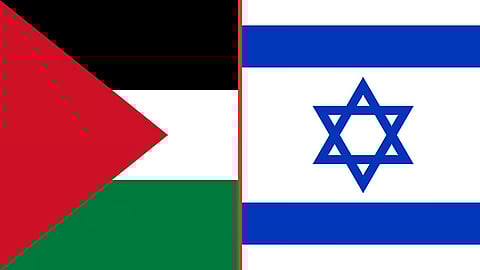
Key topics:Global narrative accused Israel of starving Gaza before facts emergedHamas hoarded food, not Israel, exposing the false starvation claimSouth Africa backed flawed accusations while ignoring regional realities.Sign up for your early morning brew of the BizNews Insider to keep you up to speed with the content that matters. The newsletter will land in your inbox at 5:30am weekdays. Register here.Support South Africa’s bastion of independent journalism, offering balanced insights on investments, business, and the political economy, by joining BizNews Premium. Register here.If you prefer WhatsApp for updates, sign up to the BizNews channel here..By Saul Jassinosky.On October 9 2023, while Israel was still counting its dead after the Hamas massacre, a fully formed global narrative had already taken hold. Activists, media outlets, and political actors began accusing Israel of genocide and deliberately starving Gazan children before a single Israeli soldier had set foot on the ground.That narrative spread faster than facts ever could. It shaped protests, headlines, and international diplomacy. It became the emotional anchor for South Africa’s case at the ICJ. But now, with the release of footage showing Hamas-run warehouses filled with thousands of kilograms of stolen baby formula and humanitarian supplies, the central accusation has collapsed.The starvation was not caused by Israel withholding food. It was caused by Hamas hoarding it. This revelation has done more to expose the fragility of the anti-Israel narrative than any courtroom argument or diplomatic rebuttal.A storyline built on assumptions, not evidenceThe accusation that Israel intentionally starved civilians became the moral engine of the global outcry. It was repeated so relentlessly that it hardened into “truth” before any verification was possible.Yet the baby-formula warehouses make one thing unmistakably clear: Hamas had the means to feed its people and chose not to. This was not neglect. This was strategy. A manufactured crisis provides powerful imagery. And Israel was assigned the role of villain long before the facts were known.The regional hypocrisy no one wants to discussWhile South Africa and much of the Western activist world accused Israel of cruelty, the regional reality was quietly ignored.Egypt kept its border tightly shut, refusing mass entry or supply to Gazans.No Arab country offered to take in Palestinians, not even temporarily.Israel, remarkably, remained the only state feeding, supplying, and providing medical care to people who were being used as human shields by those who attacked her.This is unprecedented in modern warfare: a country supplying food, fuel, water, medicine, and electricity to a territory controlled by an organisation that had just massacred its citizens..Read more:.Chuck Stephens on Israel and Hamas: Enough is enough.Yet the international narrative insisted Israel was starving Palestinians – even as Israel continued supplying the very population held hostage by Hamas’ brutality.The contradiction was staggering. Few dared acknowledge it.South Africa’s rush to judgmentSouth Africa embraced the early starvation myth wholesale. The government rushed to the ICJ, positioning itself as the moral champion of the Palestinians – all while relying on claims that have now been exposed as false.And the contradiction grew even sharper when, despite its loud public posturing, South Africa later blocked Palestinian arrivals at its own borders. It was a revealing moment: Palestinians were useful as symbols, but not as guests.This was never simply about humanitarianism. It was about ideology.When evidence finally breaks through the noiseThe baby-formula scandal is not an isolated detail. It pierces the central assumption that Israel engineered Gaza’s humanitarian crisis. If the foundational allegation collapses, what happens to everything built on top of it?If Hamas starved its own civilians to generate global outrage, what else was misrepresented? If early claims were taken as unquestionable truth, what scrutiny was ever applied at all? If Israel continued to feed its enemies while Arab states closed their doors, why was Israel painted as uniquely cruel? These are not comfortable questions for those who adopted the Hamas narrative so quickly and so confidently.A moment for South Africans to pause and reconsiderSouth Africans understand the power of propaganda. We’ve lived through it. We know how suffering can be manipulated, how images can be weaponised, and how quickly global audiences can be swept away by emotionally charged narratives.And yet, in this conflict, many accepted the simplest and most convenient storyline without hesitation. Now the evidence tells a different story. Hamas hoarded food. Arab states closed their borders. Israel kept supplying civilians in a war waged against her. And South Africa built international legal action on claims that no longer withstand scrutiny. So the question that lingers is not merely whether Israel was falsely accused.It is this: If the central narrative was wrong, how much else were we too quick to believe? The reader can decide where the mythology ends and where reality begins