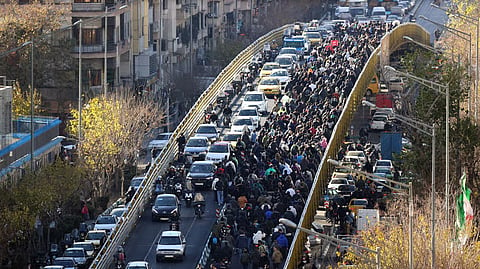
Key topics:Economic collapse and currency crash spark strikes and protests nationwideProtests grow political as regime cracks down amid inflation and shortagesWild cards: Israel tensions and Trump threats could reshape unrest.Sign up for your early morning brew of the BizNews Insider to keep you up to speed with the content that matters. The newsletter will land in your inbox at 5:30am weekdays. Register here.Support South Africa’s bastion of independent journalism, offering balanced insights on investments, business, and the political economy, by joining BizNews Premium. Register here.If you prefer WhatsApp for updates, sign up to the BizNews channel here..From The Economist, published under licence. The original article can be found on www.economist.com© 2025 The Economist Newspaper Limited. All rights reserved..The Economist.For many Iranians the prevailing mood at the end of 2025 was one of despair. The country had endured a year of war, economic collapse and environmental crisis. The government was paralysed, its leaders unable to change course because they were too weak, ideological or inept (and in some cases all three). It was only a matter of time until such gloom gave rise to another round of mass protest. The only question was what would trigger it.It came from an unlikely corner on December 28th, when electronics vendors in Tehran went on strike. Their grievances were straightforward: most of their wares are imported, and it is hard to buy and sell imported goods when the currency is in free-fall. But the unrest quickly spread. Other businesses followed suit, including merchants in the capital’s grand bazaar, which is seen as a weathervane of Iranian politics..Read more:.Trapped in a valley of lies: How Trump’s fabrications are shaping Ukraine’s Fate – Marc Champion.Street protests started in Tehran and swiftly spread to Isfahan, Shiraz and other big cities. Their chants grew more political: “Death to the dictator” is not merely a call for a stable exchange rate. In one provincial town in the south people tried to storm a municipal building. On December 31st schools and offices were ordered to shut across 21 of Iran’s 31 provinces. Officially, the closure was meant to conserve energy during a cold snap. But many Iranians saw it as a scheme to keep would-be troublemakers at home.The demonstrations have not been huge—thousands of people, rather than millions as in 2009—but they are the biggest since 2022, when Iran was roiled by protests after a young woman arrested for her “indecent” dress (ie, appearing with her hair uncovered) died in police custody. The regime has cracked down hard in small towns but so far tended to avoid open confrontation in big cities. Still, several people have been killed and more than 100 arrested.Iranians have much to be angry about. The rial has lost more than 40% of its value since June, when Iran and Israel fought a 12-day conflict. Last month it hit an all-time low of 1.4m to the dollar. Though the minimum wage has nearly doubled over the past two years, it is still barely $2 a day. Inflation has been in double digits for years and is now above 40%. Add to that chronic energy and water shortages: rolling blackouts have plagued the country for months, and in November Masoud Pezeshkian, the president, warned that parts of Tehran might have to be evacuated if water supplies kept dwindling.If these grievances sound familiar, they should. Similar complaints have animated other big waves of protest, including in 2017 and 2019. Indeed, it may be a mistake to see them as discrete events. Almost 50 years after the Islamic revolution, Iran has become a country in a state of ferment, with large eruptions every few years and scores of smaller ones in between.Mr Pezeshkian promised reform when he was elected in July 2024, but it is hard to reform a country run by an 86-year-old cleric who is resistant to change. Ayatollah Ali Khamenei, the supreme leader, has not offered the sorts of big concessions on Iran’s nuclear and ballistic-missile programmes that might unlock a deal with America—and thus relief from economic sanctions.Some officials had hoped that the war with Israel might produce an enduring rally-round-the-flag effect that would stifle dissent. The government has largely given up enforcing the wearing of the hijab by women, a big source of popular anger, and made an appeal to secular Iranian nationalism, plastering the capital with billboards of pre-Islamic heroes. None of this has worked: the real issue, for most Iranians, is their steadily worsening quality of life.The president can only fiddle at the margins. On December 29th he removed the unpopular central-bank governor and replaced him with Abdolnaser Hemmati, an economist and former head of the bank. Ironically, Mr Hemmati had been removed from his previous job as economy minister in March, impeached by conservative lawmakers angry about high inflation. More than one Iranian compares the shuffle to rearranging deckchairs on the Titanic.If the regime looks adrift, however, so does the opposition. For protests to succeed, they usually need a few ingredients: scale, leadership and the ability to create rifts within the ruling elite. None of these exists in Iran. Unhappy as they might be, most Iranians prefer to stay home. The protest movement is disorganised and leaderless, and there are no signs yet of powerful insiders breaking with the regime. All of this suggests that the current unrest will fizzle out or be crushed, much like past rounds.Yet there are two wild cards this time. One is Binyamin Netanyahu, the Israeli prime minister, who seems keen on launching another round of air strikes against Iran, which is trying to rebuild its ballistic-missile programme after the damage caused by the June strikes. That was on the agenda when he visited Donald Trump at Mar-a-Lago on December 29th. The spectre of war may reshape Iranian politics in ways that are hard to predict.So might the prospect of American involvement. On January 2nd Mr Trump warned Iran not to crack down on protesters. “If Iran [shoots] and violently kills peaceful protesters, which is their custom, the United States of America will come to their rescue. We are locked and loaded and ready to go,” he wrote..Read more:.Historic Trump deal could reshape Gaza and Middle East peace: Katzenellenbogen.As ever with the president’s social-media bluster, it is hard to know what he intends. Iran, however, has good reason to take Mr Trump’s threats seriously: after all, he assassinated an Iranian general in his first term and has bombed its nuclear facilities in his second. But Iran has already killed protesters; should the demonstrations escalate, it will almost certainly kill more. If it ignores this warning, will Mr Trump really follow through on his promise? And what might that involve? No one knows.