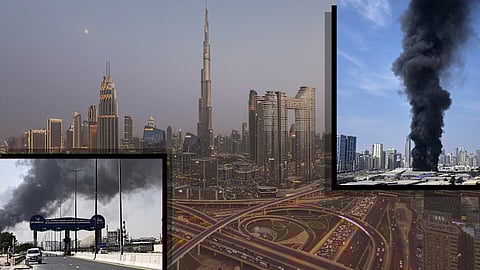
As the world grows more uncertain, clarity matters more than ever. BNC#8 brings together some of the smartest and most experienced minds to help you cut through the noise and navigate the turbulence with greater confidence. Tickets are selling out fast, with only 40 left. Don’t waste time, book your place at BNC#8 by clicking here or on the image below..Key topics:Iran missiles light up Dubai skies; panic spreads among residentsWar threatens Dubai’s reputation as a safe global business hubFlights halted, property deals freeze amid Gulf conflict fears.Sign up for your early morning brew of the BizNews Insider to keep you up to speed with the content that matters. The newsletter will land in your inbox every morning on weekdays. Register here.Support South Africa's bastion of independent journalism, offering balanced insights on investments, business, and the political economy, by joining BizNews Premium. Register here.If you prefer WhatsApp for updates, sign up to the BizNews channel here..By Simeon Kerr in Dubai.On Palm Jumeirah, the deluxe artificial island that symbolises the swagger of Dubai, tourists and residents alike have been watching missiles and interceptors illuminate the night sky, a spectacle a new arrival described as “something out of Star Wars”.So concerned were some guests by the threat posed by Iran’s bid to escalate its war with Israel and the US that one five-star hotel transformed its ground-floor ballroom into a makeshift dormitory.The streets rapidly emptied out in a city that has become a byword for economic dynamism over the past half-century, amid wailing sirens and frequent alerts to take shelter.Dubai Airport, normally the world’s busiest, cancelled thousands of flights after Iran’s initial attacks, although many stranded passengers have subsequently been repatriated in recent days.“This is new to me,” says a communications executive shocked by the thunderous sound of missile debris falling outside his balcony window. “Dubai always sold itself as the metropolis of peace and stability and it’s really being tested now.”Since the US and Israel launched the war a week ago, the United Arab Emirates, which for years has enjoyed spectacular success as a global entrepot, has been the target of about two-thirds of all ordnance fired by Iran across the Gulf.For years, the UAE’s brand — and that of Dubai in particular — was underpinned by its claim to be an island of stability in a dangerous neighbourhood. Tech billionaires, influencers and holidaymakers alike were pulled in by factors ranging from favourable tax treatment to winter sunshine and a location where east meets west, convenient for Europe, Africa and Asia alike..Read more:.FT: Iran executes Khamenei’s plan to spread regional war.But now the allure of Dubai is under threat, raising the question of whether its decades of extraordinary growth are in jeopardy.“This is an unprecedented moment in our history,” says a senior Dubai government official.Dubai’s travails are widely shared. Across the Gulf states, the war ignited by the US and Israel’s assault on Iran brought to life their worst fears: a conflict they cannot control that threatens to undermine their grand ambitions.Iranian attacks have also peppered military, infrastructure and energy targets in Saudi Arabia, Bahrain, Kuwait and Oman, confirming long-held fears that Tehran would lash out at its US-allied neighbours if the regime’s survival was at risk.The Iranian response threatens the ambitious plans of Saudi Arabia’s Crown Prince Mohammed bin Salman to revamp the region’s largest economy into a tourism and services destination — a drive largely inspired by the UAE’s successes — and his hopes of leading a region focused on development rather than conflict.But it is Dubai’s business model that has come under particular strain.The UAE’s multi-layered defence system’s interception of 93 per cent of more than 1,100 incoming missiles and drones has limited casualties and damage, and in recent days the streets of Dubai have become busier.While the attacks have claimed the lives of three people in the UAE, many residents see the Gulf state’s response as a successful outcome to a long-dreaded scenario.Nevertheless the direct strikes on civilian infrastructure, such as the Palm’s Fairmont hotel, have shattered any idea that Dubai is immune from the volatility of the Middle East.Images of the self-styled “seven-star” Burj Al Arab hotel in flames, caused by debris from a drone interception near the hotel, also reverberated around the world.Some expatriate residents are considering whether or not to stay and some have already fled.The property market has been halted in its tracks and exports have slowed to a crawl. In the event of a prolonged war in Iran, a country of 92mn people just a few dozen miles off the UAE’s coastline, some fear long-term damage to Dubai’s reputation — and way of doing business.“This economy is reliant on money coming in, so these events could be fatal,” says one corporate lawyer. “The myth is broken.” Historically, Dubai has benefited from regional instability and global crises — but this time the port city is at the centre of the storm.Transforming itself from fishing village to regional trade hub in the 1970s, the rise of Emirates airline — linking cities across the continents through its ever-expanding airport — kick-started a tourism industry that made Dubai the world’s sixth most visited city last year..In the aftermath of the 9/11 attacks in the US, funds from Muslim-majority nations flowed to the Gulf. Dubai opened its property market to foreigners, fuelling the city’s first real estate boom.The global financial crisis rattled the region in 2009, shrinking Dubai’s debt-strewn economy and prompting bailout loans underpinned by Abu Dhabi. But the influx of money and people precipitated by the Arab popular uprisings of 2011 boosted its economy further.When the coronavirus pandemic struck in 2020, the government locked down harder and reopened faster than others, fostering a relaxed, safe environment that attracted a new generation of newcomers: social media influencers, cryptocurrency investors and hedge fund managers.The war on Ukraine in 2022 brought Russians seeking sanctuary, while higher UK taxes lured a wave of wealthy residents and long-term residency programmes incentivised all foreigners to put down roots.For many such newcomers, the attacks have been a wake-up call — and a lesson on the region’s history and geography, even as services seek to return to normal, with Emirates promising to resume flights to all its normal destinations in coming days.The government has also set a goal of repatriating 20,000 stranded tourists.Nervousness in the expatriate community has been amplified by fear-mongering in hyperactive WhatsApp messaging groups. The UAE authorities are expected to crack down on those sharing videos regarded as compromising national security, according to one adviser.Wealth advisers say a split had emerged between recent arrivals to Dubai, including Britons who left after chancellor Rachel Reeves abolished the non-dom tax system, and longer-term expatriates, some of whom pledge to hang on in the city.Ashley Crossley, a partner at law firm Baker McKenzie, says newer arrivals from the UK were most concerned but were not yet considering moving back, given tax rates. Dubai imposes no income tax on individuals, investors or most companies.Instead, he predicted people would “wait and see”, then consider jurisdictions such as Italy, which offers a flat tax.Many recently arrived, ultra-wealthy residents are monitoring the situation, says one who had secured a departing flight earlier this week. “We are lucky to be able to sit this outside for the next few months before assessing whether to come back,” he says. “There are other options, such as Portugal or Italy.”Yet for every resident flying out, many more remain. Labourers from south and south-east Asia still toil on building sites across the country; white-collar executives working from home are watching the economic impact unfurl while organising online learning for their children.And while some Dubai residents are contacting private jet services to leave the emirate — facing bills of up to $250,000 to do so — others are trying to fly back in, to maintain their tax residency status.Large property transactions have already been put on hold, lawyers say, with potential buyers of one luxury villa plot demanding discounts of 20 per cent, with further renegotiation down expected.One of them has already received four requests from other buyers to cancel reservations on off-plan purchases.An institutional investor has withdrawn a bid worth hundreds of millions of dollars on a logistics park in Jebel Ali, the free zone next to the region’s busiest port that accounts for nearly a quarter of Dubai’s economy and was hit by an Iranian attack this week.Most residents reckon real estate prices could fall by a quarter to a third — a development that would be welcomed by many struggling to cover overinflated rents.Investors are allocating resources for distressed assets, with one preparing to pounce on single-family homes that see falls of 35 per cent from prewar valuations.Exports are “almost at a standstill”, with shipping avoiding the Strait of Hormuz chokepoint, says one consultant. Alternative routes outside the Gulf, such as Fujairah and Oman’s Salalah, have limited capacity.“Even if hostilities end, there will be a huge backlog to clear and a long-term impact on perceptions of reliability of supply,” the consultant says. Officials and executives both seek to maintain their optimism about the UAE’s long-term economic future.“We are the link between east and west, established markets and the global south,” says the Dubai official. “Anyone serious about growth knows that this is the place to be.”The UAE’s leaders are wandering around malls to encourage a return to normal life. A public service announcement delivered by a child actor explains that the “big booms” in the sky are “the sound of us being safe”.“The lesson to learn is that the UAE is good at crisis management — there has been no panic, just steady work to attend to stranded passengers,” said Abdulkhaleq Abdulla, an Emirati political analyst.“Safety is not the absence of threats — it is the ability to absorb them, intercept them, and protect civilian life,” added Zachary Cefaratti, founder of Dubai-based investment bank Dalma Capital. “In Dubai, you are seeing what security looks like when it is actually stress tested.”But many worry that, after the Gulf states have been dragged into a war they did not want, the US may fail to “finish the job” or start negotiations with Iran that leave them exposed, officials and advisers say.That could leave a wounded Iranian regime determined to rebuild arsenals and reassert itself across the Gulf.As the risk of protracted conflict grows, worries are growing about the extent of the expected economic downturn.“In addition to energy, there will be a halt on all other trade in between the GCC [Gulf Cooperation Council countries] and the world,” warns Qatari energy minister Saad al-Kaabi. “This will have a significant effect on the economies of the GCC and all the trading partners around the world.”Businesspeople in the Gulf expect a rerun of the Covid playbook in the UAE and beyond, including stimulus packages of expansionary spending, easier credit and reduced fees..Read more:.How a war on Iran could go spectacularly wrong: Ivo Vegter.The latest five-year growth surge has restored Dubai’s coffers, thanks to abundant real estate fees and sales and corporate taxes — with the federation also underpinned by Abu Dhabi’s oil-fuelled wealth.There are other policy levers that could be pulled. The UAE government in 2023 allowed gambling, an option taken up by the emirate of Ras Al Khaimah, where Wynn Resorts is developing a large casino — though Dubai has yet to approve any.“Casinos have always been an option for a rainy day,” says one senior expatriate. “And now it’s pouring.”And with large tracts of the economy under state control, the UAE should be able to sustain a short downturn, officials and executives argue. They are banking on their regionally dominant position in aviation, trade and finance to generate a rapid recovery — when peace returns.In addition, Abu Dhabi’s plan to deploy vast sovereign wealth and energy resources into AI data centres could allow it to build a dominant position in the next generation of technological development.V Shankar, chief executive of Dubai-based investment fund Gateway Partners, says the “exemplary response” to the crisis had made him more bullish on the emirate’s future.“Few places can rival their infrastructure and openness to global talent and capital,” he says. “This conflict will be viewed by future historians as even more of a defining moment than Covid.”.© 2026 The Financial Times Ltd.