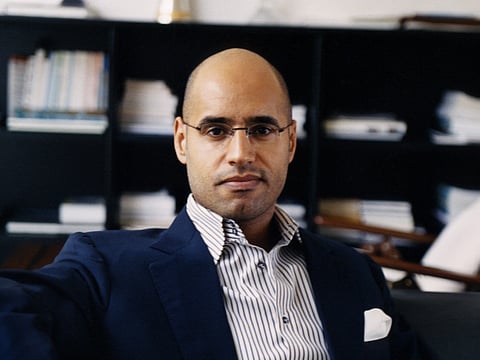
Key topics:Saif al-Islam Qaddafi shot dead in apparent assassination in western LibyaKilling underscores ongoing political violence since 2011 uprisingDeath may deepen power struggle amid Libya’s east-west divide.Sign up for your early morning brew of the BizNews Insider to keep you up to speed with the content that matters. The newsletter will land in your inbox at 5:30am weekdays. Register here.Support South Africa’s bastion of independent journalism, offering balanced insights on investments, business, and the political economy, by joining BizNews Premium. Register here.If you prefer WhatsApp for updates, sign up to the BizNews channel here..By Hatem Mohareb, Tarek El-Tablawy and Sherif Tarek.Saif Al-Islam Qaddafi, the son of ousted Libyan dictator Muammar Qaddafi, was shot dead, bringing a violent end to his years-long push to regain political influence in the North African OPEC member.An investigative team on Tuesday examined the 53-year-old’s body, ruling he died from gunshot wounds, the office of Libya’s chief prosecutor said in a statement. It didn’t give more details, but local media reports said he’d been killed in the town of Zintan, about 85 miles (137 kilometers) southwest of the capital, Tripoli.Libyan media cited a statement from Qaddafi’s political team that said four masked men attacked him in his home in a “cowardly and treacherous assassination.” One of his advisers in United Nations-backed political negotiations, Abdullah Othman Abdurrahim, also told Bloomberg in a message that Qaddafi had been killed..Read more:.Katzenellenbogen: What the fall of the Islamic Republic could mean.The shooting marks the latest political violence in a country that’s been wracked by unrest ever since a 2011 uprising, which was backed by the North Atlantic Treaty Organization, brought down his father’s regime of four decades.Following successive waves of militia fighting that drew in outside powers, Libya is divided between rival eastern and western governments. While there’s been no all-out conflict in years, tensions over control of state institutions and crucial energy revenue often threaten to spiral — a potential worry for Western oil majors who are returning to a country with Africa’s largest crude reserves.The head of Libya’s presidential council urged all to await the results of the official investigation and stressed the need to “reject incitement” that would undermine national reconciliation efforts.“Libya cannot be governed by violence nor built on fear and extrajudicial killings,” Mohamed al-Menfi said in a statement on the body’s Facebook page.Although he never held any official post, Saif al-Islam was a prominent and influential figure in the latter years of his father’s rule. In the 2000s, he was seen by some as a reformer who might tame the authoritarian excesses of his father, who led a police state, brooked no political opposition and was an outspoken foe of the US through the 1980s.Saif al-Islam earned a doctorate from the London School of Economics in 2008, though the achievement was clouded by plagiarism allegations. That same year he said he was withdrawing from state affairs and called for reforms to his father’s so-called Jamahiriya political system. Any hopes he’d bring real change were dashed with the 2011 revolt, when Saif al-Islam backed a no-holds-barred crackdown on protesters. The International Criminal Court in 2011 charged him with crimes against humanity, and in 2015 a Libyan court sentenced him to death in absentia for mass killings during the uprising.Libyan lawmakers later approved an amnesty law that allowed him to avoid execution by firing squad. Having been detained by a militia, he was freed in 2017 and then publicly reemerged in late 2021 with a bid to regain power by running in UN-backed presidential elections. He garnered some local support for his candidacy, which was also backed by Russia, although the vote was eventually canceled amid legal challenges and security concerns. In the aftermath, a feud brewed between Prime Minister Abdul Hamid Dbeibah, head of the internationally recognized government in Tripoli, and authorities in the east where military commander Khalifa Haftar holds sway.The younger Gaddafi never formally abandoned his goal of regaining clout. He loomed as a potential future player in Libyan politics, with a potent family name and some devoted followers. “In a country split in two, it’s a minority that has some weight,” Riccardo Fabiani, North Africa project director at the International Crisis Group, said of the rump Gaddafi supporters.While his father had many children, there’s no clear successor. One of Saif al-Islam’s brothers, Hannibal, was recently freed in Lebanon where he’d been jailed for a decade in connection with a notorious disappearance dating from their father’s rule in the 1970s..Read more:.Assassination of Hamas leader Haniyehin in Tehran stirs fears of all-out war in the Middle East.“There is now a pretty important constituency that has lost its leader and will struggle to replace him,” which potentially creates a vacuum that other Libyan actors can take advantage of, Fabiani said. It’s also possible leaders in eastern and western Libya will try to seize this opportunity to consolidate their control, he added..© 2026 Bloomberg L.P.