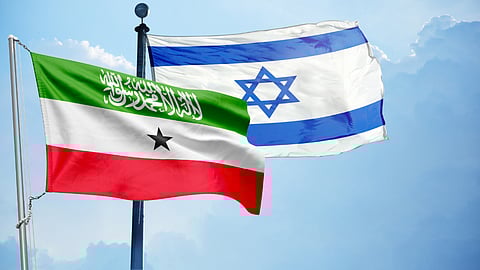
Key topics:Somaliland’s peaceful state-building contrasts with Somalia’s collapseIsrael’s recognition challenges decades of non-recognition policyDebate weighs regional risks against self-rule and democratic reality.Sign up for your early morning brew of the BizNews Insider to keep you up to speed with the content that matters. The newsletter will land in your inbox at 5:30am weekdays. Register here.Support South Africa’s bastion of independent journalism, offering balanced insights on investments, business, and the political economy, by joining BizNews Premium. Register here.If you prefer WhatsApp for updates, sign up to the BizNews channel here..By Nkanyezi Ndlovu*.Since the collapse of the Somali state in the early 1990s, Somaliland has followed a markedly different political trajectory from the rest of Somalia. While the southern regions descended into prolonged civil war, state failure, and extremist violence, Somaliland embarked on a locally driven process of reconciliation, governance-building, and political stabilisation. This divergence did not emerge overnight. It is rooted in historical grievances dating back to Somalia’s formation in 1960, when the former British Somaliland voluntarily united with Italian Somaliland to form the Somali Republic.That union, initially framed as a pan-Somali project of unity and brotherhood, quickly unravelled. Political power became increasingly centralised in Mogadishu, and northern regions experienced marginalisation, neglect, and later violent repression. By the 1980s, under the authoritarian rule of Mohamed Siad Barre, these tensions erupted into open conflict. The regime’s response, including aerial bombardment of northern cities and mass civilian killings, left deep scars. When the Somali central government collapsed in 1991, Somaliland’s leaders declared the dissolution of the union and reasserted sovereignty within the borders of the former British protectorate..Read more:.Premature recognition of Palestinian state rewards terror, not peace: Ivo Vegter.What followed stands in stark contrast to the chaos elsewhere in Somalia. Over three decades, Somaliland has built many of the core institutions of a functioning state: an elected parliament, a presidency chosen through competitive and democratic elections, an independent currency, its own security forces, and relatively stable civil administration. Despite limited resources and the absence of formal international recognition, Somaliland has remained comparatively peaceful - often described as an island of stability in the Horn of Africa.Yet recognition has remained elusive. International organisations and most states have prioritised Somalia’s territorial integrity, fearing that acknowledging Somaliland could encourage secessionist movements elsewhere on the continent. This position, while understandable, has come at a cost. Lack of recognition has constrained Somaliland’s access to international finance, limited its ability to enter formal security and trade agreements, and restricted its participation in global institutions, despite its demonstrable record of governance.Against this backdrop, Israel’s decision to recognise Somaliland as an independent state marks a significant diplomatic shift. The move carries both symbolic and strategic weight. Somaliland, notably, had a brief period of internationally recognised independence in 1960, during which it was recognised by several countries (including Israel) before voluntarily uniting with Somalia. From this perspective, Israel’s recognition is less an act of disruption than a reinstatement of a previously acknowledged political reality.Supporters argue that Israel’s decision reflects a values-based approach to foreign policy: rewarding democratic practice, institutional stability, and peaceful self-determination. From this view, recognising Somaliland is not about undermining Somalia, but about acknowledging the reality that three decades of separation, governance, and public consent cannot simply be wished away in the name of abstract unity.Critics, however, warn of regional repercussions. They argue that recognition could complicate relations with the African Union, unsettle fragile diplomatic balances, and provide propaganda opportunities for extremist groups such as Al-Shabab. These concerns merit serious consideration. Yet they also raise a fundamental question: how long should a population that has demonstrably governed itself peacefully be denied recognition because of fears rooted elsewhere?The reluctance of many states to recognise Somaliland often reflects their own internal anxieties about separatism rather than conditions on the ground in the Horn of Africa. In effect, Somaliland has been asked to pay the price for problems it did not create. Meanwhile, Somalia itself continues to struggle with insecurity and political fragmentation, despite sustained international engagement.Israel’s recognition also carries broader regional significance. It challenges the assumption that engagement between Israel and Muslim-majority societies must be mediated exclusively through long-standing regional power blocs. Somaliland is a Sunni Muslim society with strong local traditions and pragmatic leadership. The decision underscores the possibility of cooperation based on shared interests rather than ideological alignment alone.Practical cooperation in agriculture, water management, health systems, and technology could deliver tangible benefits to Somaliland’s population. These are not abstract diplomatic gestures, but areas where partnerships can materially improve lives, build resilience, and strengthen governance capacity. For Somalilanders, recognition is not merely symbolic; it opens pathways to trade, investment, and international legitimacy that have long been denied.Some analysts speculate about broader geopolitical calculations, including great-power competition in the Red Sea and Gulf of Aden. Somaliland’s strategic location undeniably attracts interest. Yet reducing recognition solely to geopolitics risks overlooking the agency of Somaliland’s people and the legitimacy of their long-standing aspirations.Ultimately, the question is not whether recognition carries risks - all diplomatic decisions do - but whether continued non-recognition is sustainable or just. After more than thirty years of effective self-governance, democratic practice, and relative peace, Somaliland represents a rare case in which reality on the ground diverges sharply from international legal formalism..Read more:.Israel’s justified self-defence: Double standards in the fog of war – Nicholas Woode-Smith.Israel’s recognition does not resolve all questions surrounding Somaliland’s status, nor does it guarantee regional stability. But it does force a necessary reckoning. It asks whether international diplomacy should remain frozen by precedent and fear, or whether it can adapt to evidence, outcomes, and lived political reality.Viewed through that lens, Israel’s decision is less a threat than an opportunity. Not only for Somaliland, but for a region in desperate need of pragmatic, forward-looking approaches to peace, governance, and self-determination..*Nkanyezi Ndlovu is a Zimbabwean international human rights activist with experience on migration, human rights and climate change matters.