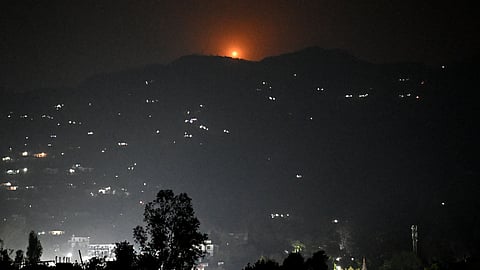
Key topicsIndia launched targeted strikes in Pakistan after deadly Kashmir attackPakistan vowed retaliation, calling the strikes an "act of war"Tensions rise but both sides show signs of avoiding full escalation.Sign up for your early morning brew of the BizNews Insider to keep you up to speed with the content that matters. The newsletter will land in your inbox at 5:30am weekdays. Register here.Support South Africa’s bastion of independent journalism, offering balanced insights on investments, business, and the political economy, by joining BizNews Premium. Register here.If you prefer WhatsApp for updates, sign up to the BizNews channel here..By Khalid Qayum, Faseeh Mangi and Anup Roy.India conducted targeted military strikes against Pakistan, which said it retaliated in expected tit-for-tat blows after a militant attack last month in Kashmir that killed 26 people.India said in a statement early Wednesday that it conducted “a precise and restrained response” that was “designed to be non-escalatory in nature.” The strikes hit seven locations, according to officials from both countries, and were the deepest breach of Pakistani territory since the 1971 war.New Delhi said it only targeted “known terror camps” and hit no Pakistani civilian, economic or military targets. A spokesman for Pakistan’s military told a briefing that eight Pakistanis were killed and several others wounded. Pakistan’s Ministry of Foreign Affairs called the strikes an “act of war.” Pakistani Defense Minister Khawaja Muhammad Asif said on Bloomberg Television his country’s military shot down five Indian jets. India’s Ministry of External Affairs didn’t immediately respond to requests for information. Earlier, India’s military said that Pakistan forces fired artillery into India-controlled portions of Kashmir. “These are not hostile acts — we are just defending our territory,” Pakistan’s Asif told Bloomberg Television. “We have been saying all along the last fortnight that we will never initiate anything hostile toward India,” he added. “But if India attacks, we’ll respond. If India backs down, we’ll definitely wrap up.”.India struck Pakistan beyond the disputed Kashmir territory, hitting seven locations — Bahawalpur, Muridke, Tehra Kalan, Sialkot, Bhimber, Kotli, Muzaffarabad — according to government officials from both countries.The question now is whether the conflict will escalate further. The last time the two sides came close to an all-out war was in 2019, after a suicide bomber killed 40 members of India’s security forces. India blamed Pakistan and responded about two weeks later with its first airstrikes on Pakistani soil since 1971. Pakistan retaliated by shooting down an Indian jet and arresting the pilot, who was later released. Tensions died down soon afterward..The action so far mirrors previous incidents, indicating a reluctance by the two sides to escalate the conflict, Rajeswari Pillai Rajagopalan, resident senior fellow at the Australian Strategic Policy Institute.“Things can go out of control, spin out of control,” she said. “That’s something that the political leadership on both sides are mindful of. But if you look at their repeated conflicts over the last three decades since both countries went nuclear in 1998, both sides have shown restraint.”India’s benchmark NSE Nifty 50 Index fell 0.7% in opening minutes of trading on Wednesday, before erasing the decline to trade little changed. The Indian rupee traded lower while bonds erased early losses.Financial markets will likely be jittery in the immediate aftermath of the military action, said Sonal Varma, an economist at Nomura Holdings. “That said, past episodes show that the market and economic impact of similar geopolitical events tends to be short-lived,” she added.The Indian National Congress, the country’s main opposition party, backed the military action, but refrained from calling for more strikes. .Pakistani Prime Minister Shehbaz Sharif on Wednesday called India’s actions a “cowardly attack,” while the nation’s Foreign Ministry released a separate statement saying that women and children died in the attack.“Pakistan has a full right now to respond in a befitting manner to the conflict imposed on us,” Sharif said in a statement. “The enemy won’t be allowed to achieve its goals.”.Read more:. Delhi’s political showdown: Modi’s rivals unite to unseat India’s PM.India said that National Security Advisor Ajit Doval briefed US Secretary of State Marco Rubio after the strikes. Rubio had sought to de-escalate tensions, speaking with both sides in recent days. India is currently engaged in trade talks with the US. US President Donald Trump, speaking in the Oval Office on Tuesday, called the situation “a shame.” “They’ve been fighting for a long time,” Trump said. “I just hope it ends very quickly.”Pakistan airspace was closed after the Indian strike, Pakistan International Airlines Corp. spokesman Abdullah Hafeez said in a text message..Ties between the nuclear-armed South Asian rivals have rapidly deteriorated in the wake of the Kashmir attack, which India has called an act of terrorism. Prime Minister Narendra Modi’s government had accused Pakistan of involvement and vowed to punish those responsible. Pakistan has denied any links to the attacks. India called its military strike “Operation Sindoor,” a reference to the sacred vermillion powder married Hindu women wear along their hairline. Survivors in the April 22 attack said that men were shot while their wives and children watched.Tensions had also escalated following the Kashmir attack after India suspended a long-standing Indus Waters Treaty, with Pakistan saying earlier in the day that India has almost entirely stopped the flow of water across the border through the Chenab river, which is crucial for farm irrigation. India and Pakistan are two of the world’s most acrimonious neighbors, and the long-running tensions between them center on the border region of Kashmir, an area in the Himalayas claimed in full — and ruled in part — by both. New Delhi, for decades, has been frustrated by what it sees as the Pakistan military’s support for terror groups that strike inside its territory.Skirmishes in the border areas have continued in the past few days and both nations took steps to show their operational readiness. Pakistan conducted surface-to-surface missile tests this week, highlighting its military might and India ordered mock drills across several states to ensure preparedness amid the standoff.Since achieving independence from Britain in 1947, India and Pakistan have fought several times over the disputed Himalayan region. The most recent prolonged fighting occurred in 1999, when Pakistani troops infiltrated Kargil, an Indian-controlled district in Kashmir. That lasted for several months until Pakistani forces withdrew from locations on the Line of Control, the de facto border..© 2025 Bloomberg L.P.