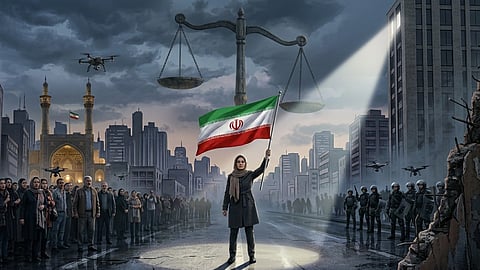
Key topics:Iran executes 1,639 people; most executions kept secretProtests met with deadly force; thousands killed and censoredSystemic repression sustains regime amid calls for democracy.Sign up for your early morning brew of the BizNews Insider to keep you up to speed with the content that matters. The newsletter will land in your inbox every morning on weekdays. Register here.Support South Africa's bastion of independent journalism, offering balanced insights on investments, business, and the political economy, by joining BizNews Premium. Register here.If you prefer WhatsApp for updates, sign up to the BizNews channel here..By Kenneth Moeng Kgwadi*.It is absurd that there are people who still see a future for the brutal, bloodthirsty Iranian regime, which has been in power since 1979. It is largely praised by outsiders with absolutely no idea of how the human rights of the locals have been neglected over the years. Capital punishment has been employed as a political tool to suppress and silence potential political opposition. It is safe to say that the 46-year rule of the Ayatollah regime has been defined and thrived on violence.According to the recently published 2025 Annual Report on the Death Penalty in Iran, prepared by Iran Human Rights (IHRNGO) with the support of ECPM (Together Against the Death Penalty), about 1,639 people were executed by the Iranian regime. Although it happens every year, it has come to be known that Iran is the largest ‘killer’ when it comes to capital punishment. However, what raises eyebrows is not only the fact that they have carried out the biggest killing spree in 2025, but that they wanted to conceal the real numbers by only officially announcing under 7% (113 executions) while 1,524 executions were never announced.These executed people have been accused by the Iranian regime of different counts of crimes, including security-related, rape, murder, drugs, and others. .Read more:.FT: Iran executes Khamenei’s plan to spread regional war.The numbers provided by the report show that at least 4 to 5 people were killed daily as a tool to instil fear among the Iranians. It is one of the most notorious mechanisms to control and rule the country, which has been in effect for many years. Following the popular movement (Women, Life, Freedom) in 2022 September, the number of executions surged each following year. This year’s execution figure was characterised by a dramatic increase from 979 in 2024 to a whopping 1639, which is a 63% increase. The fear of many people inside and outside Iran is the higher probability of killing even more people in the post-conflict period. More people will be accused of security-related crimes and not be given fair trials to be found guilty and executed by the Iranian regime. People cannot continue to be killed with such disregard for human life; they deserve far better than what their government is providing. To make matters worse, the Iranian regime carried out massacres across the country earlier at the beginning of this year when people took to the streets to protest against the visible economic collapse and poor governance. It was reported before the protests that Iran’s capital, Tehran, was not coping with water woes, which affected the lives and livelihoods of the middle class in that country. If this problem, which has come to affect South Africa too, can disorganise people in the big cities, what would happen to the most vulnerable who are on the outskirts of the country?At the time, before the US-Israel escalation with Iran, Human Rights Watch (HRW) reported growing evidence of mass killings in the country. While different media outlets cited varying fatality figures, what remains clear is that Iranian authorities used lethal force against protesters demonstrating over legitimate economic and social grievances. There is no justification for such senseless loss of life, and it must be condemned in the strongest possible terms. Due to systemic censorship and possible victimisation, the government hid the real figures of the Iranian protest, while the HRW and BBC News Persian revealed through their investigations that the total number of casualties stood at 6,872 protesters, which included more than 150 children. Unlike decent countries with democratic values, the Iranian government has not even committed to investigating the killing of the multitude of people they are supposed to be protecting from harm. Instead, they defended their evil actions by claiming that the protest was the work of a foreign influence, which was not completely true, as protesters raised genuine issues affecting them..Read more:.The Economist: Bereft of legitimacy, the reeling regime in Iran massacres its own people.It is fundamentally misguided to imagine that the Islamic Republic of Iran would hesitate to turn its coercive machinery against its own people. Its endurance over the past 46 years has not been accidental, but sustained through a calculated reliance on repression, intimidation, and the systematic silencing of dissent. Yet beneath this rigid façade lies a society that has repeatedly signalled its aspirations—Iranians, like citizens elsewhere, seek a political order grounded in democratic accountability, individual liberty, genuine opportunity, and constitutional governance. .*Kenneth Moeng Kgwadi is a political scientist.