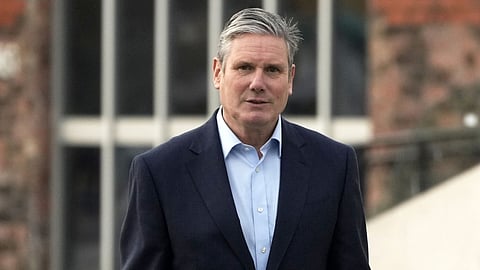
Keir Starmer, likened to Parliament's Ringo Starr, secured a strong Labour majority. Though lacking charisma, his mandate allows for long-term strategies to address the UK's post-Tory and Brexit challenges. Labour should cautiously implement policies, focusing on infrastructure, housing, and economic reforms, while gently revisiting Brexit relations and avoiding rash fiscal changes..Sign up for your early morning brew of the BizNews Insider to keep you up to speed with the content that matters. The newsletter will land in your inbox at 5:30am weekdays. Register here..Join us for BizNews' first investment-focused conference on Thursday, 12 September, in Hermanus, featuring top experts like Frans Cronje, Piet Viljoen, and more. Get insights on electricity and exploiting SA's gas bounty from new and familiar faces. Register here..By Mark Gilbert .___STEADY_PAYWALL___.Keir Starmer is Parliament's Ringo Starr. He may not be the best drummer in the world, but he's got the best band. After winning a landslide majority, what the Labour leader needs next is the equivalent of a two-album deal — basing his political strategy on the assumption that he'll win a second term, giving him 10 years rather than just five to reshape a nation damaged by 14 years of Tory misrule and still suffering the aftershocks of Brexit..Starmer lacks the charisma of Tony Blair or the magnetism of Boris Johnson. Apart from professing his love of football and asserting his working-class "my father was a tool maker" credentials, his campaign has left the electorate largely ignorant of his personality. But what he does have after last week's election is a thumping majority that even the most skeptical among Britain's commentariat must acknowledge gives him a mandate to make good on his promise to change the UK..The scorched economic and social earth left behind by the Conservative Party can't be replanted in a single season, or even five. The scale of Labour's majority gives it the luxury of time — and not just the hope but the expectation that the Tories are about to embark on the kind of savage infighting that will make the party unelectable once again at the next election, which will be at a time of Starmer's choosing..So it would be smart for Starmer and his cabinet — who, it should be said, are neophytes at running a country — to ease themselves into their newfound Westminster dominance, rather than embarking on the usual mad dash to deliver manifesto commitments in the first hundred days..Take, for example, Labour's pledge to build millions of houses to tackle the UK's accommodation shortage. Reforming the country's byzantine planning laws needs to be undertaken judiciously, or run the risk of unintended and undesirable consequences. And, as my colleague Matthew Brooker has pointed out, Britain's construction workforce is at its lowest level in more than two decades. Reskilling sufficient carpenters to work the wood, bricklayers to erect the walls and plumbers and electricians to install the pipes and wiring to build 1.5 million houses in the next half decade won't happen overnight..Britain's woeful underinvestment in infrastructure will take even longer to address. Revisiting previous disastrous Tory choices — like the decision to neuter the HS2 high-speed rail network that was designed to link cities in the North of England to London and each other — would probably be a waste of valuable political capital. But the water industry, for example, is clearly not fit for purpose in its current form. If Labour can spark a public discussion about taking some of the nation's utilities back into state ownership without invoking the communist demons of years past, the social fabric can start to be mended. .One of the worst examples of Tory mismanagement is the missed opportunity to make good on the promises of prime minister after prime minister to achieve so-called levelling up — harnessing the latent economic potential of manufacturers and service providers outside of London and the South East. Devolving more tax-and-spend powers to regional authorities, empowering local decisions made by local folk and shifting more of the apparatus of government departments out of the capital can deliver economic benefits to the country as a whole — provided the process is nurtured over several years. .Fiscal policies need to be recalibrated slowly so as not to frighten an electorate weaned on the admittedly hypocritical Tory attack line that Labour will steal from people's purses and wallets. Ending tax breaks for non-doms, making the levies on private equity fairer and possibly introducing a wealth tax can all be achieved without triggering capital flight — again, provided the policies are planned and explained in advance, with their aims and objectives clearly stated..Chancellor of the Exchequer Rachel Reeves will be acutely aware that any accounting sleight of hand, using what wriggle room there is to expand the scope for public spending and investment, must be carefully coordinated to keep the market vigilantes from smelling another Liz Truss moment. According to strategists at Barclays Plc, Labour could save £20 billion ($25.3 billion) a year by tweaking how losses on the bonds accumulated by the Bank of England via quantitative easing are dealt with — but any change mustn't undermine the central bank's independence. .The economy is already recovering from last year's brief and shallow recession, and inflation is back down to the government's 2% target; with the election out of the way and Britain looking like a beacon of political stability in a world gone mad, consumers and businesses look poised to increase spending and investment, boosting growth..Banking on 10 years in power would also give the Labour Party an opportunity to gently unwind the taboo around Brexit. Having ditched the European Union in the most unharmonious breakup imaginable, inveigling Brussels back into a relationship that's anything but an ice-cold post-divorce affiliation will take all of the government's seductive powers. Rejoining the EU will remain the love that dare not speak its name for at least the duration of the current parliament; Starmer said last week he doesn't envisage membership of the EU, the single market or the customs union happening in his lifetime. But five years is a long time in politics; in the next parliamentary session, those of us who voted to remain can hopefully start to dream of a rapprochement..Read also:.🔒 'Restless' Keir Starmer and his new Labour cabinet🔒 FT: Keir Starmer hails historic Labour victory as Conservatives sink to worst-ever result🔒 Keir Starmer's character is as Elusive as his policies: Martin Ivens.© 2024 Bloomberg L.P.