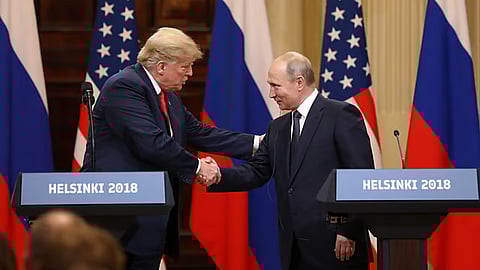
Key topics:Trump’s deadline to Putin risks empty threats and global credibility lossEconomic pressure, not military action, is the main US tool against RussiaSecondary sanctions could backfire, straining US ties with China and India.Sign up for your early morning brew of the BizNews Insider to keep you up to speed with the content that matters. The newsletter will land in your inbox at 5:30am weekdays. Register here.Support South Africa’s bastion of independent journalism, offering balanced insights on investments, business, and the political economy, by joining BizNews Premium. Register here.If you prefer WhatsApp for updates, sign up to the BizNews channel here..By Andreas Kluth.An anecdote springs to mind as the world awaits the passing of a deadline — shortened from 50 days to 10 and coming up this Friday — which President Donald Trump recently gave to his Russian counterpart, Vladimir Putin. It comes from the late George Schultz, who as secretary of state in the 1980s told the story to his boss, Ronald Reagan, the original purveyor of “peace through strength” in foreign policy.Once when he was in Marine Corps boot camp, as Shultz recounted, a sergeant handed him his rifle. “This is your best friend,” sarge told the young Shultz; “and remember one thing: never point this rifle at anybody unless you’re willing to pull the trigger. No empty threats.”He harped on it with Reagan, Shultz elaborated, to show that “we need to be very careful in what we say.” If the US draws a red line, sets an ultimatum or simply declares something or other to be unacceptable, it is in effect pointing the world’s largest rifle. If the adversary ignores this gesture “and you don’t do anything, nobody pays attention to you anymore.” No more strength, and probably not much peace.Trump has a complicated relationship with deadlines. He doles them out liberally, whether the subject is tariff bargaining, TikTok’s survival in the US, Iran’s nuclear program or, as now, Putin’s willingness to agree to a ceasefire in Ukraine.In the case of trade, Trump has been equally liberal in adjusting those deadlines (inspiring the stock-market meme that Trump Always Chickens Out). In Iran, by contrast, he pointed his metaphorical rifle in April with a 60-day deadline, and when that expired — the US and Iran were still negotiating but Israel was already bombing — he did pull the trigger, with surgical but huge strikes on Iran’s nuclear sites.But Iran, whether or not it was actively developing nukes, did not yet have any, whereas Russia has the world’s largest stockpile of atomic weapons. So pointing a military rifle at Putin, and risking war between the US and Russia, is “not even a fathomable thing,” says Marco Rubio, the national security advisor as well as secretary of state. A bizarre but brief digression, in which Trump traded veiled nuclear threats with a peripheral Russian official, in effect proved that point.The rifle, for now, can only be economic, and even that opens up a lot of scenarios. Andriy Yermak, a top Ukrainian official, suggests imposing “a full economic blockade.” Another idea would be seizing Russian currency reserves held abroad and giving them to Ukraine. None of those steps, however, is likely to impress Putin, who has already incurred about a million Russian casualties since 2022, as well as reams of Western economic punishments. .Read more:.Putin’s long game: How Trump’s Iran focus hands Russia the upper hand in Ukraine - Marc Champion.Aware of these limitations, Trump is eying another economic weapon, secondary sanctions. Those are tariffs imposed on third countries that continue to buy Russian oil, gas and other exports, thus funding its war machine. The president’s inspiration came from a bipartisan bill in the Senate that allows for draconian secondary tariffs of 500%; Trump has mentioned a more modest but still hefty 100%.The problem is that such sanctions, while aiming at Russia, would hit other countries, primarily China and India, the main buyers of Russian hydrocarbons. And neither of them has a mind to blink either.China considers the US its main geopolitical antagonist and has partnered with Russia (and other countries) to present an increasingly coordinated front. It has also stared down Trump’s other tariff threats, promising to retaliate in kind. In a way, Beijing has pointed its own rifles and seems to have learned Shultz’s lesson.India is in a different but similar situation. It has maintained close ties with Moscow for decades, even if it has recently moved somewhat closer to the US. Washington placed high hopes in the so-called Quad, for instance, a quasi-alliance among the US, India, Australia and Japan that is meant as a balance against Chinese power in the Indo-Pacific. And for a while Prime Minister Narendra Modi, a populist strongman, had good chemistry with Trump.That comity is gone now, as Modi has turned defiant in the face of Trump’s trade harassment generally — the US just slapped a levy of 25% on India’s exports — and the threats of secondary tariffs specifically. As a byproduct of pointing its economic rifle at Russia, the US now seems caught in an escalation spiral with a country that was supposed to become its ally.These complications have turned into a big geopolitical hairball as Trump dispatches his special envoy, Steve Witkoff, to Russia for talks ahead of the Friday deadline. For months, Trump was eager to give Putin the benefit of the doubt. That was a mistake that Reagan and Shultz would not have made, because Putin never deserved the goodwill of America, or anybody.Now the US is in the awkward position of having to point its rifle at not only Russia but also China and India, and then probably discovering that all three will ignore the gesture. Once that happens, what next? Washington could do nothing, and look weak. Or it could point an even bigger rifle, which it does not want to use. I believe that Shultz would agree with me when I say that the situation looks bad..© 2025 Bloomberg L.P.