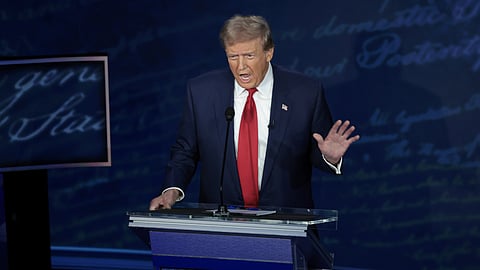
Donald Trump's claim during the U.S. presidential debate about Haitian immigrants eating pets in Ohio has sparked a media frenzy, overshadowing more critical topics like healthcare and immigration policies. Experts say the narrative shift, fueled by misinformation, has allowed Trump to dominate media attention despite the implausibility of his statements. His tactics effectively redirect focus from key issues, frustrating Democratic strategists while galvanizing partisan divides, as political discourse revolves around viral, emotional stories..Sign up for your early morning brew of the BizNews Insider to keep you up to speed with the content that matters. The newsletter will land in your inbox at 5:30am weekdays. Register here..By Joshua Green.It's doubtful anybody anticipated that the enduring story coming out of the Sept. 10 US presidential debate would be a hair-raising piece of misinformation: Donald Trump's claim that Haitian immigrants in Ohio are eating their neighbors' dogs and cats. .___STEADY_PAYWALL___.But a week after more than 67 million people tuned in to watch Trump and Kamala Harris square off on a Philadelphia debate stage, the charge has sparked hundreds of stories and additional news cycles, as partisans fight over the validity of the claim and reporters swarm Springfield, Ohio, to document the local fallout. Trump's struggles during the debate to explain his views on abortion or elucidate his "concepts of a plan" to replace Obamacare have been mostly forgotten..A rational-minded debate viewer might have assumed that Trump's charge about migrants kidnapping and eating pets would boomerang and hurt him with the swing-state voters he needs to win the election. But experts on misinformation say that's not how it generally works. "The vast majority of people don't follow day-to-day political news," says Jiore Craig, a senior research follow at the Institute for Strategic Dialogue who studies misinformation. "Their impressions are formed a week or two later based on what everyone is talking about. Trump's 'cats and dogs' line and Taylor Swift's endorsement of Harris are what's taking up most of the oxygen.".Read more: How Donald Trump has paved the way for future demagogues: Francis Wilkinson.One way researchers track the effect of misinformation is through "share of voice," which refers to the proportion of the total news coverage or social media presence that a particular story holds compared to other ones..Although it's difficult to measure precisely, a good proxy for political news is what's being talked about on the Sunday shows. On Sept. 15, Trump's wild allegations of pet-eating were a major topic, and his vice presidential nominee, Ohio Senator JD Vance, was keen to defend them, even if untrue. "I've been trying to talk about the problems in Springfield for months," Vance said on CNN, referring to the effect of Haitian migrants on the city. "The American media totally ignored this stuff until Donald Trump and I started talking about cat memes. If I have to create stories so that the American media actually pays attention to the suffering of the American people, then that's what I'm going to do.".Vance in June. Photographer: Eva Marie Uzcategui/Bloomberg.From the outset of his political career, Trump has shown a talent for reprogramming the news narrative. In 2016 many media outlets were willingly complicit, racing to cover his latest tweet or broadcast a live feed of his press conference. After the 2020 election and the assault on the US Capitol by hundreds of Trump supporters, most news organizations adopted a more careful approach to covering him..But Trump is showing that even these guardrails can't prevent him from dictating news coverage, even if much of it is unflattering or openly critical. Democratic strategists point out that Vance was amplifying claims about Haitians eating pets before the debate. One researcher who tracks misinformation noted that on the night of the debate, Eric Trump, one of the president's sons, shared artificial intelligence-generated images of a tough-looking Trump surrounded by cats and geese, with the hashtag #PetsForTrump—raising the question of whether Trump's claim was preplanned and not a gaffe.In an emailed statement, a Trump campaign spokesperson said the former president is seeking to raise awareness of immigration issues in Ohio. She cited rising rent costs, strains on public health and education services, and threats to public safety, but she did not address Trump's claims about pets. "The media continues to try and distract the American people from the very real problems plaguing the residents of Springfield," she wrote..On Monday details spread about the man caught lurking outside Trump's Palm Beach golf course with an AK-47-style rifle and what the FBI says were plans to assassinate the former president. Trump didn't pause before attempting to shape this story, too, to generate maximum controversy and political benefit. He claimed, once again without evidence, that Harris' criticism of him had inspired the would-be killer.."Trump has been the master of earned media and attention since 2016," says Erik Nisbet, a professor of policy analysis and communication at Northwestern University who studies misinformation. "It's hard to know if he planned this or not. But it does shift the narrative away from abortion, away from 'concepts of a plan'—and it shifts the media gaze, too, whether it's true or not.".Many experts suspect that altering the media narrative around the presidential race, which had previously focused on Harris' positive momentum since becoming the Democratic nominee, was indeed the rationale for Trump's pet-eating claim. "The fact that they've doubled down on it says to me that they think it's useful to them," says Craig. "Whether or not it's ridiculous or offensive, he wants us talking about immigration.".Read more: 🔒 Trump is right about World War III, wrong about the analysis: Andreas Kluth.Among allies and opponents, Trump is also well-known for insisting that news revolves around him. Harris' lengthy political honeymoon following her ascension to the top of the ticket in late July was a rare extended period in recent political history where news was largely focused elsewhere. "One consequence of his pets comment was that he's recentered himself and his top issue in the conversation," says Sasha Issenberg, author of The Lie Detectives, a new book on the global rise of misinformation and the efforts to combat it..Although Democrats have delighted in sharing the countless memes and videos that have flooded social media to mock Trump's alleged ignorance—like this one—Harris' campaign has notably abstained, a sign that her strategists don't view it as a helpful development. Neither of the two ads that her campaign released using debate footage featured Trump talking about dogs or cats..But moving on may not be easy. Controversial stories tend to endure—even stories that are quickly disproved, like the Haitian pets story—because universally trusted sources of authority have all but disappeared. "Misinformation itself has been politicized," says Matt Oczkowski, a Republican strategist who was Trump's lead data adviser on his 2016 and 2020 campaign. "If you're a liberal, the experts you're looking to for guidance are different from the experts you look to if you're a conservative.".Whether or not Trump's comments about Haitians eating pets were planned, and whether or not they're helping his campaign, are both hotly contested questions. They didn't alter the widespread perception that Harris won the debate. They haven't eliminated her narrow lead in most polls. But political coverage has shifted in a direction Republicans prefer (82% named immigration as a top issue in a Sept. 9 Pew poll), taking airtime away from issues such as abortion and health care that are top for Democrats (76% and 67%, respectively). And Harris, despite general agreement that she prevailed in Philadelphia, doesn't appear to have pulled further ahead in the polls as a result..But even viral stories that arouse heated emotions across the political spectrum don't last forever. Eventually, something else replaces them. That's the nature of the news cycle..Read also:.🔒 The Economist – Lexington: Kamala Harris makes Donald Trump look out of his depthTrump's tariff plan could drive up prices, experts warn🔒Trump's debate defeat signals GOP's decline – Timothy L. O'Brien.© 2024 Bloomberg L.P.