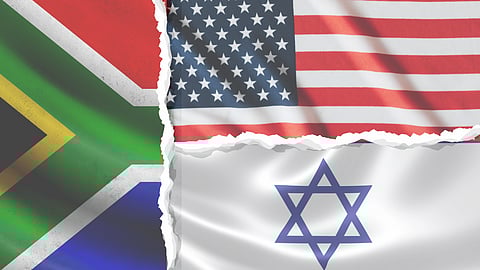
Key topics:US bill proposes aid freeze over South Africa’s anti-Israel actionsTargets SA officials with sanctions under Global Magnitsky ActAims to reshape SA foreign policy through financial pressureSign up for your early morning brew of the BizNews Insider to keep you up to speed with the content that matters. The newsletter will land in your inbox at 5:30am weekdays. Register here.Support South Africa’s bastion of independent journalism, offering balanced insights on investments, business, and the political economy, by joining BizNews Premium. Register here.If you prefer WhatsApp for updates, sign up to the BizNews channel here.The auditorium doors will open for BNIC#2 on 10 September 2025 in Hermanus. For more information and tickets, click here..By Kerry Lanaghan.On 17 June 2025, Congressman Greg Steube introduced House Resolution 4051, the Addressing Hostile and Antisemitic Conduct by the Republic of South Africa Act of 2025. The bill, currently under consideration by the House Committees on Foreign Affairs and the Judiciary, proposes a set of punitive measures in response to what it characterises as sustained diplomatic and legal hostilities by South Africa against Israel and the global Jewish community.Key findings and policy rationale The bill asserts that the South African government has engaged in repeated misuse of international legal mechanisms to unfairly target Israel, allegedly advancing politically motivated and antisemitic narratives under the guise of international law. It also accuses South Africa of aligning with authoritarian regimes and actors deemed hostile to U.S. interests. Citing these developments, the bill calls for the US withholding direct financial assistance to South Africa unless certain conditions are met.Provisions of the Bill Suspension of direct assistance: The legislation mandates a freeze on all direct US government assistance to South Africa unless the US Secretary of State certifies that South Africa has:Ceased support for legal actions that unfairly target Israel or Jews.Implemented meaningful anti-corruption reforms.Constructively engaged with US diplomats on legal standards and minority protections.Notably, this restriction excludes humanitarian aid and public health initiatives administered by non-governmental organisations.Targeted sanctions: The bill directs the President to impose sanctions under the Global Magnitsky Act against current or former South African officials who:Promote antisemitic policies or rhetoric.Abuse international courts or platforms to attack Israel or Jewish individuals.Commit acts of gross corruption, especially those involving misuse of US aid.Reporting requirements: The Secretary of State is required to submit a comprehensive report to Congress within 90 days of the Act's passage. This report must outline all diplomatic and legal actions by South Africa over the past five years that target Israel or Jewish institutions, along with a breakdown of all US assistance to South Africa. Updates to this report are mandated annually for the next three years.Termination clause: The suspension of assistance and sanctions may be lifted if the President certifies that South Africa has ended politically motivated legal actions against US allies, reformed institutions to prevent further abuses, and improved cooperation with the US and its democratic partners.Clarifying scope: The bill explicitly states that it does not prohibit diplomatic engagement, private humanitarian aid, or affect unrelated trade agreements or tariffs.Implications If enacted, H.R. 4051 could significantly alter the US-South Africa bilateral relationship, particularly by tying financial and diplomatic engagement to South Africa’s stance on Israel and its use of international legal forums. The bill reflects growing congressional frustration with South Africa’s global advocacy against Israeli policies, particularly at forums like the International Court of Justice. It also underscores the US legislature’s broader strategy of leveraging aid and sanctions to influence foreign policy alignment.The bill's strong language and sweeping scope suggest it is more than symbolic - should it advance, it may have tangible repercussions on South Africa’s foreign policy posture, aid-dependent sectors, and broader diplomatic relations with Washington.