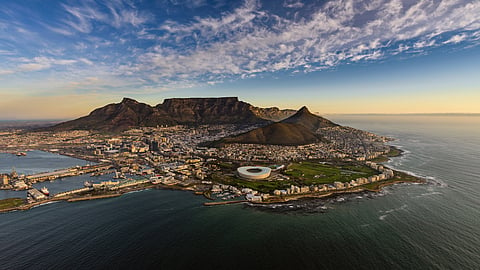
Key topics:US ambassador Bozell arrives amid tense US-South Africa relations.Cape autonomy could anchor pro-Western stability in Southern Africa.Somaliland recognition signals shift toward decentralised African governance..Sign up for your early morning brew of the BizNews Insider to keep you up to speed with the content that matters. The newsletter will land in your inbox at 5:30am weekdays. Register here.Support South Africa's bastion of independent journalism, offering balanced insights on investments, business, and the political economy, by joining BizNews Premium. Register here.If you prefer WhatsApp for updates, sign up to the BizNews channel here..By Robert King*.America’s long-awaited ambassador to South Africa, Brent Bozell III, has arrived at an unusually consequential moment. Unlike most ambassadors - whose names few South Africans, even politically engaged ones, could readily recall - Bozell steps into a country where US-South African relations sit at the centre of domestic political debate.He also arrives as ambassador to what is still, at least for now, the most important country on the African continent. Yet Africa itself is entering a period of potential realignment. Despite the postcolonial elite’s determination to preserve inherited borders, the continent may be approaching another moment of territorial change, as political realities on the ground begin to assert themselves for the first time since South Sudan’s independence fifteen years ago.On 26 December 2025, Israel became the first UN member to recognise the Republic of Somaliland. The reaction was revealing. Many of the same voices that loudly demand recognition for Palestine - recognised by 157 countries despite lacking several core attributes of statehood - responded with outrage to the recognition of a polity that has functioned independently and successfully for more than three decades, particularly when compared to its neighbours.The question now is not whether another country will recognise Somaliland, but when - and which one.America is the most frequently cited candidate. While President Trump has reportedly dismissed the idea for now, prominent figures within his political orbit, including Senator Ted Cruz, have been outspoken in their support for American recognition. If this momentum continues, it could trigger a domino effect across Africa’s weaker states, encouraging regions seeking greater self-government and insulation from dysfunctional central authorities to follow Somaliland’s example..Read more:.Imagine the Western Cape with federalism: Prosperity through autonomy – Woode-Smith.South Africa may not yet be a failed state - but it has experienced repeated episodes of state collapse, and the prospect of it eventually achieving such status has been widely discussed. Crime rates rank among the highest on Earth. Unemployment hovers above 30 percent. Economic growth is anaemic. The military is a husk - over 95 percent of the Air Force is grounded - and the army was badly exposed in the Congo by militias from a country one-fiftieth its size. Johannesburg, once the “City of Gold,” is now stripped for copper wiring by addicts. The decline is evident for all to see.The ANC’s loss of its majority in last year’s election and the subsequent formation of a Government of National Unity - padded with more centrist, ostensibly pro-Western parties - proved to be little more than moving the deck chairs on the Titanic. If South Africa’s pro-Western communities are to survive politically and economically, it will be through a far more decentralised order. A decisive factor in that future will be what happens to the Cape.Home to Cape Town, the Cape has for centuries been defined by its position along the Cape Sea Route - one of the main arteries of global trade. The first European settlers arrived barely 30 years after the Mayflower dropped anchor in America. That shared Atlantic heritage is no historical footnote; it shaped a culture, politics, and economy far closer to the Western world than to the ANC’s ideological experiments.Today it remains one of the few regions in South Africa still governed - imperfectly, but recognisably - by competence, meritocracy and functioning institutions.Freed from much of the dead weight of Pretoria, the Cape could anchor a new pro-Western order in Southern Africa - securing one of the world’s busiest trade routes, providing a stable base for commerce into the continent, and aligning its economic and regulatory policy far more closely with Western markets and standards. .This is not merely in the Cape’s interest. It is in America’s.South Africa’s ideological rigidity is nowhere more apparent than in its 2025 trade clash with the Trump administration - a dispute that ended with Washington imposing 30% tariffs on South African goods. In an era of American protectionism, the severity was striking: neighbouring states left the table with tariffs of 10–15%. Pretoria earned double that through sheer obstinacy.When an Afrikaner delegation visited Washington in June to try and resolve the impasse, they found the Americans’ trade conditions straightforward:● Treat farm attacks as a priority crime, with the same urgency as rhino poaching or cash-in-transitheists.● Publicly and unequivocally condemn “Kill the Boer, Kill the Farmer” in any form.● Guarantee no land seizures without fair market compensation and full legal process.● Exempt American companies from race-based laws such as BEE.Pretoria would not move. To the ANC, these points are not policy debates but articles of faith. In the country that invented DEI before the acronym existed, ideological purity still outweighs national self-interest - a sentiment faithfully echoed in regime-friendly newsrooms.Now imagine those same talks with a self-governing Cape exercising full control over its economic and regulatory frameworks. None of these points would even be up for debate; they would already be embedded in law and practice. The Cape would meet Washington as a partner, not a problem: an investor-friendly economy with strong property rights, predictable governance, and a comparatively well-educated workforce. In a continent often hostile to Western business, the Cape would be America’s secure southern gateway.Cape autonomy need not be an isolated initiative. It could form the southern pillar of a broader American strategy to anchor reliable partners at Africa’s maritime gateways. In the north, a US-recognised Somaliland stands watch over the Gulf of Aden; in the south, a highly autonomous Cape could perform a similar stabilising role at the Cape of Good Hope. Between these points, Washington could advance its new “trade not aid” policy for Africa. Where Democrats relied on NGOs to project influence - and export their ideological agenda - the Republicans could achieve the same reach by incentivising concessions and special economic zones. Placed in key African ports and cities, these hubs would bypass corrupt central governments, open markets to private enterprise, and make it easier for American companies to operate on the continent. The result: strategic depth for America and its allies, and secure platforms for trade, humanitarian access, and technological cooperation in a region that will define much of this century’s geopolitical contest..Read more:.Woode-Smith calls for federal autonomy: SA’s need for decentralised governance.America cannot impose order on Africa - and history suggests it should not try. But it can support decentralisation, accountable governance, and regions that demonstrate competence and alignment with Western norms. In places like Somaliland and the Cape, Washington has the opportunity to reinforce stability by empowering those already building it. The question is not whether America can afford to support greater autonomy in the Cape. It is whether it can afford to ignore it..*Robert King is a Politics, Philosophy and Economics student and executive committee member at the Cape Independence Advocacy Group.