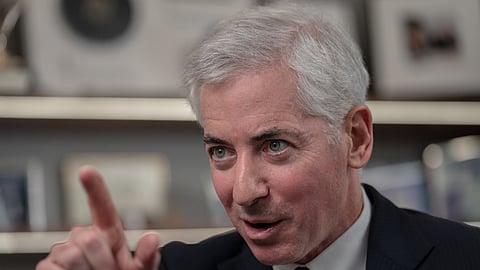
Bill Ackman is betting big on a 1,200% profit from Fannie Mae and Freddie Mac stocks, expecting the Trump administration to privatise the mortgage giants. After a 227% surge since Trump's election, Ackman sees a public offering in 2026, but critics warn of legal and financial hurdles that could undermine the trade..Sign up for your early morning brew of the BizNews Insider to keep you up to speed with the content that matters. The newsletter will land in your inbox at 5:30am weekdays. Register here..The seventh BizNews Conference, BNC#7, is to be held in Hermanus from March 11 to 13, 2025. The 2025 BizNews Conference is designed to provide an excellent opportunity for members of the BizNews community to interact directly with the keynote speakers, old (and new) friends from previous BNC events – and to interact with members of the BizNews team. Register for BNC#7 here..By Scott Carpenter, Norah Mulinda and Katherine Burton ___STEADY_PAYWALL___.Two months after the US election, the most spectacular of all Trump trades isn't Bitcoin, Tesla Inc. or any other likely suspects. Rather, it's shares of a stodgy, 87-year-old company many on Wall Street had forgotten about long ago. .The Federal National Mortgage Association, the government-backed home loan giant better known as Fannie Mae, has soared 227% since Trump's election. And it's done so in large part due to the promotion of one man: Bill Ackman..Ackman, the founder of Pershing Square Capital Management, called this moment an "extraordinarily compelling" opportunity to scoop up shares of Fannie Mae and rival Freddie Mac on the cheap before the US government unwinds its massive stakes in the companies, acquired as part of a roughly $190 billion bailout during the financial crisis. After a late December social media post laying out his case for the trade, the stocks skyrocketed 45% in less than an hour, and have continued to climb..Ackman has tried this gambit, unsuccessfully, before. Over a decade ago, his hedge fund bought hundreds of millions of dollars worth of Fannie and Freddie shares, betting the firms would surge in value once restructured and released from US oversight, technically known as conservatorship..Efforts to privatise them, though, have been slow-moving. There's complexity in the government's gargantuan stakes in the two companies. There's the risk of botching what would be one of the world's largest-ever initial public offerings, and of saddling homebuyers with higher mortgage rates. And there's no guarantee that the incoming administration will make it a priority..Read more: 🔒 Trump assembles business-heavy team for new administration .Still, Ackman says, the Trump team's renewed vow to shrink the role of government will help finish what his first administration started in releasing Fannie and Freddie. What's more, Biden officials just last week released a roadmap for the end of federal supervision, another sign, some say, that a resolution is around the corner..Just how much does Ackman expect to make? A lot..He predicts Fannie and Freddie will be taken public late next year at around $31, or almost 1,200% above his roughly $2.40 average purchase price, according to his post on X. Fannie closed Tuesday at $4.55, while Freddie ended the session at $4.40.."Trump and his team will get the job done," Ackman wrote. "Trump likes big deals and this would be the biggest deal in history.".A spokesperson for Ackman declined to comment..I am often asked for stock recommendations, but generally don't share individual names unless I believe the risk versus the reward is extraordinarily compelling.As we look toward 2025, one investment in our portfolio stands out for large asymmetric upside versus downside so I…— Bill Ackman (@BillAckman) December 30, 2024.Others, however, say not so fast. An initial public offering in 2026 is wildly optimistic, they warn. Nor is it a sure thing that key officials in the new administration will prioritize the project. Ending the government's stewardship would hand a major victory to hedge funds while potentially raising borrowing costs for homebuyers already facing sky-high prices — a tough sell to ordinary Americans.."It's unclear to me why the incoming administration would prioritize ending the conservatorships when it won't obviously benefit its base of working class voters," said Donald Layton, the former chief executive officer of Freddie Mac. "In fact, not only will its extreme complexity unduly take scarce policymaker time away from other priorities, it has a real risk of hurting those very voters by making their mortgages more expensive.".While Fannie and Freddie would appear to be unlikely poster children for the speculative surge that's boosted various assets after the former president's election win, they are, in some ways, the quintessential Trump trade. His populist platform included making the US government smaller and deregulating the private sector, after all..Fannie was established in 1938 by Congress to help boost homeownership by making mortgages more available. It doesn't actually make home loans, but, along with smaller rival Freddie — created in 1970 — buys them from lenders, wraps them into securities and financially guarantees them to buyers..In 1968, Fannie was converted into a private company, yet Washington's implicit backstop remained. Leading up to the financial crisis, the two government-sponsored enterprises expanded their presence in the mortgage market, owning or backing roughly half of all US home loans. When those investments soured in 2008, the Treasury effectively bailed them out, getting the equivalent of an 80% stake in the two in return. By 2010, the pair were de-listed from the New York Stock Exchange, and currently trade over-the-counter..As the housing market recovered, so did Fannie and Freddie's financials, with Fannie reporting a net income of $17.2 billion in 2012. The same year, the government enacted a controversial plan, later dubbed the "net worth sweep," to remit virtually all of the companies' profits to the Treasury..Beginning around 2013, numerous money managers, including Pershing Square, Fairholme Capital Management, Paulson & Co. and others started loading up on the GSEs' common and junior preferred shares, wagering in part they could convince the courts that the government was collecting an unwarranted windfall. But their lawsuits were repeatedly batted down..Some firms previously active in the trade, including Blackstone Inc., have fully exited their positions..Others continue to own significant stakes in the two companies. They include Capital Group, an asset manager that oversees more than $2.7 trillion and owns common and preferred shares in the entities. Owl Creek Asset Management, which bought preferred shares in Fannie Mae and Freddie Mac for pennies on the dollar back in 2008, has been trading around the position ever since, according to a person familiar with the matter who asked not to be identified citing private information..Rob Citrone's $2.5 billion Discovery Capital Management has owned Fannie and Freddie preferreds for more than 10 years, according to an investor in the fund, buying them for anywhere from 4 cents to 12 cents. The firm purchased some right before the 2024 election, in anticipation of a Trump victory..PointState Capital, a hedge fund run by Zach Schreiber, is also a holder of the preferreds, according to people familiar with the firm. John Paulson, who has been a large owner of the GSEs since the financial crisis, still owns the preferred shares, according to a person familiar with the matter..A Paulson spokesperson had no immediate comment. .Those that stuck with the bet would eventually pin their hopes on Trump and his officials taking the companies out of conservatorship. While that didn't pan out during the Trump administration's first term, enthusiasm is running high that privatization will be a priority during his second stint in the White House. .Former Trump administration officials have discussed plans for the two companies, and Republican Representative Scott Fitzgerald from Wisconsin has written draft legislation that would privatize the firms. .While exact plans will only become clear once Trump takes office, proponents point to the fact that the president-elect wrote a 2021 letter to Kentucky Senator Rand Paul, in which he stated that he would have ordered the release of the companies from conservatorship and sold the government's holding in the entities at a "huge profit.".'Massively Diluted'.Ackman laid out a two-year timeline for the government's exit in his post in late December. In his scenario, the Treasury would count the distributions it's gotten in recent years as payment on the senior preferred shares it received from the bail outs, effectively retiring the securities. The two companies would then need to raise about $30 billion combined to reach a capital ratio of 2.5% of guarantees outstanding, a significant sum, but one widely seen as feasible..He predicts the US government would make a profit of about $300 billion when all is said and done..But the path to privatization is littered with potential obstacles. The idea of retiring the government's senior preferred shares was considered a political "nonstarter" when it was weighed during Trump's first administration, and risked legal peril, Mark Calabria, the director of the Federal Housing Finance Agency under Trump who sought to unwind the government's stakes in Fannie and Freddie, wrote in a 2023 book..An alternative privatization scenario involves the Treasury converting its senior preferred shares into common shares, and then gradually selling. That would cause existing holders to face significant dilution, according to Michael Kao, the former chief executive at Akanthos Capital Management who now runs a family office.."The main bull thesis rests on government largesse and its willingness to write down hundreds of billions of dollars," said Kao, who previously had large stakes in the firms but now says he's thoroughly disillusioned with the trade. "Absent that, shareholders would likely be massively diluted in almost every scenario.".Brian Violino, an analyst at Wedbush Securities, says Ackman is potentially underestimating the amount of cash Fannie and Freddie would need to raise via the public market to meet capital requirements set by the government.."We think either they stay in conservatorship and it's a negative for the common shares, or they leave conservatorship and there's so much dilution that it totally degrades the value of the common shares today," said Violino, who has a sell rating on the companies..'$10 Trillion Market'.Perhaps most importantly, the government would also need to ensure its exit doesn't undermine investors' confidence in the $10 trillion mortgage bond market. Some argue that releasing Fannie and Freddie without replacing their explicit government guarantee of mortgage-backed securities could make investors wary about buying them, which in turn would increase funding costs and home financing rates.."Given the very significant disruptions that would likely ensue, I just don't see it being a priority for a president who says he's for the little guy," said Mark Zandi, chief economist at Moody's Analytics and a noted opponent to privatization..Whatever path is taken, the debate over the need for a government guarantee threatens to make it tough to take the companies public.."The biggest challenge is how to deal with the government guarantee on the mortgage bonds," said Bank of America Corp. strategist Jeana Curro. "How do you preserve the market liquidity that stems from the government's implicit backing? One way may require returning to the pre-crisis version of Fannie and Freddie, which became very problematic in the housing downturn.".Read also:.🔒 Zuckerberg scraps US fact-checks in Trump-friendly shift🔒 The FT View: The Musk threat to European democracy🔒 Nvidia shares drop despite AI innovations at CES.© 2025 Bloomberg L.P.