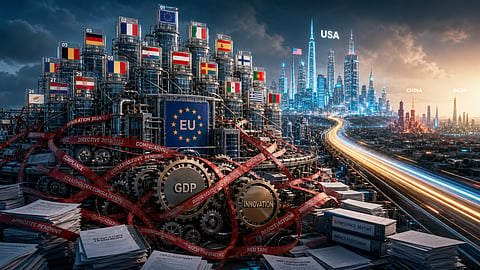
Key topics:EU is huge but lagging US growth due to red tape and fragmentationBrussels targets deregulation and deeper single market integrationProgress limited by politics, structural barriers, uneven reform success.Sign up for your early morning brew of the BizNews Insider to keep you up to speed with the content that matters. The newsletter will land in your inbox every morning on weekdays. Register here.Support South Africa's bastion of independent journalism, offering balanced insights on investments, business, and the political economy, by joining BizNews Premium. Register here.If you prefer WhatsApp for updates, sign up to the BizNews channel here..From The Economist, published under licence. The original article can be found on www.economist.com© 2025 The Economist Newspaper Limited. All rights reserved..The Economist.The European Union is an economic giant. Its 27 member states combine into the world’s second-biggest economy behind America and its third-most-populous internal market, behind India and China. The EU is home to some of the world’s most recognisable brands, from Adidas to Zara, and most important industrial firms such as ASML, whose lithography machines are critical in AI chipmaking, and Zeiss, whose lenses are critical to ASML.Alas, these days the giant is sleepy. The bloc’s GDP and its stock market have lagged far behind America’s over the past decade (see charts 1 and 2). In April activity in its services sector fell to a 62-month low. The recent shocks which contributed to the powerlessness were not of its own making: the covid-19 pandemic, Russia’s invasion of Ukraine and now America’s war on Iran. But the EU and its members have also been getting in their own way, by overregulating companies (see chart 3) and failing to properly integrate its supposedly single market..Between 2014 and 2024 the European Commission, the bloc’s executive arm, considered more than a thousand proposals. Some 660 of these were adopted. Among (many) other things, these forced even smallish firms to monitor their data and global supply chains for all manner of digital, environmental and human-rights transgressions..Read more:.Hungarian markets soar as Viktor Orbán exit sparks EU reset.The EU’s official beancounters at Eurostat estimate that reporting requirements and other paperwork cumulatively cost European businesses €150bn ($176bn) a year, equivalent to nearly 1% of the EU’s GDP—and that is not counting the innovation and growth forgone because entrepreneurs were put off by it all. New rules under discussion could, if implemented, add another €80bn. The IMF reckons that selling goods and services across national borders in the EU costs firms the equivalent of a 44% and 110% tariff. A survey in 2025 found that German firms had to hire an additional 325,000 employees over the preceding three years whose job was to tick ever more bureaucratic boxes..Spurred on by two landmark reports on European competitiveness (or lack thereof) courtesy of two former Italian prime ministers, the EU is saying basta! In March the 27 national governments jointly acknowledged that deepening its single market was “an urgent, shared responsibility of all member states and the EU’s institutions”. “There cannot be minor tweaks,” says Maria Luís Albuquerque, the EU’s financial-services commissioner, “we need fundamental changes.” Or, in the blunter words of a eurocrat involved in bringing those changes about, “We have to eliminate the crimes of the past five years.”This is not the first time the EU has wrung its hands about economic underperformance. Previous efforts at reform often began and ended in what Scott Bessent, America’s treasury secretary, derided as “the dreaded European working group”. Now, though, it is no longer just about economics. In a world of Russian revanchism next door, transatlantic fracture under Mr Bessent’s boss, Donald Trump, and Chinese commercial expansion everywhere, a stronger economy is suddenly a matter of security, even survival as a geopolitical project. Ursula von der Leyen, who relished red tape in her first term as commission president in 2019-24, has turned into a champion of reform.Ms von der Leyen’s commission is going about this in two ways. The first involves keeping the substance of rules but streamlining procedures. The commission is working on ten “omnibus” bills, each focused on making companies’ lives easier in a particular area. One that has already been passed exempts companies importing less than 50 tonnes per year of dirty products like steel or fertiliser from the EU tax on carbon emissions embedded in foreign goods. Another lets firms with fewer than 1,000 employees and annual sales of less than €450m dispense with reporting some environmental risks. Companies with a workforce below 5,000 and yearly worldwide revenue of less than €1.5bn also no longer need to track their global environmental footprint and human-rights impact. If the commission gets its way, businesses employing up to 750 people will soon be let off the hook for keeping many detailed records of how they process customers’ personal data.Eurocrats reckon that such simplification could reduce businesses’ annual administrative costs by €37.5bn by 2029. The bigger hope in Brussels is that the exercise is only the start, and that a deeper clean is coming. The prize could be large. The Ifo institute, a think-tank in Munich, looked at 27 episodes of bureaucratic decluttering around the world between 2006 and 2020 and found that it boosted GDP per person by an average of 4.6%.The second part of the strategy is to fulfil the EU’s unrealised aspiration to create a genuine pan-European market. The IMF reckons that better regulation and deeper integration could boost the bloc’s GDP by 3% over the next decade—nothing to sniff at for a continent that grew by an average of less than 1% a year between 2008 and 2024..One obvious move is to dust off “services passports”. These would allow firms licensed to serve customers in one member state to do so across the EU. The bloc is currently pushing a passporting proposal for telecoms services, many of which are regulated at the national level. Another policy with potential is to stop countries gold-plating EU rules, which often set bloc-wide goals but leave national governments to fill in the details. Especially when it comes to the single market, the commission is determined, wherever legally and politically possible, to write exhaustive regulations that leave no room for extra national glitter.A more ambitious idea concerns the creation of truly pan-European companies. Because EU treaties leave fundamental choices about taxes, labour relations, bankruptcy and other aspects of corporate law to member states, any company incorporated in any one of them faces complications when it crosses national borders. After years of haranguing from think-tanks and other policy wonks, the commission has unveiled a streamlined “28th regime” of corporate rules that lives side by side with the 27 national frameworks. It allows companies to register digitally for less than €100 and demands no minimum capital. Startups that meet criteria such as spending a lot on research and development enjoy a simplified insolvency procedure conducted entirely online, EU-wide stock-option plans and other perks.The commission’s newfound zeal to simplify and integrate is on clear display in finance. Unifying the EU’s fragmented capital markets could lower businesses’ funding costs, encourage investments in riskier, more innovative ventures and boost returns. The commission has proposed changes to make financial firms less rule-bound and financial plumbing less prone to clogging. It wants to make it easier to register cross-border investment funds, which today costs between €20,000 and €60,000 in every member state where a fund operates, and cheaper to run them than the current annual administrative bill of €400,000. It would also like to harmonise rules for trading venues and centralise more supervision in the hands of the European Securities and Markets Authority.Will the war on red tape work? Getting to American levels of integration is impossible unless the EU becomes a much more federal entity, for which there is no appetite. Many obstacles to a more vigorous economic union are beyond eurocrats’ power to shove aside. Member states are unlikely to give up their say over how mortgages work, how to treat debt and equity for tax purposes, and how to govern labour markets. Part of the costs borne by companies trying to sell across the EU are the result of different languages, cultures and legal traditions, not regulations. However much they are reformed and integrated, capital markets will remain small if Europeans hesitate to invest their savings in anything riskier than a bank deposit..Read more:.European stocks drop as Trump eyes EU tariffs.And even the limited reforms may stumble. On April 28th discussions between the commission, the European Parliament and national governments over the “omnibus” relating to AI regulations broke down. A critical industry of the future may be stuck with existing, restrictive rules. Something similar to services passports and the 28th regime has been tried before with little to show for it. “We want to be in favour of this,” sums up Fredrik Sand of TechSverige, a lobby group for Sweden’s technology industry, referring to pan-European startups, “but it is not a silver bullet.” He is right. But it is still nice to see the EU shoot on target.