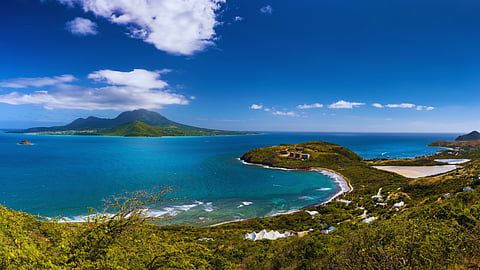
Key topics:Bitcoin investor plans libertarian “network state” with own courts in NevisNew Nevis law enables multibillion-dollar Destiny development reshaping coastIslanders fear “state within a state”, resource strain, lack of consultation.Sign up for your early morning brew of the BizNews Insider to keep you up to speed with the content that matters. The newsletter will land in your inbox at 5:30am weekdays. Register here.Support South Africa’s bastion of independent journalism, offering balanced insights on investments, business, and the political economy, by joining BizNews Premium. Register here.If you prefer WhatsApp for updates, sign up to the BizNews channel here..By Josh Spero.A wealthy bitcoin investor wants to set up his own court system within a libertarian community on a Caribbean island as part of the tech-backed “network state” movement.Olivier Janssens’ company, South Nevis Ltd, is buying up land on Nevis for his proposed “Destiny” development — the first scheme of its kind on the island, which has been enabled by a new Nevisian law.Destiny, which the island’s government has called a multibillion-dollar project, is due to involve a massive reshaping of the south coast of the island, including villas and medical clinics.Speaking via video link to a panel of islanders in late November, Janssens criticised Nevis’s court system for lacking “efficiency . . . And if we’re just going to copy that, it’s not attractive to people to come”.Instead, he said Destiny could “propose that for certain matters we have our own efficient court systems”, but would ultimately “still abide by” the national legal system..Read more:.Bitcoin slumps as investors hedge, ETFs see record outflows.The scheme, a series of lush green terraces and pools, has been designed by Skidmore, Owings and Merrill, the architects behind 7 World Trade Center in New York and the Broadgate Tower in London. Janssens declined to comment on its cost or the price of homes within the development.Destiny is part of a trend in which wealthy figures in technology and crypto try to establish their own, more libertarian, territories, known as the “network state” movement.A few have collectively received hundreds of millions of dollars in venture capital from funds backed by the likes of investors Peter Thiel and Marc Andreessen, OpenAI founder Sam Altman and Brian Armstrong, Coinbase chief executive. Many remain theoretical at this point.However, the founder of Próspera, a gated private community on a Honduran island run by a Delaware-based company, claims to have created more than 4,000 jobs and brought more than $150mn in foreign direct investment. The Honduran government has tried to repeal its charter and Próspera is now suing the government for $11bn for lost future profits.In summer 2025, the St Kitts and Nevis government passed the Special Sustainability Zones Authorisation Act, which allows the government to enter into agreements for developments such as Destiny. Janssens is in negotiations with the government and has said the project will invest $50mn into Nevis’s infrastructure if it goes ahead.The law has a provision for developers to set up their own “dispute resolution services and mechanisms”, which has worried islanders, several of whom have expressed fears that Destiny could become “a state within a state”. One has even written a song in opposition.Kelvin Daly, a member of the opposition Nevis Reformation Party (NRP), told the Financial Times that the law to enable special sustainability zones “was passed without any consultation with the public. That causes real anxiety among the general population”.“They’ve been very careful in using the word ‘sustainable’ because it translates into something that is good and upstanding,” Daly added. “It’s just a highfalutin way of saying economic zone with added benefit.”Janssens has rejected the characterisation of a state within a state, saying Destiny will be open to all islanders and will ultimately be subject to the government’s jurisdiction.Janssens said that he wanted a libertarian community because “I don’t trust politicians . . . We’re just like, ‘Leave us alone and let us do our things’.” He referred to Nevis as a “host nation”.Mac Kee France, general manager of the Palm Garden hotel in Nevis, which hosted the panel, said when the project was initially announced, he had questions about Destiny’s size and how it would benefit Nevisians.But he said attendees at the panel, including him, had been reassured by Janssens’ answers: “People walked away feeling very confident about the answers they got. They felt their concerns were addressed.”The law has caused controversy on the island because it establishes wide parameters for potential developments without specifying a maximum size.Islanders fear that the scheme will consume existing water and power resources, that it is already displacing long-term residents by buying their land, and that it will be cut off from the rest of the island.Janssens contended during the panel discussion that the law set principles and regulations on energy, water use and sustainability, such as requiring at least 70 per cent of the new developments’ energy to come from renewable sources.Some local politicians have criticised the fact that the real estate agent assisting Janssens in the land purchases has been Sharon Brantley, who is married to Nevis’s premier, Mark Brantley.Patricia Bartlette of the opposition NRP said in a radio interview in the autumn that she wanted to “get to the bottom of the issue . . . whether it started on the left side of the pillow or it started on the right side of the pillow”.Neither Mark Brantley nor Sharon Brantley responded to requests for comment..Read more:.Bitcoin slides 6% as investors pull out ahead of Fed decision.Janssens holds both Belgian and Nevisian citizenship, thanks to the federation’s citizenship by investment programme. This now offers passports for people who make a minimum investment of $250,000 in the island’s economy or a purchase of a condominium unit from $325,000.Janssens said on the panel that he would give up his Belgian passport if he could find an alternative that provided him with a European visa and that he had “a repulsion, almost, for Belgium”.Nevis, part of the St Kitts and Nevis island federation, has a population of 13,200 and is 93 sq km. The combined islands have a GDP of $1.1bn, with Nevis’s economy largely driven by tourism and real estate.Janssens declined to comment to the FT..© 2025 The Financial Times Ltd.