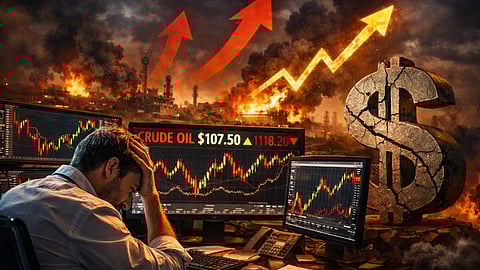
Key topics:Iran war triggers global market volatility, hitting stocks and bonds.Dollar faces challenges; Middle East conflict tests petrodollar system.Rising energy and food prices signal higher inflation, interest rates..Sign up for your early morning brew of the BizNews Insider to keep you up to speed with the content that matters. The newsletter will land in your inbox every morning on weekdays. Register here.Support South Africa's bastion of independent journalism, offering balanced insights on investments, business, and the political economy, by joining BizNews Premium. Register here.If you prefer WhatsApp for updates, sign up to the BizNews channel here..By Katie Martin.The war in Iran is, for markets, a hot mess. It’s on, it’s off, it’s getting better, it’s getting worse and pretty much every asset class on the planet is getting bashed around with every new headline like a ping-pong game from hell.Some of this is frankly too exhausting and ultimately too pointless to track. But once the chaos has passed, this episode will leave a lasting mark on investors.This past Monday illustrated the madness in glorious technicolour. At breakfast time in Europe, investors clearly feared the already hideous conflict in the region was threatening to escalate still further, ramming energy prices higher, hammering inflation-sensitive bonds and biting into stocks.Before lunch that same day, with a tap of the “send” button on a social media post, Donald Trump turned those short-term market moves on their head, claiming “VERY GOOD AND PRODUCTIVE CONVERSATIONS” with Iran aimed at finding a resolution. Oil prices dropped by 10 per cent in a day despite Iran’s insistence that no such talks had taken place..Read more:.Trump officials’ mixed messages on US-Iran war prompt more market volatility.By Wednesday, the “peace trade” was very much on, inspired by news that the US had sent a plan to end hostilities, with Pakistan acting as an intermediary, even as Washington prepared to send thousands more troops to the region. Will this “15-point peace plan” end up as yet another head fake? Traders have no clue, but they know the now familiar signs of a Trump backtrack when they see one and markets responded accordingly. And so we stumble on, trapped between a potentially nightmarish near future in which global energy supplies are pinched beyond recognition, and a muddle-through option where the US president declares victory and walks away. To put it mildly, those binary outcomes have very different implications for markets and the global economy. It makes no sense for any investor to jump forcefully in either direction.This has kept most markets in volatile but pretty tight ranges. Global stocks have fallen by 6 per cent since the conflict erupted. But even so, that puts them at the weakest point only since November — hardly a disaster, and a fraction of the decline we saw last April when Trump slapped massive trade tariffs on the world.To market participants sympathetic to Trumponomics, this is a sign that we should all ignore what one — Jefferies’ analyst David Zervos — calls “all the excursion-related fear-mongering”. “I know Europeans are feeling quite cranky,” he wrote in a note to clients this week that sheds some useful light on how Team Trump might view this moment in financial-market history. Some ugly moves in the region’s short-term debt markets “have caused some serious pain”, Zervos acknowledged. “But away from these largely irrelevant moves for global markets, there has been far more stability than many would have expected. That’s a fact. And that continues to have me feeling quite optimistic that this too will pass.”He’s certainly right about the “cranky” bit, and he’s right to point out that markets have broadly been strikingly stable. Still, when this conflict does end, some lessons will be important to remember.The first is that, despite the rise in the dollar over the course of this crisis, the buck is not back. Its once rock-solid status as the undisputed king of all the currencies has taken a knock since Trump came back to office last year. Yes, it has jumped since the war started — an echo of its traditionally reliable tendency to rise in times of stress — but analysts and investors broadly agree that this time around, the ascent was not about fund managers scurrying into the dollar in search of safety. Instead, at least in part it was about getting back to neutral, having edged back and hedged away dollar risk at the start of the year — a pattern clear across many asset classes.In fact, the conflict threatens to undermine the dollar further. “The strategic importance of the Middle East to the dollar’s role as the world’s reserve currency should not be underestimated,” wrote Deutsche Bank analyst George Saravelos in a note this week. “The long-term legacy of the Iran conflict for the dollar could be the way it tests the foundations of the petrodollar regime. If faultlines are further exposed, there could be significant downstream effects to the dollar’s use in global trade and savings.”The second, related point is that at times US stock markets have suffered less than others when the conflict heats up — a function of the country’s energy independence and geographical distance from the war. But global investors’ urge to keep on diversifying away from the US over the long term is undimmed, particularly for those who believe, quite rationally in my view, that the conflict will prove a huge boost to green and sustainable investing in the years ahead. As one banker put it to me this week: “Donald Trump is the best thing that ever happened to green energy.”.Read more:.Chaos and consequences of the Iran conflict - Katzenellenbogen.The third is that inflation pressures are back, in energy of course but also in food prices. Along with the obvious additional needs now for government spending on defence and energy resilience, this all points to higher interest rates than we might otherwise have expected and a tricky investing environment for those seeking a balance of stocks and bonds.The headline ping-pong is dizzying and the market noise is deafening, but some of it is worth listening to. .© 2026 The Financial Times Ltd.