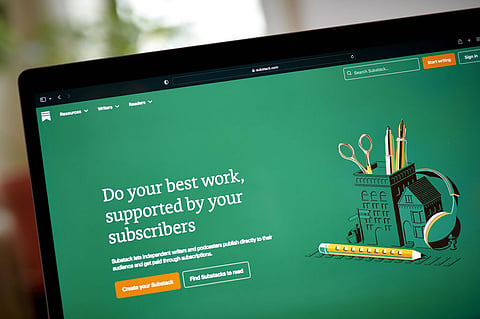
Key topics:Substack hits 5M paid subscribers, tops WSJ and CBS News in web trafficPolitical and niche newsletters fuel revenue; top writers earn millionsSubstack expands with app and creator network, eyes YouTube as rival.Sign up for your early morning brew of the BizNews Insider to keep you up to speed with the content that matters. The newsletter will land in your inbox at 5:30am weekdays. Register here.Support South Africa’s bastion of independent journalism, offering balanced insights on investments, business, and the political economy, by joining BizNews Premium. Register here.If you prefer WhatsApp for updates, sign up to the BizNews channel here.The auditorium doors will open for BNIC#2 on 10 September 2025 in Hermanus. For more information and tickets, click here..By Marc Rubinstein.Everyone seems to have a Substack these days. What started as a simple newsletter service in 2017 has become the platform of choice for a wide range of content creators. Even the State Department has one – a sign of the platform’s arrival in the mainstream. Readers have responded in kind: Last month, Substack’s website attracted more traffic than those of the Wall Street Journal or CBS News, marking a dramatic shift in digital media consumption.Full disclosure: I’ve run a weekly newsletter on Substack since its early days, giving me a front-row seat to the platform’s evolution. So when news broke last week that Substack raised $100 million in a funding round at a $1.1 billion valuation, I paid close attention.Substack’s growth metrics are certainly impressive. The platform added a million paying subscribers in the four months to March 2025, taking its total number of paid subscribers to 5 million. While many writers don’t charge for access to their content (State Department included), those that do pull in an estimated $450 million. Already, that’s over a third of what the New York Times generates in digital subscription revenues.Political content is the biggest driver of revenue, benefiting from heightened engagement since the US election. History professor Heather Cox Richardson exemplifies this success with more than 2.5 million subscribers to her daily newsletter about American democracy. With typical conversion rates from free to paid subscribers running around 3%, even a fraction of her audience translates into substantial revenue.Specialists and industry practitioners also command devoted followings that mainstream press can’t replicate. Lenny Rachitsky’s product-management newsletter has built a community of tech professionals from over 1 million free subscribers willing to pay for insider expertise. Finance takes this dynamic even further, with practitioners like Citrini Research charging premium rates that reflect the high value of specialized analysis. More than 50 writers across all verticals now earn over $1 million annually, many of whom built their audiences from scratch on the platform. But while creators are thriving, Substack itself captures only a sliver of the value. The company takes just 10% of subscription revenue, remitting 90% to writers. At the Financial Times, the highest salary is £1.8 million ($2.4 million), according to company filings, but the firm pays employees only 37% of its total revenue. The New York Times doesn’t disclose journalist compensation, but over the past five years, journalism costs have risen by an amount equal to 38% of the publication’s revenue growth, so the payout is likely similar. This leaves them with enough to invest in infrastructure and pay shareholders the small amount left over.In contrast, Substack’s low take rate leaves it with around $45 million in annual recurring revenue – impressive growth, but modest given the platform’s cultural influence and traffic. From this, the company has to maintain infrastructure which it offers for free to those writers who don’t charge for their content. It hasn’t provided a more recent update, but in 2022 the company reported a $22.8 million loss..Read more:. The Economist: YouTubers like Mr Beast are coming for Hollywood.Substack's response has been to expand into adjacent markets. The company launched a mobile app designed to challenge Twitter/X’s dominance in text-based social media — “an escape from the doomscroll, and a place to take back your mind,” the founders wrote.The app now boasts 5.5 million monthly active users and 1.5 million daily actives – growth of 3 to 4 times the past year. It also drives new subscribers to underlying publications. But it pitches Substack into a new marketplace. “We’ve sort of made a transition from a single-player tool company to a company that provides both a set of publishing tools and a network that helps create a place to reach new audiences,” said co-founder Chris Best in an interview streamed on the platform. “And so what that means is our competitors are no longer like Mailchimp and Patreon and Beehiiv, the competitors we have in our mind right now are like YouTube.”From a business model perspective, though, there are big differences — such as advertising, which contributes more than 90% of YouTube’s revenue (and 34% at the Financial Times and 20% at the New York Times). Currently, many publications on Substack sell their own sponsorships and advertising, but Substack doesn’t take a cut. That may change. Still, the company remains committed to optimizing for subscriptions first. “It's like the difference between monetizing relationships and monetizing impressions,” says co-founder Hamish McKenzie.For new investors – which include venture capital firms Bond Capital Associates and Andreessen Horowitz – the fundamental question isn’t whether Substack can continue growing – clearly it can. It’s whether the company can command valuations comparable to other content networks. Reddit, which took years to monetize effectively, now trades at a $27 billion valuation. The success of Substack’s expansion strategy will determine whether it becomes a comprehensive creator platform, or remains constrained by the economics of the media business it chose to enter.At a $1.1 billion valuation, investors are betting on the former. Whether that proves correct will depend on Substack's ability to solve the central tension between creator success and platform profitability – a challenge that has humbled many media companies before it..© 2025 Bloomberg L.P.