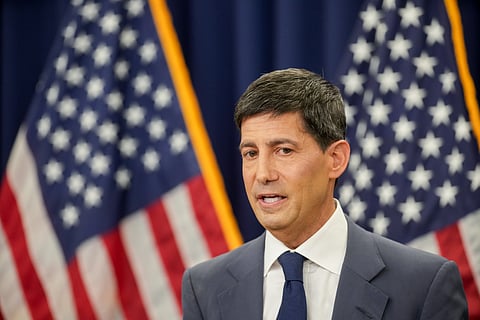
Iran peace talks pushed oil lower and gave emerging market bonds a rare tailwind. Then Kevin Warsh — in his first Fed meeting as chair — killed the rally with hawkish inflation warnings, sending the dollar to its biggest monthly gain since March. For South Africa, the double bind is familiar: a stronger greenback tightens financing conditions, pressures the rand, and limits the SARB's room to cut rates. Goldman Sachs and Citi both flag the Fed, not oil, as the dominant EM risk now. SA bond investors, who'd been quietly optimistic, are recalibrating fast..By Marcus Wong and Malavika Kaur Makol.Just when it looked like emerging-market bonds would catch a break from falling energy prices, along came Federal Reserve Chairman Kevin Warsh to spoil the party.Warsh’s hawkish pivot at the Fed’s meeting this month cut short a rally in developing-nation debt, limiting the drop in yields fueled by Iran peace talks to much smaller moves than after the April 8 ceasefire. Now, the key risk for the securities has shifted to the US central bank, instead of the oil market, say top Wall Street banks including Citigroup Inc. and Goldman Sachs Group Inc. That’s reinforced by a rising correlation between Treasury yields and emerging-market ones.“The path for US interest rates has been repriced much higher,” said Philip Fielding, a portfolio manager at Fidelity International in London. “This has led to broad-based US dollar strength, creating an obvious headwind for dollar-funded emerging-market local currency positions.”A hawkish Fed leading to a broad tightening in financing conditions would affect countries relying more heavily on foreign capital inflows, such as Turkey and Colombia, Fielding said..Warsh’s comments at his first policy meeting as Fed chair that the central bank won’t tolerate high inflation sent Treasury yields and the dollar higher. The greenback is now on track for its biggest monthly gain since March, while the US five-year yield remains more than 60 basis points above where it stood before the Iran conflict began.“Close on the heels of the signing of a US-Iran agreement to end the war, EM local rates are now fighting a new adversary – a hawkish Fed,” Goldman Sachs strategists including Kamakshya Trivedi and Danny Suwanapruti wrote in a note published June 18.The US-Iran peace agreement this month removed one of the biggest headwinds for developing economies by pushing crude prices lower, easing inflation pressures and giving emerging-market central banks more flexibility over monetary policy. That’s generally positive for developing-nation bonds, as slower inflation raises the prospect of future rate cuts, boosting the prices of existing debt while improving the outlook for many oil-importing economies.But the stronger dollar is making emerging-market central banks more cautious about signaling policy easing, limiting the scope for local-currency bonds to extend their gains.“The baton of risk factors will only get passed from oil to Fed and El Nino,” Citigroup strategists including Luis Costa wrote in a note published June 18. “Central banks are likely to remain cautious in signaling all clear which could keep risk premia elevated in EM local currency.”The rolling 30-day correlation between US five-year yields and similar-maturity Latin America bonds climbed to 0.49 last week from 0.10 at the end of February, while that for emerging Europe, the Middle East and Africa rose to 0.43 from 0.03. In emerging Asia, the correlation climbed to 0.09 from 0.04.The relationship is even stronger in some higher-yielding markets. The 30-day correlation between US and Mexican five-year yields rose above 0.8 in June.‘More Hawkish’Not everyone expects higher US rates to derail the asset class. The extent of the risk on EM local currency bonds “depends on why the Fed becomes more hawkish,” said Ward Brown, a fixed income portfolio manager at MFS. “If tighter policy reflects stronger growth, the implications for EM local currency debt would likely remain constructive overall, with country-specific fundamentals and reform stories continuing to drive performance,” he said. For now, investors say the durability of the US-Iran peace agreement remains another key variable. A lasting reduction in geopolitical tensions would help keep oil prices contained and preserve room for central banks to ease monetary policy, while any renewed conflict may quickly reverse those gains..Read more:.Oil drops, risks remain: What the Iran ceasefire reveals about a fragile global economy - Joan Swart.The interim peace agreement “is a net positive for EM local currency bonds,” said Hakan Aksoy, senior emerging-market portfolio manager at Amundi. Still, “the durability of the peace deal is not yet certain, so we continue to expect headline-driven two-way volatility in markets,” he said..© 2026 Bloomberg L.P..Sign up for your early morning brew of the BizNews Insider to keep you up to speed with the content that matters. Register here. Support South Africa’s bastion of independent journalism, offering balanced insights on investments, business, and the political economy, by joining BizNews Premium. Register here.If you prefer WhatsApp for updates, sign up to the BizNews channel here.