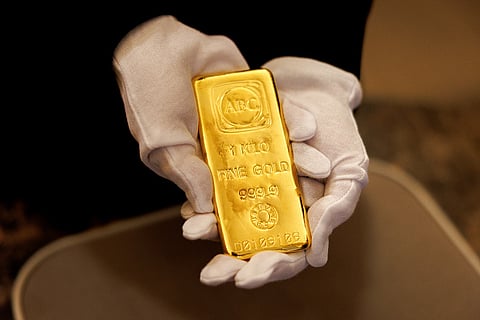
In 1936 the search for gold on the Far East Rand was called off. Twenty boreholes and a magnetic survey of 53,209 stations had found no reef, and the profession's verdict was that nothing there could be tied to the Upper Witwatersrand. Twenty-two years later Winkelhaak poured the first bar of a goldfield that has since yielded 1,500 tonnes — opened by a borehole drilled on the wrong farm. Every one of the last four Witwatersrand goldfields was found by somebody who refused a verdict like that one. The verdict now in force, that South Africa is fully explored, is being tested by nobody. The country has stopped looking..By Dr Duarte da Silva*.This paper is built on boreholes, because a borehole is the only evidence an exploration argument has: the twenty dry holes of the Far East Rand before 1936 and the ten after 1950, seven of them in reef; the 300 to 400 holes drilled across the Free State before a mine was sunk; the six on a gravity low at Stilfontein in 1947, every one in Vaal Reef; and the 4,200 metres the state's own survey drilled in the whole of 2024/25. Prices and totals are as at this week: gold US$4,411.20 at the close on 7 September 2026, the rand at 15.99, output of 88.5 tonnes in 2025, and exploration spend on all minerals of R738 million in the same year on Stats SA's constant-price series, the seventh fall in a row. Three different series measure exploration in this paper and they are kept apart throughout: Stats SA's rand spend on every mineral, S&P Global's dollar budgets for non-ferrous minerals, and the gold-only line inside the S&P count. Where a judgement is mine, I say so..EXHIBIT A · THE WRONG FARMI. Twenty dry holes and a verdictStart where the industry stopped. In 1903 a first hole on the farm Winkelhaak, west of Bethal, was pulled before it reached anything, and by 1910 every company on the Far East Rand had let its ground go. Then on 27 December 1932 South Africa left the gold standard, the local gold price rose by more than forty per cent inside a few weeks, and the Highveld filled with geologists. A ground magnetic survey of 53,209 stations along 1,240 miles of traverse was run in 1933, and its strongest anomaly, near Leslie, was drilled into the Contorted Bed of the Lower Witwatersrand. Twenty boreholes followed. Not one found the Main Reef. Not one found the Kimberley Reef either. In 1936 the programme was closed, and the profession drew its conclusion in a sentence still quoted by the company that later held the Twistdraai ground: “No formations have been intersected in the Far East Rand which can definitely be correlated with the Upper Witwatersrand.”It was reasonable, it was published, it was believed, and it was wrong. Reasonable, because in 1936 the payable Witwatersrand meant the Main Reef, and the Main Reef is what all twenty holes had been sited to find. Wrong, because the Evander sub-basin does not carry the Main Reef. It carries the Kimberley Reef — a younger conglomerate thirty to fifty centimetres thick, dipping ten degrees north, its gold on the footwall contact in carbon and pyrite — which nobody on the Far East Rand had thought to correlate because the model said it should not be there. The verdict measured the model. It reported it as the rock.The verdict of 1936 measured the model and reported it as the rock. Twenty boreholes sited to find the Main Reef proved, correctly, that the Main Reef was not there.Union Corporation's chief geologist, E. F. Marland, went back to the old plans in 1938 and, on the company's own later account, believed something in them had been overlooked; other business put the work off for a decade. When it resumed in 1948 it resumed with a new instrument. An airborne magnetometer was flown in 1948 on a regional grid at five-mile spacing; after six boreholes a detailed survey of 2,000 profile miles over 1,300 square miles of ground under Karoo cover was flown from March 1952 at half-mile and one-mile intervals, backed by ground magnetics and gravity. A word on that cover, because it recurs through this paper and is easily misread: the Karoo here is the Karoo Supergroup, the blanket of shale, sandstone and tillite that lies over most of the Highveld and hides the Witwatersrand beneath it, and not the semi-desert of the same name six hundred kilometres to the south-west. The first two holes, UC57 and UC60, went through that cover into basement schist and stopped. The third, on Winkelhaak, found Upper Witwatersrand beds. UC65, on portion 107 of Winkelhaak 135 IS in 1951, cut the Kimberley Reef at 1,101 metres with low values, and is a provincial heritage site today for being the first prospecting hole to prove the reef near a town that did not yet exist. By August 1952 ten holes had been drilled and seven were in Kimberley Reef.Then came UC74. Its site had been planned on one plan and transposed to another, and the transposition mislocated the rig onto ground that is now the centre of Evander township. The reef came up at a mean value of 2,615 centimetre-grams a tonne — about 2.6 kilograms of gold in every square metre of reef — and the field was made. Union Corporation applied for the Winkelhaak lease in 1955, sank the first shafts from 1956 and poured gold in July 1958; Bracken and Leslie followed in 1962, Kinross later in the decade. Alfred Frost, the consulting geologist credited with the discovery, was remembered by Oscar Weiss in 1983 in a tribute titled “The discovery of two goldfields”. On Handley's audit of the basin, in the Journal of the Southern African Institute of Mining and Metallurgy in April 2023, the Evander goldfield produced 1,483 tonnes from 212 million tonnes milled to 2005 at 6.99 grams a tonne; on Pan African's count to 2016, 49 million ounces, 1,515 tonnes. Four mines and a town, from a district a learned society had written off on twenty holes.If the best geologists in the country, with fifty thousand magnetometer readings and twenty boreholes in hand, could declare barren a district that held 1,500 tonnes, what is the weight of a verdict reached in 2026 on almost no drilling at all? That is the question of this paper, and the wrong farm is where it starts.EXHIBIT B · THE PATTERNII. Four fields that were not on the mapEvander was the last Witwatersrand goldfield found, and it was not an exception. It was the fourth repeat of a pattern. The basin has seven goldfields, and Handley's Table I dates each one's first gold: the Central Rand 1886, the East Rand 1888, the West Rand 1893 — and then, after a gap of forty-six years, Carletonville 1939, the Orange Free State 1951, Klerksdorp 1952, Evander 1958. The first three were found by men walking outcrop. The last four were found under cover, by drilling and geophysics, against the settled view of where the gold was, and each required somebody to keep spending after the industry's collective judgement had said stop.The two groups compare as follows. The three outcrop fields produced 20,290 tonnes to 2005. The four concealed fields produced 27,083 — 57 per cent of the 47,373 tonnes the Chamber's members had produced by then, with Carletonville alone, at 10,076 tonnes and 10.27 grams, the largest and richest of the seven. More than half of the greatest goldfield on earth came from ground that in 1930, when the industry was forty-four years old and sure it knew its basin, was farmland under Ventersdorp lava, dolomite and Karoo shale, with no gold on anybody's map.More than half of all the gold the Witwatersrand has yielded came from four fields that were on no map when the industry was forty-four years old.Each of the four fields was hidden by a different thing — cover the instruments could not see through, dry holes read as disproof, a reef nobody was looking for, an orebody whose economics had not been invented — and each was found by somebody who treated the prevailing verdict as a hypothesis. The verdict in force today is that South Africa is explored: that a basin drilled for 140 years holds no fifth Evander, and what remains is a known tail to be mined down and closed. That may be true. It has exactly the evidential standing of the sentence of 1936. It is a conclusion about a model, reached without the drilling that would test it. What follows is the record of what happened the last four times.EXHIBIT C · THE FIRST PROOF — WEST WITSIII. Carletonville: the field the instrument could not seeEveryone knew there was gold west of Randfontein. The Pullinger brothers drilled the Ventersdorp Contact Reef and the Middelvlei Reef at depth on the Far West Rand in 1898, and when a shaft was begun on them in 1910 the dolomite let go its water and drowned it within the year. For thirty years the reef was known, in the loose sense, and barren, in the only sense capital recognises: under hundreds of metres of dolomite no mapping could see through, inside an aquifer that drowned anything sunk into it.Rudolf Krahmann arrived from Germany in February 1930 and within months, near Krugersdorp, noticed his compass swing on iron-rich rock. The insight was not that gold is magnetic — it is not — but that three of the Lower Witwatersrand shales are, and could be traced under the dolomite with a magnetometer. Hans Merensky backed him; West Witwatersrand Areas was formed in November 1932 to hold the ground; Krahmann and Leopold Reinecke ran the survey for Gold Fields over 380 square miles, more than 100,000 observations on nearly 1,500 miles of traverse, and he read the results to the Geological Society in January 1936 — the first use of geophysics to find Witwatersrand reef and, in the words of Tucker, Viljoen and Viljoen's 2016 review, the blueprint for the discovery of the West Wits goldfield. Cementation answered the water. Venterspost began sinking in 1934 and poured the line's first gold in 1939; Blyvooruitzicht was floated in 1937 and milling by 1942; West Driefontein was registered on 7 March 1945 and milled from 1952, and Driefontein came to be called the richest gold mine in the world; Western Deep Levels followed in 1962 and became the deepest.Carletonville produced 10,076 tonnes to 2005 from 981 million tonnes at 10.27 grams, more than the whole Central Rand; Driefontein alone poured its hundred-millionth ounce on 30 August 2005. That is the yield of a district whose gold was known in 1898 and out of reach until a man with a compass worked out which rocks were magnetic. Nobody on the Far West Rand in 1925 was wrong about the geology. They were wrong about what their instruments could see, and the instrument changed.Nobody on the Far West Rand in 1925 was wrong about the geology. They were wrong about what their instruments could see, and the instrument changed..Read more.Dr Duarte da Silva on environmental arbitrage: The asset in the flood.EXHIBIT D · THE SECOND PROOF — THE FREE STATEIV. Odendaalsrus: thirteen years of dry holesThe Free State is the proof that a dry hole is information, not disproof, and it is best told through the men who were told to stop. Archibald Megson had dug into a small conglomerate outcrop on the farm Aandenk near Odendaalsrus in 1904, and nobody cared. In October 1932, weeks after the gold standard went, he showed his samples to Allan Roberts, a Johannesburg dental technician, who with the attorney Emmanuel Jacobson, the broker Fritz Marx and Dr Peter Woolf floated Wit Extensions in 1933 on £50,000. Their one borehole went through 2,721 feet of Ventersdorp lava by August 1934, found “some gold” between 3,549 and 3,844 feet, and stopped for want of money in February 1935 a little above 4,000 feet. It was not payable. Roberts could not raise another pound. Allanridge carries his name because he was right and broke at the same time.What turned the Free State was, again, a new method and the nerve to keep drilling after failure. Oscar Weiss reasoned that shallow Upper Witwatersrand quartzites under the Karoo cover and the lava would show as a gravity low, and torsion-balance and magnetometer surveys were run across the province to site holes on that logic. S.H.1 on St Helena, drilled early in 1938 in the middle of such a low, cut 991 feet of Karoo cover and 6,081 feet of quartzite and hit reef — the Basal Reef, on which St Helena became the field's first mine. Then the war stopped the rigs. The famous hole on Geduld in April 1946 came thirteen years after Roberts's, and by then, on Union Corporation's reckoning, 300 to 400 boreholes had been drilled across the province — some 190 miles of drilling between 1936 and 1947, most of it into nothing that could be mined. Welkom was laid out on 15 April 1947; first gold was poured in 1951; and the field went on to produce 9,667 tonnes to 2005 from 1,312 million tonnes at 7.37 grams. In 1994 alone it yielded 157 tonnes, nearly twice what the whole country produces today. By 1967 eleven mines stood on it.The point of the Free State is the arithmetic before the strike. Several hundred boreholes and thirteen years of failure were not evidence that the regional idea was wrong; they were the cost of testing a target that was deep, narrow and completely hidden. A programme that stopped at the twentieth dry hole, as the Far East Rand's did in 1936, would have stopped 250 kilometres short of the second-largest goldfield in the basin.EXHIBIT E · THE THIRD PROOF — KLERKSDORPV. The Vaal Reef: sixty years in a known districtKlerksdorp should trouble anyone who thinks a district can be too old to surprise. Gold was found there in November 1885, months before Langlaagte; Thomas Leask took options on the farms, a stock exchange opened in 1888, cyanide lifted output from about 7,000 ounces in 1890 to 71,776 in 1895, and then the Jameson Raid and the rinderpest broke it. The exchange was empty by the end of the decade and a cinema by 1912. For forty years Klerksdorp was a known goldfield that did not pay: patchy, deep, capital-hungry, and mined on the horizons the Rand had taught people to look for.Its revival after 1932 used the same tools as the Free State's, aimed at a reef the early miners had never identified as the prize. The eighty-mile gap between Randfontein and Klerksdorp was mapped magnetically through the dolomite. In 1947 B. D. Maree located a gravity low on the farm Stilfontein; Weiss extended the work across Stilfontein, Rietfontein and Hessie; and six boreholes sited on the low all intersected the Vaal Reef — the horizon Tucker and his co-authors describe as revealed “nearly fifty years after these early discoveries”, and the one that became the field's principal reef. Vaal Reefs Exploration and Mining had been incorporated in 1944 to hold the ground; Stilfontein was floated in 1949; the field declared first gold in 1952; and Stilfontein, Buffelsfontein, Hartebeestfontein, Vaal Reefs, Zandpan and the old Western Reefs all came to work the one zone. Klerksdorp has produced 5,857 tonnes to 2005 at 8.47 grams. Great Noligwa was hoisting more than 800,000 ounces a year in the early 2000s, Moab Khotsong came in in 2003, and in August 2021 Harmony committed R4.5 billion to Zaaiplaats, a twin decline 400 metres deeper on the same reef, for 225,000 ounces a year over twenty-four years at nine grams.A goldfield can be famous, sixty years old, with its own exchange and its own failures, and still be radically underexplored, because everybody in it is looking at the same reef and the payable one is another.A goldfield can be sixty years old, with its own exchange and its own failures, and still be radically underexplored, because everybody in it was looking at the same reef.EXHIBIT F · THE FOURTH PROOF — SOUTH DEEPVI. Westonaria: the discovery that was a mining methodThe fourth proof is different in kind, and it bears most on the ground South Africa holds now. Payable Ventersdorp Contact Reef and Upper Elsburg conglomerates were found near Westonaria in the early 1950s; Western Areas was formed in 1959 and mining in 1961; Elsburg Gold Mining was floated in 1965 and folded in by 1975. What lay beneath them was known for thirty years before anyone knew what it was: not a reef but a package, the Upper Elsburgs thickening with depth into a body a narrow-reef stope could not mine and a narrow-reef price deck could not value. The company's own history dates the turn to 1980, “the recognition that the orebody had potential for mechanised mining”. Nothing new had been intersected. What changed was the mining model, and with it the definition of ore.Money followed slowly. South Deep Exploration was formed in 1990, in a falling gold market, for no purpose except to keep paying for the work; it merged with Western Areas in 1995 and sinking began; the main shaft was done in 2002 and the twin-shaft complex, at 2,998 metres, commissioned in 2004. Barrick sold its half to Gold Fields on 11 September 2006 for US$1.525 billion, and Gold Fields has held all of it since 2007. At the end of 2024 the mine carried reserves of 175.2 million tonnes at 5.0 grams for 28.0 million ounces, resources of 25 million more beyond them, and a life to 2109; it produced 267,000 ounces in that year. The orebody was there in 1961 and was not a discovery until 1980. Discovery, on that record, is the moment a body of rock becomes ore, and at Westonaria it happened in a mine-planning office rather than a core shed. The wait was conceptual, not geological, and a company was formed to pay for it.EXHIBIT G · THE FOUR BARRIERSVII. What hid the gold, and what found itThe table sets the five historical cases beside the two modern ones this paper comes to later. The second column is the point: five different things concealed the gold, and none of them was its absence..Every unlocking event in that column cost money that produced nothing for years: Krahmann's 100,000 readings, the Free State's several hundred holes, Union Corporation's 2,000 profile miles, South Deep Exploration's five years without a shaft. The gold South Africa found in the twentieth century was bought with the spending it has stopped making in the twenty-first.EXHIBIT H · THE WAITVIII. How long a goldfield takesThe chart measures the one variable every exploration verdict holds still: time — from the first serious drilling on the ground to the first gold from the field, or from the orebody the drilling eventually justified. Burnstone is added on the same rule, from the option of November 2002 to the plant Sibanye-Stillwater expects to run in 2029..Klerksdorp waited sixty-six years from its first claims to the reef that made it. The Far East Rand waited fifty-five from its first hole to Winkelhaak's first bar, twenty-two of them after the verdict that it held nothing. The West Wits waited forty-one from the Pullingers to Venterspost; South Deep fifty-four from the first payable intersection to the shaft that could mine the body. The Free State was the fast one at eighteen, and it was fast because several hundred holes were drilled in the interval with a war in the middle of it. Burnstone, if the plant runs in 2029, will have taken twenty-seven.Those are not the lead times of an industry that had run out of gold. They are the lead times of an industry finding it, and the implication for the present is plain. The last Witwatersrand goldfield was found in 1951. Exploration spending on all minerals, on Stats SA's constant-price series, has fallen in each of the last seven years and stands more than 85 per cent below its level of three decades ago, and the gold line inside the world budget count fell by two-thirds between 2012 and 2024. On those lead times a field whose first hole was drilled in the mid-2000s would not pour gold until the 2040s, and a field whose first hole has not been drilled cannot pour gold at all. The absence of discovery since the collapse in drilling is not a finding about the rock. It is what the chart predicts.The absence of discovery since the collapse in drilling is not a finding about the rock. On the lead times of every field the country has, it is what the collapse predicts.EXHIBIT I · THE COLLAPSEIX. What South Africa spends, against what others spendThree series measure what South Africa spends, and they count different things, so each figure below is tagged with the count it comes from. The first is S&P Global's annual survey of company exploration budgets for non-ferrous minerals — gold, base metals, uranium, diamonds and the rest, but not iron ore, coal or oil — reported in US dollars, and the count the Department's own 2022 Exploration Strategy uses. On it South Africa attracted about five per cent of the world's budgets in 2003 and stood at US$404 million in 2007. Across 2000 to 2018 it averaged US$194 million a year against Canada's US$2 billion. In 2024 it was US$121 million out of a world total of US$12.5 billion: one per cent, in a year when Canada took 19.8 per cent, Australia 15.9 and the rest of Africa 10.4. In 2025 the world's budgets were US$12.4 billion, and South Africa's line was too small for the published coverage to give; the share, as reported in March 2026, was below one per cent. The Strategy gazetted on 14 April 2022 set a target of five per cent of that world total within three to five years, which on its own arithmetic meant about US$900 million a year, some R14 billion, across every mineral the survey counts. The year the target fell due was 2025.The second series is Stats SA's, which measures what was actually spent in South Africa on exploration for every mineral, coal and iron ore included, in rand at constant prices. It gives R738 million for 2025 — US$43.9 million at the year's rate — down 5.3 per cent on 2024, the seventh consecutive decline, and more than 85 per cent below the level of three decades ago. The two series will not reconcile to each other: one is a survey of budgets in dollars for a subset of minerals, the other a census of spending in rand for all of them. What they agree on is the direction and the order of magnitude. Against a target of R14 billion a year, the country spent under R1 billion, and less than the year before.South Africa set itself a target of five per cent of world exploration budgets by 2025, worth about R14 billion a year across all minerals. In 2025 it spent R738 million, and less than the year before.The third series is gold alone, and it is the worst of the three. The world's gold budget on S&P's count fell to US$3.3 billion in 2016 and has since nearly doubled, to a record US$6.15 billion in 2025, half of everything spent on non-ferrous exploration. South Africa's gold budget on the same count, as the Center for Strategic and International Studies reported in May 2025, fell 66.7 per cent between 2012 and 2024, years in which the price rose by two-fifths. The absolute figure is not published separately, but its ceiling is. It cannot exceed the US$121 million the country attracted for all non-ferrous minerals in 2024, which would be two per cent of the world's gold budget if every dollar of it had gone to gold — and the Minerals Council's 2024 pocketbook says the gold portion “remains minimal”, the capital redirected to Australia, Chile and Peru. The state's own survey, the Council for Geoscience, drilled 4,200 metres in the whole of 2024/25, across every commodity it works on; the holes that found the Free State alone ran to some three hundred kilometres.The peers, on like-for-like counts. Australia spent about A$3.9 billion on mineral exploration in 2025 on its own Bureau of Statistics series, which like Stats SA's covers every mineral; forty per cent of it, about A$1.6 billion, went to gold, and in the June quarter of 2026 alone the country drilled 3.46 million metres. Canada spent C$4.4 billion in 2025 on the same all-minerals basis, half of it on precious metals, and intends C$5.3 billion this year. Côte d'Ivoire, with no Witwatersrand and a fraction of the geological record, lifted its S&P budget to US$186 million in 2025, the biggest rise in Africa and half again South Africa's US$121 million of 2024 on the same count, nearly all of it for gold. The discovery ledger records the consequence. MinEx Consulting's count for 2009 to 2018 has Africa finding a third of the world's new gold deposits and 30 per cent of the ounces, at about US$31 an ounce discovered against Australia's US$38, Canada's US$81 and the United States' US$87. West Africa booked fifteen major discoveries of 67 million ounces between 2010 and 2020 and more than doubled its output; Ghana passed South Africa on 2018 output. Not one of the discoveries in those counts is South African. South Africa was not drilling.Intensity is the comparison the two all-minerals series allow. R738 million, or US$43.9 million, across 1.22 million square kilometres is US$36 a square kilometre. Australia's A$3.9 billion across 7.69 million square kilometres is about US$330. Gold for gold the gap is wider, not narrower: Australia's gold budget alone is some A$1.6 billion, and South Africa's is a minimal fraction of a total that is itself a fraction of that. The country whose basin holds 48,100 tonnes on the best audit there is explores its territory at a tenth of the intensity of the one that already out-produces every other outside China.Neither series separates new ground from old. Of the world's 2025 budget, 45 per cent went to existing mine sites and 21 per cent to grassroots ground. In South Africa the split is not measured at all. Harmony spent R1.0 billion on exploration in its 2024 financial year and does not say how much of it was South African; its R11 billion of capital the next year went to Mponeng, Moab Khotsong and Mine Waste Solutions — to deepening and re-treating known ground. That is resource conversion. It replaces reserves, keeps shafts alive and finds nothing. Exploration tests a new reef, a new structural reading, a concealed margin — what Krahmann, Weiss, Maree and Marland did. South Africa does a great deal of the first and, so far as any published number shows, none of the second. The country is not exploring less. On the definition that found its goldfields, it has stopped..Read more:.Dr Duarte da Silva: Sibanye's Burnstone decision.EXHIBIT J · THE REASONSX. Why the market stopped lookingThere are five, and the programme later in this paper answers each. The first is tenure. From 2011 the country's mineral rights ran on SAMRAD, a portal that had 5,326 unprocessed applications on its books by February 2021 and 2,625 by November 2022; in the year to March 2025 the Department processed 795 prospecting applications and refused 700 of them, and 495 mining-permit applications and refused 402. Its Director-General told Parliament in June 2026 that about 2,800 applications arrive a year and about 2,500 are dealt with — a queue that never clears. The replacement cadastre was tendered in August 2021 for delivery by March 2023; it was announced for one province in May 2025 and registered its first rightholders there that October, and in June 2026 the national rollout was moved to 31 March 2027. Between February 2025 and January 2026 the country granted 358 prospecting rights and 32 mining rights. An explorer cannot raise money on ground it cannot show it holds. The Fraser Institute's 2025 survey ranks South Africa 64th of 68 jurisdictions on policy perception — below the Democratic Republic of Congo and Angola, and above only Guinea, Burkina Faso and Mali among its African peers.The second is capital. Exploration is a junior's business everywhere it works — juniors carried US$4.39 billion of the world's 2025 budget — and the JSE has fewer than twenty listed juniors against about 700 on the ASX and 900 on the TSX Venture, none of the three that drew retail money in 2026 in gold. The state's Junior Mining Exploration Fund, set up in 2024 with R400 million, approved eight projects from 117 applications in its first window, none in gold; Anglo American's R600 million took it to R1 billion this year and the Public Investment Corporation has set aside R1.35 billion of its own for early-stage projects in copper, cobalt, nickel, lithium and manganese. That is real money, and it is a rounding error against the R14 billion a year the Department's own target implies.The third is depth and lead time. The chart says twenty to sixty years, and a major with a fifteen per cent hurdle and shareholders in Denver or Sydney will always find a brownfield ounce at a known mine cheaper than a greenfield ounce under a kilometre of Karoo cover; Sibanye's capital allocation of 1 September 2026 funded two projects and named no exploration. The fourth is skills: the structural geologists, seismic interpreters and Witwatersrand stratigraphers who could read a Kimberley Reef intersection the way Marland read the old plans are the generation now retiring, and the one behind them was trained to run mines, not find them. The fifth is data. The state's 1:50,000 mapping covered under five per cent of the country in 2017 and 18 per cent at the end of 2024/25; the borehole logs, seismic lines and assay records of a century of drilling sit mostly in company archives; and the Council's core library at Donkerhoek, with 850 kilometres of core and a virtual library launched in February 2026, is the right idea inside a survey funded at R613.6 million a year.None of the five is a fact about gold. They are facts about the country, and a country can change them.EXHIBIT K · THE OPPORTUNITYXI. What has changed since the last boreholeThree things have changed since 1951 that the verdict in force has not priced. The first is the metal. Gold closed at US$4,411.20 on 7 September 2026, against US$252.80 at the July 1999 low and a record above US$5,500 in the last week of January; at 15.99 to the dollar an ounce is worth about R70,500 and a kilogram R2.27 million. Every dry hole in the Free State and every dead borehole on the Far East Rand was drilled at US$35 an ounce, fixed by law. The grade that failed at Aandenk in 1935 does not fail at R2.27 million a kilogram, and the depth that was uneconomic in 1936 is the depth Pan African is mining at Evander now.The second is the instrument, the variable that found three of the four concealed fields. Krahmann had a magnetometer, Weiss a torsion balance, Union Corporation an aircraft flying lines five miles apart. The industry now has airborne gravity gradiometry, three-dimensional seismics, magnetotellurics, hyperspectral core scanning, and the computing to reprocess every line ever flown. The 300 Free State holes, the twenty on the Far East Rand, the six on Stilfontein — none of it has been examined by the tools that exist now, and reprocessing an archive is the cheapest exploration there is; it is what Marland did in 1938 with paper plans.The third is the modern record. Take Burnstone, on the Kimberley Reef near Balfour, purely as an exploration ledger and leave its corporate history aside. Great Basin Gold's feasibility of 12 May 2006 declared 2.4 million ounces of reserve at 4.65 grams. By the time the company's money ran out in 2012 the reserve stood at 6.4 million ounces at 4.47 grams. At 31 December 2025, under its third owner, the mine Sibanye-Stillwater's board approved on 1 September 2026 carried 2.7 million ounces of reserve inside 8.9 million of resource at depths between 550 metres and a kilometre, on R3.5 billion of project capital — about R6.2 billion all-in on Business Day's reading. Three owners, two collapses, a gold price up sixfold since the feasibility was signed, and at every reading the ounces were there. The ground never failed. The first development model did.Qala Shallows is the smaller and sharper proof: Kimberley Reef ground on the Central Rand, the oldest goldfield in the basin, inside a project resource of 7.24 million ounces at 4 grams declared in February 2026 and first gold poured on 17 March. It is not a discovery and does not claim to be. It is shallow, stranded, known ground re-examined at a scale the deep-level houses could not use — which is what Klerksdorp was in 1947 and the Upper Elsburgs were in 1980. Evander is the same story on a longer clock: the sub-vertical shaft commissioned in January 2025 lifted recovered grade from 6.8 grams to more than 11 and underground output by two-thirds in a year, and the Egoli orebody next door carries about three million ounces of resource on a right that runs to 2038.Every one of those is brownfield. Not one is a new reef, a new sub-basin, a new intersection outside a known mine plan. Two things follow. Witwatersrand ground at this price is investable at every scale from a first pour to a R6 billion decision; and the country's entire pipeline consists of ground found before 1960, which is what a country that stopped drilling for anything else would have.EXHIBIT L · THE OBJECTIONSXII. The bear, metThe case against, in its strongest form. First: the Witwatersrand is the most drilled basin on earth, a century of holes has defined its margins, and there is no fifth Evander. Conceded, in part. Handley counts 19,700 tonnes identified outside the mining leases by exploration that predates the reporting codes — gold the industry found and never developed — before any new field is imagined. And this paper does not claim a field the size of Evander is waiting. It claims nobody is entitled to say it is not, on the evidence of a drilling programme that has shrunk for seven years. The verdict of 1936 rested on twenty holes and a fifty-thousand-station survey. The verdict of 2026 rests on less.Second: what remains is deep, and deep gold is dear at any price. Conceded for the deep tail of Carletonville and the Free State. Not conceded for the basin. UC65 cut the Kimberley Reef at 1,101 metres; Qala Shallows is mining at a few hundred; Burnstone starts at 550. The “deep” objection describes the mines the industry chose to sink. It says nothing about the ground it chose not to test.Third: capital goes where tenure works, and until the cadastre runs nationally no exploration argument matters. Conceded without reservation; the programme below starts with the cadastre, not a rig. But that is an objection to South Africa, not to its gold, and the two must not be allowed to blur. Ghana and Côte d'Ivoire did not find 67 million ounces because their rocks improved. They found it because they made it possible to hold ground and spend on it.Fourth, and the one I take most seriously: exploration is not a licence to mine, and a country with 6,100 derelict and ownerless mines, 374 residue areas in Gauteng and a R99.6 billion rehabilitation liability has earned the right to ask whether it wants more. Conceded entirely, as a question. But the answer to that question is information, which is what exploration produces and what its absence withholds. A country cannot decide responsibly whether a resource should be mined if it has decided in advance not to know whether it exists. The choice not to explore is not the cautious choice. It is the uninformed one.The choice not to explore is not the cautious choice. It is the uninformed one: a country cannot decide whether a resource should be mined if it has decided in advance not to know whether it exists..Read more.Da Silva’s Gold Papers: Sibanye's plan to flood the richest reef on earth - at best gold price ever.EXHIBIT M · THE PROGRAMMEXIII. Seven things, costedThe programme has seven parts, each with a price. One: the cadastre, delivered nationally on 31 March 2027 as now promised, with the one feature the Western Cape pilot has not shown — a decision period fixed in regulation, after which an unanswered prospecting application is deemed granted. Nothing else on this list works without it, and it costs the state nothing it is not already spending.Two: a flow-through share for greenfield expenditure on the Canadian model, limited to ten years and to ground outside an existing mining right. The Minerals Council modelled it in 2020, on the world budget of that year: one per cent of the world total was then about R1.8 billion a year, five per cent about R8.8 billion, and the larger figure carried some 27,700 jobs. The Department's 2022 target, on a larger world budget and a weaker rand, put five per cent at R14 billion; the two figures measure the same share two years apart. The tax cost is a fraction of the spend it induces.Three: release the archive. Every borehole log, seismic line, assay record and mine plan held by the state, and every one held by a former operator whose right has lapsed, digitised and published through the Council for Geoscience, on the principle that data paid for by a mining right belongs to the country when the right does. Marland found Evander in a drawer of old plans. The drawer is now 850 kilometres of core long.Four: pre-competitive geophysics, led by the Council and co-funded by the majors — a modern airborne gravity and magnetic survey of the basin's covered margins, meaning the ground under Karoo cover east of Evander and south and west of the Free State field, and the reprocessing of every seismic line shot since the 1980s. A public survey of the whole margin at modern resolution is a small multiple of the Council's R613.6 million annual grant, and the cheapest way to make the drill targets no company now has.Five: the statistic. Separate greenfield exploration from resource conversion and mine geology in the national series, and report gold on its own line, and the country will see for the first time how little of the R738 million spent on all minerals is looking for anything new, and how little of that is looking for gold.Six: the structure. The Free State was found by a dental technician, an attorney and a stockbroker, and proved by the Oppenheimers. That division of labour — a junior takes the first risk, a major the second — is how West Africa found 67 million ounces. South Africa has fewer than twenty juniors and a fund of R1 billion. Carry rules for majors and a fund sized in billions are the difference between a market and a gesture.Seven: the people. A funded programme to rebuild Witwatersrand stratigraphy, structural geology, seismic interpretation and drilling as disciplines, because the generation that could read a Kimberley Reef core is leaving and no instrument reads itself.The cost. The Department's target implies R14 billion a year across all minerals. A gold programme of a tenth of that — R1.5 billion a year for ten years, R15 billion in all, public and private — is under a tenth of the R167 billion of gold South Africa sold in 2025 alone. Whether it finds anything cannot be known; that is the nature of the activity. What can be known is that the present spend, R738 million across all minerals with a minimal fraction of it on gold, and falling, cannot.EXHIBIT N · THE VERDICTXIV. The country we declared exploredI have spent this paper on boreholes because the exploration argument is an argument about evidence and a borehole is the only evidence there is. The sentence of 1936 was not written by fools. It was written by the best geologists in the country on fifty thousand readings and twenty holes, and it was correct on every point it measured. It was wrong because it treated the absence of an intersection as the absence of the reef, and the absence of the reef as a property of the ground rather than of the search. Twenty-two years later a rig standing on the wrong farm proved the difference.The verdict in force today is the same sentence with better grammar. South Africa is fully explored; the Witwatersrand is a known quantity; what remains is the tail. Serious people hold it, and it may be right. But it is not a geological conclusion, because the geology has not been done. The country's share of the world's non-ferrous exploration budgets has fallen from five per cent to under one. Its own survey drilled 4,200 metres last year. Its cadastre runs in one province. Its gold exploration budget fell by two-thirds in twelve years while the price rose by two-fifths and then by four-fifths more, and everything in its pipeline — Burnstone, Qala Shallows, Egoli, Pilgrim's Rest — is ground found before 1960. On that record, “explored” describes the drilling, not the rock.Four times the fields that made this country were found by people who refused a verdict like that and paid to test it: with 100,000 magnetometer readings, with several hundred dry holes, with six holes on a gravity low, with a decade spent re-reading old plans. More than half of every ounce the basin has yielded came from the ground those people were told was barren. I do not know whether there is a fifth field. Nobody does, which is the point. What I do know is that a country spending US$36 a square kilometre on exploration of every kind, and a minimal fraction of that on gold, in the richest gold basin on earth — while Côte d'Ivoire's budget is half again its own on the same count and Australia spends ten times as much a square kilometre — has not shown that there is nothing to find. It has shown only that it is not looking.An investor should read the pipeline for what it is: proof that Witwatersrand ground at R2.27 million a kilogram is investable at every scale, which supports a position in the operators who hold known ounces — Pan African at Evander, Sibanye at Burnstone, West Wits on the Central Rand; and proof that the only ground being invested in was found seventy years ago, which is why no position in the country's undiscovered gold can yet be taken. No vehicle exists to take it in. The seven actions above would create one. The question the wrong farm asks is not whether the gold is finished. It is whether the looking is — and that is a question the country can answer without drilling a single hole..THE VERDICT OF 1936 WAS REACHED ON TWENTY DRY HOLES. THE VERDICT OF 2026 RESTS ON FEWER.MORE THAN HALF THE WITWATERSRAND'S GOLD CAME FROM GROUND DECLARED BARREN. WHAT THE COUNTRY HAS EXHAUSTED IS NOT THE GOLD. IT IS THE LOOKING..*Dr Duarte F da Silva • Capital Markets Strategist • Managing Director, Northbound Processing • Germiston, September 2026