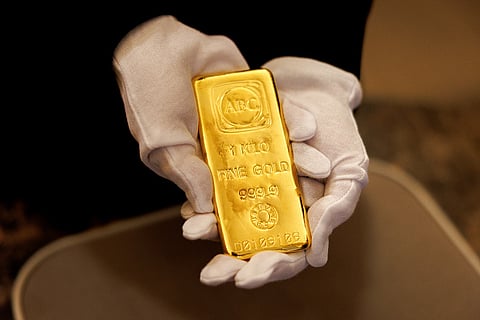
A new audit of South Africa's listed gold producers argues that the 'sunset' of the country's deep mines is a spreadsheet artefact, not a geological fact. Reserve lives are booked at conservative gold prices and shrink accordingly, while companies able to leave, notably AngloGold Ashanti, are doing so at the top of the cycle, rewarded with valuations far above those that stayed. South African gold ounces trade at roughly half the price of comparable Western assets, and exploration spending has fallen 95% since 2006. The state, immobile juniors and mining communities are left to inherit shrinking reserves and the closure liabilities the leavers shed..By Duarte da Silva*.THE SUNSET IS IN THE SPREADSHEET.What South African gold's own companies are doing — and the three questions their numbers answer. Are they simply running sunset businesses on an old-fashioned life-of-mine model? Largely yes — and the sunset is an accounting artefact of the model, not a fact about the gold. Will they leave when the going gets tough? The ones that can leave are already leaving, at the top of the cycle, not the bottom. And what does it all add up to? That the gold is mispriced, not exhausted — and the market is already paying for the half of it that sits on surface. This is the audit, with a point of view..It is one thing to describe what the companies are doing; the harder questions are why, and what it means — and they have sharp, defensible answers. The legacy majors are running their deep South African mines as sunset businesses, but the sunset is manufactured by a price-anchored life-of-mine model that mechanically produces a depleting asset, not by the orebody, which their own disclosures admit can re-rate on price alone. The capital that can leave is not waiting for a crisis to do it; it is exiting now, at the top of the cycle, because a forty-cent-on-the-dollar jurisdiction discount turns exit into the value-maximising move precisely when prices are high. And measured finding by finding, the evidence confirms the diagnosis on almost every count, is silent on two questions the operators simply do not address, and genuinely tests only one — whether the deepest gold is worth developing at all. The numbers, read with a view, are below. The MethodI. Three questions, answered from the filingsAn audit earns its keep by answering questions a slogan cannot. Three are worth putting to South Africa's listed gold producers, and the 2025–26 disclosures answer all three. First: are these simply sunset businesses run on an obsolete life-of-mine model? Second: when conditions deteriorate, will they abandon South Africa? Third: what, taken together, do the numbers prove about the gold still in the ground? The temptation is to answer with impressions; this note answers with the companies' own cost curves, reserve statements, capital allocation and valuations, and takes a position on each, because an audit that refuses to conclude is not analysis.Are they sunset businesses? Will they leave? And what does it all add up to? The filings answer each — and an audit that refuses to conclude is not analysis.Exhibit A · The Reserve Is a Line, Computed From Their Own CostsII. A CEO prices the reserve to the randThe whole argument rests on one claim: that a reserve is not a fact about the rock but a line drawn through it at the price of the day. Sibanye-Stillwater states it as arithmetic. Of Kloof, management said: "If the gold price were 1.4 million rand a kilo we don't have a business. But at R2.5 million a kilo, we've got a fantastic business." Put the company's own cost base beside it. Sibanye guides South African gold all-in sustaining cost to roughly R1.62–1.73 million a kilogram — near $2,800 an ounce as reported in FY2025, and dearer still in dollars at 2026's stronger rand — the dearest tier in the country. At R1.4 million the mine loses R200,000–300,000 on every kilogram; at today's spot of roughly R2.25 million — $4,350 an ounce at a R16.15 rand — it earns a margin of roughly a quarter. Nothing about the orebody changed between those two sentences. A price moved, and a dead mine became a fantastic business. The reserve line is not a metaphor; it is Kloof's mine plan, and management just told the market the strike price.At R1.6–1.7 m/kg of cost, Kloof loses money at a R1.4 m gold price and earns 30% at R2.5 m. The mine did not change between those numbers. The price did.Exhibit B · The Answer to Question OneIII. Sunset businesses — but the sunset is in the spreadsheetAre they sunset businesses run on an old-fashioned model? For the legacy deep mines, the answer is yes, and the indictment is sharper than the word "sunset" allows, because the sunset is manufactured by the model itself. A mine's stated "life" is booked reserves divided by annual production, and booked reserves are drawn at a conservative long-term gold price, still set across the sector at two to two-and-a-half thousand dollars while spot trades above four. A low price deck therefore produces a short reserve life by construction. That short life then justifies cutting sustaining capital — Sibanye describes "declining capital profiles" at Driefontein and Beatrix as evidence of "late-stage life" — which means no money is spent on the reclassification or exploration drilling that would extend the reserve, which guarantees the reserve depletes, which shortens the stated life again. It is a closed loop, and it manufactures a sunset out of an accounting assumption.[ CHART 2 GOES HERE — file: 02_exhibitB_lifeofmine_doomloop.png ] "Sunset by accounting" — the Life-of-Mine Doom Loop diagram. Shows the closed loop: conservative price deck → short booked reserve/short stated life → sustaining capex cut → no reclassification or exploration drilling → reserves deplete → "sunset confirmed" → back to the price deck. Annotated with the break-the-loop note (raise the deck · drill · reclassify → Kloof life 1 yr → 3 yr on price alone).Source: company reserve statements. Sibanye's own Kloof life moves from one year to three on price alone, and management concedes "2027 can look markedly different."The proof that the loop is an artefact, not a fact, comes from the operators themselves. Sibanye states Kloof's life as one year — and then says it becomes three "on the basis that we do it safely, that we pay our own bills, and that we can fund our own capital," and that the deeper reefs it has walked away from could return because "2027 can look markedly different" at a higher price. A mine whose stated life triples on a price assumption does not have a geological life; it has an accounting one. The legacy majors are mining to reserve lines drawn for a world that ended around 2005, and presenting the resulting decline curve to the market as destiny. That is old-fashioned life-of-mine thinking in its purest form, and it is self-fulfilling..But the verdict has a crucial second half, and it is where the opportunity lives. Not every operator is trapped in the loop; the industry is bifurcating into life-of-mine prisoners and life-of-mine refugees. The surface and shallow names have stepped outside the model entirely. DRDGold does not face a depleting reserve curve in the same sense; its feedstock is decades of tailings, and its binding constraint is throughput and deposition capacity, not a price-drawn reserve line. West Wits built Qala on an explicitly "different economic model." Pan African Resources is the clearest case of all, and the one a London audience can price directly: a dual-listed mid-tier whose surface retreatment plants — Elikhulu, the Barberton tailings plant, and now Mogale on the old Mintails ground — already supply about sixty per cent of group output. It lifted FY2025 production to a record 196,500 ounces at record revenue, guided FY2026 to 275,000–292,000 ounces, and told the market in its June 2026 pre-close update that the year will land at about 275,000 — the bottom of the range after a slow ramp-up at Tennant, but a record again, and a leap of forty per cent, won by adding tonnes through Mogale and the Tennant plant in Australia rather than by chasing grade down-dip. These businesses are not sunsets at all; they are early-stage growth on the very ground the deep model wrote off. The legacy major running its deep mine on a conservative deck and a declining capex profile is a sunset business. The retreater and the shallow restarter standing next to it, on the same reef, are not. Same gold, two models, opposite trajectories, and the entire case visible on a single goldfield.A mine whose stated life triples on a price assumption has an accounting life, not a geological one. The legacy majors are running sunsets — but the sunset is manufactured by the model, and the retreater next door, on the same reef, is a growth business.Exhibit C · The Cost Curve Has InvertedIV. The cheap ounce is no longer undergroundWhy is the deep model dying while the surface model grows? Because the cost curve has turned over. Rank the producers by FY2025 all-in sustaining cost and the old hierarchy is upside down. Pan African's group cost sat near $1,600 an ounce in FY2025, and its June 2026 pre-close update put the FY2026 figure near $1,870 at the stronger rand — but the group averages hide the signal: its surface retreatment ounces, now roughly sixty per cent of output, run far cheaper, the Barberton plant near $970 and Elikhulu near $1,075, with Mogale guided below $1,000. The group number is lifted only by its residual deep ounces. Gold Fields' mechanised South Deep came in around the group's $1,645, down four per cent on the year. DRDGold's pure retreatment ran at $1,716 with a margin that widened from thirty-nine to forty-eight per cent. Then the legacy deep: Harmony at $1,806 and rising seventeen per cent, Sibanye's deep gold near $2,800 and climbing into end of life. The modern ounce is cheaper and getting cheaper as it scales; the deep ounce is dearer and getting dearer as it deepens..The corollary answers part of question two before we reach it. Because the deep ounce is the high-cost, pro-cyclical one, a gold-price pullback shuts the deep shaft first and spares the surface plant: at a R1.8 million gold price the retreaters still clear a margin while the four-kilometre mines are uneconomic. The transition every operator is narrating is therefore not a strategy they could reverse if sentiment turned — it is the cost curve enforcing itself, which is why Sibanye calls deep growth "a dimming light." The cheap, defensible ounce is on surface; the fragile, expensive one is at depth.The modern ounce is cheaper and getting cheaper; the deep ounce dearer and getting dearer. A price pullback shuts the shaft and spares the dump. The transition is the cost curve enforcing itself.Exhibit D · The Jurisdiction Discount, PricedV. The same ounce, worth half, for being in the wrong countryThe second hard fact is one the market now quantifies in cash: a South African gold ounce is worth roughly half a Western one, in the ground, for no geological reason. In recent mining M&A, African producer ounces have changed hands near $210 an ounce of resource against roughly $500 in the West, and developer ounces near $79 against $150 — the same metal, marked to forty-odd cents on the global dollar. The public-market metrics agree: South African gold equities price an eleven per cent discount to spot gold, a P/NAV roughly thirty per cent below Australian peers, and EV/EBITDA multiples forty to eighty per cent below North American and Australian names. This is the single largest number in the whole picture, and it is a pure jurisdiction levy..Exhibit E · The Domicile ArbitrageVI. AngloGold did not reprice its gold. It moved its address.If that discount were about the rock, no company could escape it without changing the rock. AngloGold Ashanti escaped it by changing only its postcode. It sold its last South African assets — Mponeng, the deepest mine on earth, together with the Mine Waste Solutions retreatment business — to Harmony in 2020 for about $300 million, completing an exit a decade in the staging; moved its headquarters to Denver; shifted its primary listing to New York; and delivered a 2025 total shareholder return of about 351 per cent and record free cash flow of $2.9 billion. In early 2026 it traded near 23 times earnings, a touch below US peers at 28–33 times but a different universe from the 13-to-16-times multiples the South African names carried. AngloGold did not discover this value; it arbitraged it, walking the same management and much of the same portfolio across an invisible line on a valuation map and being repriced for the crossing. It is the cleanest possible proof that the discount in the prior exhibit is a jurisdiction levy and not a geology one, removed by removing the company from the jurisdiction, with the geology held constant. The sting is in what it left behind: the gold it sold to Harmony is the same gold, now carrying the discount AngloGold shed. The discount does not vanish when a company escapes it; it is inherited by whoever stays.AngloGold removed the South African discount by removing itself from South Africa — same management, much of the same portfolio, repriced +351% for crossing a line on a valuation map. The discount is a jurisdiction levy, proven by the one firm that walked out from under it.AngloGold was not the first to make that trade; it was the second, and the trade reads better as a chain than an event. Gold Fields ran the same play seven years earlier, by corporate structure rather than relocation. In 2013 it unbundled its deep, labour-troubled Witwatersrand mines, the Kloof-Driefontein Complex and Beatrix, into a separately listed Sibanye Gold, keeping for itself only the mechanised, bulk-mined South Deep and directing its growth capital offshore. Read the Exhibit B table again with that in mind: Kloof, Driefontein and Beatrix sit there as Sibanye's depleting deep assets, but they are Gold Fields' cast-offs, shed at the moment the deep model began to break. The discount has therefore been handed down twice on the same goldfield. Gold Fields shed the deep reef into Sibanye in 2013; AngloGold sold Mponeng to Harmony and left the country in 2020; and Harmony is now trying to pass the parcel once more, converting that gold's record cash into Australian copper. Each mobile owner offloads the deep ounce onto a less mobile one and re-rates for the distance gained — and the discount is destroyed at no step, only inherited by whoever is left holding the reef. That is abandonment and abdication written into the share registers themselves.The discount is handed down, not destroyed. Gold Fields unbundled its deep reef into Sibanye in 2013 and kept mechanised South Deep; AngloGold sold Mponeng to Harmony and left in 2020; Harmony now turns that gold into Australian copper. Three exits, one move — shed the deep ounce, re-rate for the distance, and leave the reef to whoever cannot move.Exhibit F · The Answer to Question TwoVII. Will they leave? The ones who can are already goneThis is the question with the most uncomfortable answer. The instinct is to ask whether the producers will abandon South Africa if the going gets tough. The filings show the framing is wrong: the mobile capital is not waiting for tough. It is leaving now, on record FY2025 cash flows, with the metal still above $4,300 an ounce even after its pullback from January's $5,589 record — because the jurisdiction discount makes exit the value-maximising trade in good times, and a record windfall is precisely what funds the exit. AngloGold is gone outright. Harmony is converting its record South African gold cash into Australian copper. Gold Fields keeps one mechanised mine and sends its growth to Chile and its cash to shareholders. The pattern is exact: mobility predicts exit. The more globally listed, better capitalised and multi-commodity a producer, the further it has already moved out of South African gold..Look at who is left in the committed corner, and the answer to "will they leave when it gets tough" resolves into something bleaker than flight. The all-in names cannot leave: DRDGold's asset is the tailings, which are physically in Gauteng; West Wits and Blyvoor are single-asset juniors whose entire existence is one South African orebody. They are not staying out of loyalty; they are staying because they are immobile. So when the going does get tough, when gold pulls back and the highest-cost deep mines go under water first, the sequence is not a dramatic exit but a quiet handover: the mobile majors, already diversified, simply accelerate offshore and let the deep South African assets run down, while the immobile juniors, the state's acid-water liability, and ultimately the zama-zamas are left holding the reef. That is not a hypothetical; it is abdication with the capital-flow arrows already drawn, and it was set in motion at the very top of the market — the exits were funded by the price run that carried gold to its January 2026 record. The timing is the indictment. They will not leave when it gets tough. The ones who can are leaving while it is good, and toughness merely decides who inherits what they leave.They will not flee when it gets tough — the mobile capital is exiting now, while the metal is dear, because the discount makes flight the rational trade in the best of times, not the worst. Toughness only decides who inherits the deep reef: the immobile juniors, the state, and the zama-zamas.Exhibit G · Follow the CashVIII. The record windfall, and where it actually wentThe capital-allocation record makes the flight concrete, and adds a tell worth flagging. Harmony took record free cash flow of R11.1 billion and a Mponeng grade of 11.27 grams a tonne and bought MAC Copper's New South Wales mine for about a billion dollars — and Harmony's own analysts caution that Mponeng's exceptional grade should be modelled back toward reserve grade as the high-grade zones normalise. So the record cash partly reflects a transient grade spike, and Harmony is using a possibly-peaking South African gold windfall to buy a permanent position in another country and another metal. It is monetising what may be the high-water mark of its best South African asset in order to diversify away from South African assets. Set the opportunity cost beside it: Gold Fields returned $1.7 billion to shareholders in a year; against a discovery cost near $25 an ounce and South African deep resource near $79, a fraction of one year's buyback, redirected into reclassification, would convert more gold than any acquisition on the board — at a tenth of the price of the $500 Western producer ounces the same companies are chasing. The cheapest gold on earth, on these numbers, is an already-discovered South African deep resource re-rated at price. It is also the only ounce no listed company will fund.Harmony is monetising the high-water mark of its best SA asset to leave SA. Gold Fields' single year of buybacks, redirected, would reclassify more gold than any deal on the board — at a tenth the price. No one funds it, because the model cannot book it.Exhibit H · The Answer to Question ThreeIX. What the evidence proves, theme by themeSo to the third question, theme by theme. The operators more than permit these conclusions; their own numbers price them. The near-term findings — that the reserve is a price line, that the deep mines are being abandoned rather than exhausted, that the restart and retreatment models work, that the jurisdiction discount is real, that ownership is fleeing — are each confirmed by hard evidence. Two questions the operators simply do not address: the uranium by-product, and the deepest reclassification. And exactly one is genuinely open, whether the deep endowment is worth developing at all, the single bull-versus-bear question on which the whole field is split..Run an eye down the verdict column and the shape is unambiguous: the operators reinforce the diagnosis and the cheap, near-term half of the prescription almost without exception, are silent on the second metal (a commercial gap rather than a refutation), and put on trial only the most capital-intensive claim, the deep reclassification, which every mobile operator is declining to fund. That single "on trial" line is the fair one. The market is ratifying the surface-and-shallow case with capital and rejecting, for now, the deep one — which is exactly the split an honest bear case would predict, and exactly the gap that policy and processing reform would have to close.Most of the case reinforced, two themes silent, one on trial. The market ratifies the cheap half of the case with capital and declines the deep half — the bull-versus-bear axis on which the whole question turns.Exhibit I · The Liability TailX. They unbundle the asset — and the liability with itThere is a second half to the exit that the cash-flow statements never show, and it is the ugliest number in the audit. When a major sheds a deep mine it does not only shed a depleting asset; it sheds the rehabilitation liability bolted to it — the sealing of shafts, the pumping of acid water, the closure of the tailings dams — and South African mining law has a specific safeguard against exactly this, requiring the minister to approve any sale so the state can test whether the buyer can both run the mine and fund its eventual closure. That safeguard has failed before, twice, on this very goldfield. In 2009 Harmony's old Orkney and Grootvlei ground passed through Pamodzi to Aurora Empowerment Systems, which stripped the assets, stopped the pumps, let the workings flood, and collapsed; when Aurora was finally wound up, the environmental liability passed to the State. In 2013 DRDGold sold the seventy-year-old Blyvooruitzicht mine to Village Main Reef; the sale was disputed, both parties disowned it, the mine fell into a permanent provisional liquidation, and roughly six thousand people were left in a company village with no services, a rehabilitation fund short by some seventy-seven million rand, acid water draining toward the Wonderfontein, and the zama-zamas moving into the voids. A campaigner's verdict on the seller at the time was blunt: it alienates its mines when the cost of the liabilities exceeds the profits.That is the template, and the chain of Exhibit E is the same move executed by larger, more careful hands. The danger is not that AngloGold or Gold Fields will strip and abscond — they will not. The danger is structural: each handover walks the deep reef and its closure bill one rung down the balance-sheet ladder, from a New-York-listed major to a domestic mid-cap and, at the bottom, toward a single-asset vehicle or a liquidator's estate that cannot conceivably fund a basin's rehabilitation. The country's derelict-and-ownerless backlog already runs to thousands of sites and a closure liability estimated near forty-nine billion rand; every unbundling celebrated as portfolio discipline quietly lengthens that tail. And the same administrative machinery shows up as the live risk to the upside: Sibanye's Burnstone restart, the cleanest growth story in the legacy stable, is held back not by its orebody or its thirty-six-per-cent return but by a mining right that lapses in February 2027 and an air-emission licence that lapsed in care-and-maintenance and must be re-granted before a tonne can move. The same licensing state that cannot make a good mine reopen on time is the one trusted to catch a bad closure before it strands a community. It has not, twice.They do not only unbundle the asset; they unbundle the liability with it. Blyvooruitzicht and Grootvlei are the template — the reef and its acid water handed down until they reach a vehicle that cannot pay to close them, and the bill lands on the State, the community, and the zama-zama. The R49 bn rehabilitation tail is the price of mistaking exit for discipline.Precedents: Pamodzi / Aurora (Grootvlei, Orkney), 2009–11; Blyvooruitzicht liquidation, 2013 (Lawyers for Human Rights / FIDH, 2017). Burnstone licence status per Sibanye-Stillwater project disclosure. The ~R49 bn rehabilitation liability is the published sector estimate.The Investment ImplicationXI. Two discounts, two trades, one wagerAn audit that does not end in a position is commentary, so here is the position the numbers support. There are two discounts, and they are different trades. The first, the deep-versus-surface discount inside South Africa, is closing: the market already pays up for the modern, low-cost, counter-cyclical ounce — DRDGold doubled in the six months into January's peak — while derating legacy deep. That relative trade, long surface and shallow retreatment and mechanised production against legacy deep conventional, is supported by the cost curve and is already working. The second, the forty-cents-on-the-dollar jurisdiction levy, has barely moved, and it is the larger gap: an eleven-per-cent equity discount to spot and a P/NAV a third below Australia is enormous room to re-rate if the levy ever lifts. What would lift it is no mystery: a working cadastre and regulatory certainty, a sovereign signal that the state treats the endowment as an asset, the acid-water liability converted into funded recovery. Absent those, AngloGold's exit remains the most rational individual move, and its rationality is the country's loss. The whole question is whether the discount is a temporary mispricing or a permanent feature; the operators have split themselves precisely along that wager, the immobile builders betting it lifts and the mobile diversifiers betting it never does. The audit cannot settle the bet; it can show that it is the only bet that matters, and that it is now being placed, with real capital, on both sides.The relative trade — modern ounce over deep — has worked. The absolute trade — South Africa over the world, at 40c — has barely begun. That gap is the whole wager, and the operators have split themselves exactly along it.The Reckoning · Winners and LosersXII. Winners and losers, namedAn audit this long owes a plain answer to the plainest question: who won, and who lost? The numbers say the gold is still there, and that the binding constraint is price, policy and processing, not geology. The companies have now answered with their own capital, and the answer sorts them cleanly. The winners are the firms that either left the jurisdiction outright or stepped outside the deep model; the losers are the ones that can do neither — and, beyond the share register, the public actors who inherit whatever the winners put down. The table names them..Set the two halves side by side and the asymmetry is the whole story. Every private winner won by moving — across a border, onto the surface, or out of the deep reef altogether — and every loser lost by being unable to move: the single-asset junior chained to one orebody, the community chained to one village, the state chained to the closure bill, the zama-zama chained to the only work left in the hole. The gold did not change hands because it ran out; it changed hands because the discount made moving rational and staying ruinous. Each winner is right, individually, to do what it is doing, and the sum of those individually rational exits is a national asset being abandoned at the very top of its market. The remedy is not to shame the movers but to lift the levy that makes moving the only sane trade, so that the cheapest gold on earth, the already-discovered South African ounce re-priced, is at last worth more to someone staying than to everyone leaving. And note what kind of winning this is. The leaver wins an arbitrage, not an orebody: the reward the market pays for escaping a mispriced jurisdiction, not for making gold pay. The operators that actually create value from this ground, the builders who buy the cast-offs and mine them, are penalised by that same discount, capped at a fraction of a Western multiple for staying. The market pays a premium to abandon the reef and a penalty to mine it. Close the discount and the calculus inverts: the builder who stays, not the leaver who goes, is the winner.Every winner won by moving; every loser lost by being unable to. AngloGold crossed a border, DRDGold and Pan African stepped onto the surface, Gold Fields stepped out of the deep reef — while the junior, the community, the state and the zama-zama stayed, and inherited. The exit is individually rational and collectively ruinous. That is the case for closing the discount.The Leavers' Scorecard · Question FourXIII. The leavers won — and the market paid them to leaveBehind the three questions sits a fourth the share register answers without ambiguity: are the companies that abandoned South African gold better or worse off for it? Better, emphatically, and that is the most uncomfortable finding in the audit, because it means the market has been teaching South African mining management a single lesson, in capital, for a decade: leave. The proof is AngloGold Ashanti. The company that sold its last South African mine, moved its head office to Denver and its primary listing to New York is worth roughly forty-nine billion US dollars even after the metal's 2026 pullback — fifty-five at January's peak — more than Harmony, Sibanye-Stillwater and DRDGold combined, and several times any of them alone — with a 2025 shareholder return of about 351 per cent and record free cash flow of $2.9 billion. It did not find that value in the rock. It collected it by crossing a border. The most valuable South African gold company in the world is the one that stopped being South African.[ CHART 6 GOES HERE — file: 06_leaver_is_giant_marketcap.png ] "The leaver is now the giant" — bar chart of 2026 market capitalisation (US$): AngloGold (left SA — Denver/NYSE) ~$48 bn vs Harmony (diversifying to Aus) ~$11 bn, Sibanye-Stillwater (group) ~$8 bn, DRDGold (surface, stayed) ~$3 bn — with annotation that the three "stayers" combined (~$22 bn) are still worth less than half of AngloGold alone.Market capitalisation, 2026: the company that left South Africa is worth more than the three that stayed, combined. The value did not disappear; it re-domiciled. Source: market data, 2026.The partial-leavers are rewarded in the same direction, if less spectacularly. Harmony's record cash flow and its pivot into Australian copper have re-rated the stock and diversified its risk away from the very South African gold that funded the move; Gold Fields, growing in Chile and returning $1.7 billion to shareholders, is valued as a global mid-major rather than a Witwatersrand miner. Even the stayers that won, won by escaping the deep model rather than the country: DRDGold roughly doubled in the six months into January by being pure surface retreatment, and — as the purest gold-price play on the list — has handed back a large slice of that gain in the metal's pullback since, while remaining capped by the South African discount it cannot outrun. The pattern is pitiless. Every company that moved — across a border, onto the surface, or out of the deep reef — was rewarded; every company that could not move was penalised. The legacy deep miner chained to its shafts and the single-asset junior chained to one orebody carry the discount the movers shed..The most valuable South African gold company in the world is the one that stopped being South African. Every firm that could move was rewarded; every firm that could not was penalised. The market has spent a decade teaching SA mining one lesson: leave.The National Bill · Question FiveXIV. How much capital the country has lostIf the leavers gained, the country lost, and the second half of the audit is to size that loss, because every rand of re-rating the movers collected has a mirror image in capital that did not stay, was not spent, or was priced away at home. The loss is not a single line; it is a ledger. Begin with the capital never invested: South African gold exploration collapsed from about R6.2 billion in 2006 to R738 million in 2025 (in dollar terms, from roughly $900 million to $43 million, a ninety-five per cent fall), dropping the country to under one per cent of global exploration spend, from a position of historic leadership. Industry estimates put the spend needed to compete near R12 billion a year, a funding gap above ninety per cent; carried across two decades, the cumulative exploration the country simply never did runs into the order of a hundred billion rand of foregone geological investment — and with it, the discoveries, mines, jobs and tax base that exploration would have produced.Then the capital that left. AngloGold's forty-nine-billion-dollar market value — fifty-five at January's peak — is now domiciled in Denver and listed in New York: the Johannesburg exchange lost its flagship gold major, its head office, its tax residency, its capital-market depth, to a relocation, not a bankruptcy. The value did not vanish; it moved, and the country is no longer where it sits. On top of that is the windfall exported at the high-water mark: roughly a billion dollars of Harmony's South African gold cash flow redeployed into Australian copper, Gold Fields' growth capital sent to Chile, and billions in dividends and buybacks returned to a largely global shareholder register rather than reinvested in the reef. And beneath all of it is the largest and softest number of all — the in-ground value the country prices away every day by leaving the endowment in a jurisdiction the market marks at roughly forty-two cents on the dollar: 48,100 tonnes of gold, hundreds of billions of rand of recoverable value discounted not for any flaw in the rock but for the address it sits at. Set against these gains, the country keeps one thing the leavers shed: the closure liability, a derelict-and-ownerless rehabilitation tail estimated near forty-nine billion rand, inherited by the State as each major unbundles..The capital was not destroyed — it was relocated. Exploration capital never spent; a flagship's value re-domiciled to Denver; a record windfall flown to Sydney and Santiago; and an endowment priced at 42c on the dollar at home. The country kept only the R49 bn closure bill.Sizing the Soft Numbers · The CounterfactualXV. The counterfactual, sizedTwo of the figures above are estimates rather than reported facts, and an analyst's note should say so and then size them properly rather than wave at an order of magnitude. They are the cumulative exploration the country never did, and the in-ground value the discount marks away. Both can be modelled with explicit assumptions, and both survive the modelling.Take exploration first. The reported endpoints are firm: real exploration spend fell from R6.2 billion in 2006 to R738 million in 2025, a decline of about 10.6 per cent a year, for a modelled cumulative of roughly R52 billion actually spent across the twenty years. The counterfactuals are the question. Had the country done nothing more ambitious than hold its 2006 level in real terms, it would have spent about R124 billion — a shortfall of around R72 billion. Had it spent what the industry itself says is needed to compete for global exploration capital, about R12 billion a year, it would have spent some R240 billion, and the shortfall is about R188 billion. So the fair figure is not a single number but a bounded range: between roughly R72 billion and R190 billion of exploration the country chose not to do, in real terms, with a central estimate near R100–130 billion. The original ledger's 'order of R100 billion' sits squarely inside the model..Then the in-ground value, which must be framed as value the country is not capturing rather than cash destroyed, and bounded to the fraction that is bankable now rather than the whole basin. Take only the near-term developable gold that is recoverable today — the roughly 2,200 tonnes of surface tailings, sulphide-locked and shallow remnant ounces. At spot, that slice is worth about $300 billion gross in-situ and, on a conservative net-recoverable fraction, on the order of $130 billion. Apply the jurisdiction discount the audit measured (using the gentler equity and P/NAV figure of about thirty-five per cent rather than the fifty-eight-per-cent transaction haircut) and the country is failing to capture roughly $45 billion of value — about R0.73 trillion at a R16.15 rand — on the near-term slice alone. On the full 48,100-tonne endowment the number runs to the multiple-trillions, but that is a long-run, fully-developed figure too speculative to bank; the near-term R0.73 trillion is the fair anchor, and it is already enormous. 'Hundreds of billions' was, if anything, conservative.Sized, not waved at: roughly R72–190 billion of exploration the country chose not to do (central ~R100–130 bn), and about R0.73 trillion of value it fails to capture on the bankable slice alone. Both estimates survive the modelling — and the second was understated.The VerdictXVI. The market has already voted — in numbersSo, the three questions, answered. Are they sunset businesses on an old-fashioned model? The legacy deep miners are — but the sunset is manufactured by a price-anchored life-of-mine loop, not by the gold, and the surface and shallow operators on the same reef have escaped the model and are growing. Will they leave when it gets tough? The ones that can are already leaving while the going is good, because the discount makes the exit the sensible move when the cycle is high, not low; toughness will not trigger flight, it will only decide who inherits the deep reef the mobile capital is already quitting. And what does it all add up to? Almost every finding is confirmed by hard evidence; two questions go unaddressed; and only one is genuinely on trial — the most capital-intensive of all, the deep reclassification.The companies that own South African gold have given their verdict in numbers rather than slogans — their cost curves, their reserve lives, their capital flows and their valuations. The tell was never in what any of them said about the gold. It was in the life-of-mine that triples on a price assumption, the ounce that trades at half its Western twin, and the record windfall boarding a plane for Denver and Sydney. Read those, and the conclusion is not opinion. The deep model is a sunset the spreadsheet built; the cheap, clean, shallow gold is a sunrise the market is already paying for; and the largest prize of all sits unfunded between them, waiting for the one actor whose horizon is the country's and not the quarter's.THE SUNSET IS IN THE SPREADSHEET — NOT THE REEF.Sunset businesses on an obsolete model; mobile capital leaving at the peak; the case priced, argument by argument. The market has already voted.The numbers say what was done. They do not say by what, or by whom — that is the work of the two papers that follow: first the company that chose the retreat, then the people who signed it..*Dr Duarte da Silva, Capital Markets Strategist • Managing Director, Northbound Processing • Germiston, 2026.Sign up for your early morning brew of the BizNews Insider to keep you up to speed with the content that matters. Register here.Support South Africa’s bastion of independent journalism, offering balanced insights on investments, business, and the political economy, by joining BizNews Premium. Register here.If you prefer WhatsApp for updates, sign up to the BizNews channel here.