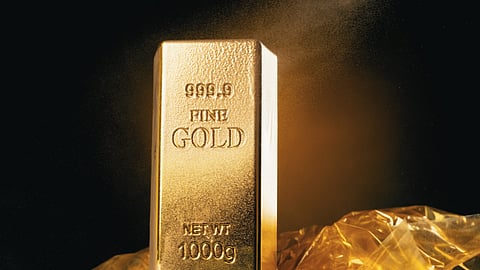
Key topics:Gold price is misleading; USD strength drives apparent gold movesGold as ultimate store of value vs risky investments across asset classesSA gold decline; AngloGold exit; Switzerland dominates global refining.Sign up for your early morning brew of the BizNews Insider to keep you up to speed with the content that matters. The newsletter will land in your inbox every morning on weekdays. Register here.Support South Africa's bastion of independent journalism, offering balanced insights on investments, business, and the political economy, by joining BizNews Premium. Register here.If you prefer WhatsApp for updates, sign up to the BizNews channel here..By Hlelo Giyose*.Gold neither rises nor fallsFor one of the earliest forms of currency known to mankind, gold is still highly misunderstood. The source of miscomprehension about gold is the terminology used to describe its behavior. We often hear that the gold price has either risen or fallen - what captivates investor attention is often the quantum of the rise or fall in the price of gold. To the naked eye, a change in the price of gold from one day to the next must mean the metal does rise or fall in price, surely. The learned eye, however, recognizes the mirage, the illusion that arises when two cars are parked side by side and one car reverses while the other stands still. Passengers in the stationary car monetarily feel like their car is moving forward. Investors hardly realize that when they hold gold, they are sitting in the stationary car. It is the “cars” to their left and right that are moving. Those “cars” could be fiat currencies, (e.g., the US Dollar), real estate, equities, bonds, soft commodities, energy (e.g., oil and coal), base metals (e.g., copper, nickel), bulk metals (e.g., iron ore), and precious metals (silver, Platinum Group Metals).It is these “cars” that are either moving forward or backwards, gaining or losing consumption value, rather than gold. Gold is not consumable and any gold used in fabrication (e.g., jewellery) is fully recovered for use repeatedly into perpetuity. All the gold that has ever been mined is still in circulation. There is no other asset class (you can say that about). So, an ounce of gold that was mined a thousand years ago is still doing the rounds today and will be used again in some form or another for thousands of years to come. That is, it will store value either as a bar, a piece of jewellery, a high- fidelity electricity conductor, or even a tooth filling. In this vein, gold is the ultimate store of value against which investors assume risk when they veer into other “cars”/asset classes. Investors that get out of the stationary car (gold) into any one of the moving cars (e.g., equity) are taking the risk that the asset class will more than compensate them for leaving the safety of a stationary “car”, namely, gold. Gold is therefore the true risk-free asset that, while you should not expect to be paid for holding, prevents you from losing your short (the value of your capital) possible in other asset classes. To extend the analogy, gold is like the sun in that it is the center around which all other planets (asset classes) revolve (turn to for light)..Read more:.The Economist: What is driving gold’s relentless rally?.Yet it is as common to hear investors say the gold price has rallied or plummeted as it is to hear people say the sun has risen (in the East) or set (in the West). The correct terminology is that the US Dollar, for instance, has weakened or strengthened, making an ounce of gold less affordable or more affordable, respectively. The cosmological equivalent is that the earth has turned toward the light (of the sun in the East) and turned away from the light (of the sun in the West). Why is it important to use the right terminology to describe the US dollar weakening or strengthening rather than gold rising or falling? So that you can act – when the US dollar has weakened (sell gold to buy the US dollar) or when the US dollar has strengthened (sell the US dollar to buy gold) respectively.Let us explain the mechanics of this operation. Since an ounce never changes in quantity (an ounce is an ounce) but the dollar changes in value for well-known reasons that are beyond the scope of this exposition, a weak dollar buys you less ounces of gold (you pay more dollars for an ounce, hence the misnomer that the gold price has risen) while a strong dollar buys you more ounces of gold (you pay less dollars for an ounce of dollars, hence the misnomer that the gold price has fallen). If your business is in real estate, then a weak property portfolio value means you must sell more of your property to afford an ounce of gold. The converse is true – a strong property portfolio value, relative to the price of gold, means you sell less of your property portfolio to afford an ounce of gold. If your business is equities, a weak equity market means you have to sell more of your portfolio (pay away more) to afford an ounce of gold while a strong equity market means you must sell (pay away) less of your portfolio to afford an ounce of gold. If your business is bonds, a weak bond market means you must sell (pay more) more of your portfolio to afford an ounce of gold while a strong bond market means you sell (part with) less of your portfolio to afford an ounce of gold. I’m sure you get the point. Failure to identify which car is moving and which is stationary prevents you from maximizing the ounces of gold you get when you sell the dollar, equities, bonds, real estate and vice versa -maximizing how much US dollar, equities, real estate, or bonds you get when you sell an ounce of gold.Another phenomenon that baffles investors is when relationships between gold and any of the other asset classes break down (e.g., gold and Treasury Inflation Protected Bonds). Investors throw their hands up in despair that gold is no longer an inflation hedge. Or when the equity market falls and instead of getting more ounces per share of equity, an investor gets even less ounces of gold (e.g., gold also “falls”, to use incorrect terminology). Investors do not appreciate that án “increase or decrease in the price of gold is in fact a decrease or increase in the composite value of other asset classes. Simply speaking, while all the cars parked next to the stationary car are constantly moving forward and backward, one or more of them are jerking forward and backward more aggressively than others, offsetting the relationship an investor would have based his model on. If all relationships breakdown, that is, all asset classes “bring gold down with them”, then cash - pure cash – would have hitherto been the big loser when most asset classes were expensive along with gold (e.g., high equity valuations, property valuations, bond valuations, along with a high gold price). That often happens when interest rates are on a downward trajectory, cash underperforms everything. The minute interest rates are jolted into rising by some sudden surprising development (e.g., aggressive supply shocks), cash beats everything, including gold. No mystery there. The saving grace is that cash is a poor investment in the medium to long term. Its outperformance quickly gives way to traditional correlations between gold and other asset classes reasserting themselves.Gold is a store of value, not an investment nor a speculative assetThe second miscomprehension is caused by investors using the terms “store of value” and “investment” interchangeably. While investments potentially possess value (intrinsic or extrinsic), none of them store value, let alone permanently. All investment assets are intended to grow (not store) value. There is a lot of risk that resides in the space between growing and storing value. To continue the analogy of cars, when the “car” (e.g., equity market) next to the stationary “car” (gold) goes forward, it is growing/gaining value (capital gains and dividends, income on bonds and preferred shares, and distributions from REITS). The same car (equity market) going in reverse means the capital is shrinking/losing capital and income value. This is the risk investors wish to be paid for (that their capital can expand or shrink), when they move out of storing value in gold into capital growth and income yielding assets. That’s the distinction between an investment and a store of value. The former contains inherent risk an investor requires to be compensated for while the latter has no risk whatsoever and the holder requires no compensation.The million Dollar question you must be asking yourself at this point is, (i) if gold is an asset, but not an investment, and if the price you pay for an ounce of it is determined by the value of other asset classes that are often investments, what makes it a store of value?Gold is a store of value because it, and it alone, possesses enduring qualities that address (mitigate against) the risks associated with investing in all other classes combined. That’s right, gold singlehandedly takes on the world’s investment problems! Here’s how:Spoilage/PerishabilityWhile soft commodities spoil (and lose value) if not stored correctly, gold does notOxidation (rust)While base metals oxidize to rust (if not stored correctly), gold does notBankruptcyWhile equities and bonds can go bankrupt (and lose value), gold does not.Currency DebasementWhile fiat money is often debased by an expansion of money supply through excess credit creation, the gold industry struggles (despite its best efforts) to increase mined gold production by more than 1%-1.5% in any given yearValue-to-weight RatioWhile the cost of transporting other commodities is a significant portion of their market value (115%-30%), the cost of transporting gold is negligible (less than half a percent) due to the high value of gold relative to its density.PermanenceWhile most commodities are impossible to use into perpertuity if and once recycled from their original manufactured product, gold can be re-used into perpetuity when recovered from jewelry, tooth fillings, electronics, etc.Stock-to-Flow RatioThe amount of mined gold in storage (stock) is equivalent to 70 years of annual production (flow) today. The next most stored metal relative to its annual production is silver at 20years. All other commodities are consumed within a year of production..Read more:.Gold triumphs as economists lose the bet.It really is a misnomer to refer to gold as a commodity as you can see above, it has nothing in common with other commodities. The other misnomer is a commonly held view that gold only has a price but no value when in fact commodities and paper money require human intervention to prevent or minimize inherent diminution of value (e.g., preserve soft commodities from spoiling, prevent metals from rusting, central banks controlling the rate at which currencies debase) and gold was built “God ready”, so to speak.South Africa’s own goal in goldAngloGold Ashanti, the fastest growing gold producer in the world, moved its head office from South Africa to the United Kingdom and its primary listing from the Johannesburg Securities Exchange to the New York Stock Exchange in 2023. The company does not own or operate any mines in South Africa. To achieve redomiciling in the UK, the South African Reserve Bank levied a once off R4.5bn exit tax on the company. Anglo Gold also paid R1bn to Australian authorities for also exiting the country as a secondary jurisdiction. That total of R5.5bn worked out to USD286m between the year 2023 and a portion of 2024.For the financial year ending December 2025., AngloGold paid a total of USD2.66bn to host governments where it owns and operates mines (Chile, Peru, Ghana). This amount is over 9x the exit tax paid just two years earlier. Not a cent of USD 2.66bn was paid to the South African Revenue Service (SARS). Yet it is well accepted in geological research that half of the world’s unmined gold deposits lie in South Africa. While those deposits are deeper underground, a structural bull market in gold price makes mining them economically feasible. If a buoyant gold price is not an impediment to mining gold economically in South Africa, then what is? We’d rather you say it.If missing out on globally traded seaborne (in the case of gold, airborne) commodity trade was an Olympic sport, South Africa would win the gold medal (excuse the pun) every time the cycle comes around. This despite voluminous policy statements about beneficiating raw ore into finished product to capture the full value of mined product. Refined gold is the pinnacle of beneficiation. That is, no beneficiation process can result in greater commercial value than refining gold. We used to rule the roost in this.Due to the precipitous decline in gold production locally, South Africa only refines about 5% of the world gold production (down from 66% in 1970). In 2024, South Africa mined and exported USD8.17bn of refined gold. In the same year, Switzerland, a country that does not mine any gold but refines for everybody else (between 50%-70% of gold world production) exported USD105bn worth of high purity refined gold. Switzerland is thus the world’s largest exporter of the precious metal. As well, gold exports were the country’s largest export (27% of all exports) in 2024. The country earns about 3% of the value of exported gold in refining margins (USD 3.15bn) versus the USD8.17bn South Africa earned from exporting mined and refined gold. Simply divide the amount earned by each country by the number of people in the country and you’ll easily understand why Switzerland is the wealthiest country in the world. South Africa (USD8.17bn divided by 63m = USD129 per person). Switzerland (USD3.15bn divided by 9m= USD 350 per person). The moral of the story – use it, lose it..*Hlelo Giyose, Chief Investment Officer at First Avenue Investment Management