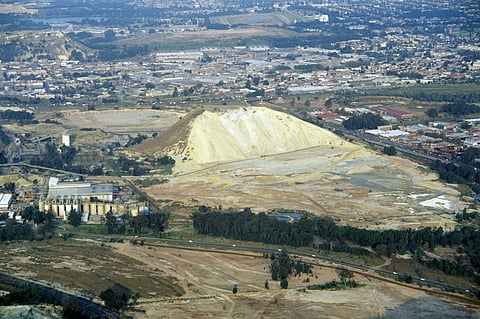
Johannesburg's mine dumps hold about 1,600 tonnes of gold. About a third of it appears in a company reserve statement. The rest? On nobody's books. It sits in liquidated estates, on lapsed rights and on the state's derelict-mines register, carried as a liability. Dr Duarte da Silva, former tech investment guru now of gold-focused Northbound Processing, builds the ledger. The economics are proven: Harmony, DRDGold and Pan African earn fatter margins on waste sand than deep mines earn on rich reef. The mispricing is at the boundary. Pan African bought the Mintails dumps for $1.33 per resource ounce. Investors value DRDGold at $340. And the uranium? Nobody is extracting it..By Dr Duarte da Silva*.The economics of treating Witwatersrand sand are no longer in dispute. Three listed companies publish them every six months, and the year to June 2026 was the most profitable any of them has had. The largest of the three surface businesses is the one least discussed: Harmony produced 6,880 kilograms of gold from surface sources in the year, more than DRDGold's 4,839 and more than the 3,774 from Pan African's tailings plants, inside a deep-level miner whose surface business the market barely sees. This paper takes the margin as settled and asks what comes after it: how much gold is actually on the surface,with what error bars; how much of it has been counted into anyone's books; who owns the rest, and on what terms; and what it costs to move an ounce across the line from a liquidator's liability to a producer's reserve. The answers are less comfortable than the margin story. The endowment count carries an error band of nearly six hundred tonnes. The counted portion is a little over a third of the whole. The uncounted portion is held by companies that no longer exist, on rights that have lapsed, beside communities that were never asked. And the price at that boundary, 1.33 dollars an ounce in the one transaction that has been done properly, is where the second reef is still mispriced by three orders of magnitude, and where the case for environmental arbitrage is plainest: a public hazard carried at a negative value on one ledger and as ore on the other. And the plants take out only about half of what they treat, so the residue leaving them today, with its uranium, is a third life already being assembled in a handful of engineered facilities the operators own. .The second reefI. A mountain range made by hand I have watched them my whole working life: the flat yellow hills that stand along the mining belt from Krugersdorp to Springs, through the middle of Johannesburg and past the gate of my own plant in Germiston. Visitors think they are geology. They are not. They are the largest man-made landscape in the southern hemisphere, the crushed and processed residue of a century in which this basin produced more gold than any goldfield in the history of the world, hauled up from as deep as four kilometres, milled to powder, stripped of what the plants of the day could take, and pumped out onto the veld as slurry, dump after dump after dump. .Across the Witwatersrand the industry left on the order of six billion tonnes of tailings, in some 270 tailings dams and 380 residue dumps covering about 400 square kilometres, ringed around and through the conurbation of Gauteng; the provincial survey counts 374 mine residue areas in the province alone, 157 of them radioactive, over 220 square kilometres. Six billion tonnes is a stratum rather than a stockpile. At the rate Harmony's and DRDGold's tailings plants now mill between them, some sixty million tonnes a year, it is about a century of feed. And every tonne of it has already paid the two costs that break a modern mine before it starts: it has been brought to surface, and it has been crushed. The most expensive work in all of mining, the shaft, the hoisting and the breaking of rock three kilometres down in sixty-degree heat, was done by another generation and paid for out of another century's wages, and the product of that work is stacked in the open air behind chain-link fencing, classified as a liability. Why is there still gold in it? Because recovery is a function of its era. The plants that built these dumps worked with the technology of their day, stamp mills and amalgamation in the early decades, recovering half the gold and losing the rest, then cyanidation in rising states of refinement, and every era's plant let a fraction slip through into the residue. The sand DRDGold treated in the year to June 2026 yielded 0.193 grams a tonne, a seventieth of what Kloof's reef averaged between 1968 and 1994; the sand Harmony's Mine Waste Solutions put through its plant near Klerksdorp in the year to June 2025 yielded 0.13, a hundredth. For a hundred years that number meant nothing, because no price and no plant could make it pay. Both of those constraints have now moved. What has moved only halfway is the count. Another generation sank the shafts, hoisted the rock and milled it, and paid for all of it out of another century's wages. What it left behind is fenced off and called a liability.Exhibit A · The count, with its error barsII. How much gold is actually on the surface The surface argument has been made for years on a single round number, and the number needs its provenance stated. The figure of 1,600 tonnes of gold in the Witwatersrand tailings comes from Handley's reconstruction of the basin's whole production history, published in the Journal of the Southern African Institute of Mining and Metallurgy in April 2023. It is built by subtraction: 50,200 tonnes produced between 1887 and 2019; 2,110 tonnes sent to the tailings between 1886 and 2005, at an average discarded grade of 0.36 grams a tonne; about forty per cent of the impoundments retreated by 2005; about 1,600 tonnes remaining. Those last two figures do not reconcile by simple subtraction, and Handley does not show the step. Retreating forty per cent of the tonnage does not remove forty per cent of the gold, because the plants that did the retreating took out perhaps sixty per cent of what they were fed, which is the figure Handley himself gives for what is recoverable; on that basis the retreatment removed on the order of 500 tonnes and left about 1,600, and that inference is mine. The author gives his own error band on the discarded figure, plus or minus 590 tonnes, and it is the number every subsequent citation drops. On the same method the basin below ground holds 48,100 tonnes, plus or minus 9,000. The bands say that the surface endowment lies somewhere between about 1,100 and 2,100 tonnes, and that anyone quoting 1,600 tonnes to three significant figures is quoting a midpoint rather than a measurement. The second count is mineralogical rather than historical. Chingwaru, von der Heyden and Tadie of Stellenbosch University published, in Scientific Reports in February 2023, a census of where the remaining gold sits: sixty-five per cent of it inside pyrite in the Klerksdorp dumps, seventy-eight per cent in Carletonville, eighty-five per cent in Evander, and up to 420 tonnes across the surface tailings locked in sulphide that a conventional carbon-in-leach plant recovers at about thirty per cent. Read against Handley, that puts a quarter of the surface endowment behind a chemical door the current retreaters do not open, and the ledger has to allow for it, because a reserve statement counts only what the declared flowsheet can recover. The third count is the one nobody has made: a physical, dump-by-dump survey of the 650 residue facilities with a common sampling standard. The Council for Geoscience has mapped the footprints; the provincial department has classified the radiological ones; the operators have drilled the dumps they own. No public body has ever assayed the whole. A country that in 1970 mined two-thirds of the gold produced on earth that year has never counted what it left on the surface, and the round number the surface case rests on is a subtraction from a production ledger rather than a measurement of sand. The first entry in the ledger, then: the endowment is large and real, and its error band is a third of its size. The count only matters at a price. Gold closed at 4,182.11 dollars an ounce on 29 September 2026, a quarter below the 28 January record of 5,589; the rand was at 16.40. At that price a tonne of 0.193- gram sand carries about twenty-six dollars of contained gold, some 425 rand, and the 1,600-tonne midpoint carries about 215 billion dollars of contained metal, some 3.5 trillion rand, with a band from 148 to 282 billion dollars. Nobody will recover all of it, and contained value is an order of magnitude rather than a valuation. The order of magnitude is the useful part: against a national gold output of about ninety tonnes in 2025, eleventh in the world and down 1.9 per cent on the year, the sand holds eighteen years of the country's production, in the middle of its largest city, already crushed. Sixteen hundred tonnes is a midpoint, not a measurement. The band runs from 1,100 to 2,100, and no public body has ever assayed the dumps as a whole.Exhibit B · The proof that history already ranIII. The first second life The surface thesis has already had one complete, profitable life, and that life is the precedent for everything that follows. In 1977 Anglo American established East Rand Gold and Uranium (ERGO) expressly to reprocess the slimes dams of the East Rand, and for more than a quarter of a century that operation treated the old dumps at a scale the present operators have only just climbed back to: 1.6 million tonnes a month through a flotation plant that pulled gold, uranium and pyrite from the sand, a carbon-in-leach plant of 1.5 million tonnes a month from 1985, and two Lurgi acid plants that turned the pyrite into 1,500 tonnes of sulphuric acid a day. By the time it stopped it had put 890 million tonnes through the plant and taken out 8.2 million ounces of gold, 5.5 million pounds of uranium and a generation's supply of acid. The largest mining house in the country looked at the dumps half a century ago, read them as an orebody, built one of the biggest metallurgical complexes in the world on that reading, and was proved right for twenty-five years. Then it closed, and the reason it closed is the lesson. ERGO had not run out of sand. AngloGold, which had absorbed it in 1998, discontinued it in 2005 with gold averaging 445 dollars an ounce, four years after the trough of 255, on the logic that the margin had thinned to nothing and the residue business was finished. In June 2007 AngloGold agreed to sell the Ergo assets to a joint venture of DRDGold and Mintails; the plant changed hands for forty million rand, under six million dollars at the time, was refurbished for a hundred million rand, fourteen million dollars, and DRDGold took full control by January 2010 as its partner failed. The resurrected Ergo, connected in 2013 to the Crown dumps in the middle of Johannesburg by a fifty-kilometre pipeline that cost 305 million rand, about thirty-two million dollars at the time, has since become the cash engine that reported on 19 August: on the same dumps, with the same chemistry, at a price more than nine times the one that killed it. The surface endowment has now been declared finished once and resurrected once, inside a single working lifetime, for one reason: a verdict about price was mistaken for a verdict about the resource. The precedent carries a warning as well as a proof. The operators of the first ERGO read the geology correctly and the price too early, running a plant costed for 1977 against a metal that spent the 1990s falling. The operators of the second are collecting what the first ones proved, on a price that has, in the last eight months, already fallen a quarter from its high. When the price moves this far, every old verdict on the residue has to be re-read from scratch. When it moves back, every new one will be too. Retreatment has already lived once: twenty-five years, 890 million tonnes, 8.2 million ounces, built by the biggest house in the country, shut at 445-dollar gold and resurrected at nine times the price. The verdict was never about the sand. Exhibit C · The proof, runningIV. The audited case, in one table The operating proof is published, audited and recent, and it fits in a table. Three listed companies run it, and the largest of the three is the one that does other things as well. Harmony's South African surface operations (the Mine Waste Solutions tailings complex near Klerksdorp, which it took over from AngloGold in 2020, the Phoenix and Central Plant reclamation plants in the Free State, the Savuka tailings on the West Wits, and the Kalgold pit and waste-rock dumps) produced 6,880 kilograms, 221,199 ounces, in the year to June 2026, down thirteen per cent after a cyanide shortage and heavy rain. They earned 14.4 billion rand of revenue, 850 million dollars, more than DRDGold earned in total, and 6.6 billion rand of adjusted free cash flow, 390 million dollars, a margin of forty six per cent, at an all-in sustaining cost of 1,049,537 rand a kilogram, 1,933 dollars an ounce at thecompany's average rate for the year of 16.89. Its tailings plants alone put 36.5 million tonnes through in the year to June 2025, the latest year for which Harmony has published a plant-by-plant breakdown, for 5,164 kilograms, 166,000 ounces, at 0.14 grams a tonne and 754,260 rand a kilogram, 1,293 dollars an ounce at that year's rate of 18.15: more sand than any other retreater in the country. DRDGold, the pure surface retreater, milled 25.07 million tonnes at 0.193 grams in the year to 30 June 2026 for 4,839 kilograms (155,577 ounces), at an all-in sustaining cost of 1,078,068 rand a kilogram, 1,986 dollars an ounce at its average rate of 16.88, and an operating margin of 57.8 per cent, with no debt, 2.77 billion rand of cash, 164 million dollars, and a dividend raised from 70 cents a share to 170. Its West Rand operation did it at 639,211 rand a kilogram, 1,178 dollars an ounce, half the cost of its East Rand operation and a third of the cost of the deep mines around it. Pan African Resources' three tailings plants (Elikhulu on the Evander dumps, the Barberton plant and the Mogale complex on the old Mintails ground west of Johannesburg) produced 3,774 kilograms (121,334 ounces) in the year to June 2026, forty-five per cent of the group's 8,470, at all-in sustaining costs, which the company reports in dollars, of 1,231 dollars an ounce at Elikhulu, about 669,000 rand a kilogram at its average rate of 16.90, 1,386 dollars at Mogale, 753,000 rand, and 1,564 dollars at Barberton, 850,000 rand, against a group figure of 1,867 dollars, 1,014,000 rand; the results, published on 16 September, took the group from 150 million dollars of net debt, 2.5 billion rand, to 186 million dollars of net cash, 3.1 billion rand, in a year. In the same basin, Sibanye-Stillwater's remaining South African deep-level gold produced 9,134 kilograms, 294,000 ounces, in the first half of 2026, about 18,300 kilograms or 587,000 ounces a year at that rate, at an all-in sustaining cost of 1,638,089 rand a kilogram, 3,105 dollars an ounce, a margin of about twenty-six per cent at today's price; the half-year is the latest period it has reported, and the annual figure is my arithmetic. The margin on treating waste sand exceeds, by a wide distance, the margin the deep mines earn on ore fifty times richer. Nobody has to model whether re-mining the dumps works. The model runs daily, and it reported on 19 August, 27 August, 1 September and 16 September. .Surface sand against deep reef, latest reported periods, every cost on both bases. Gold is given in kilograms and ounces; all-in sustaining cost in rand a kilogram and dollars an ounce, converted where a company reports only one at that company's own average exchange rate for the period (Harmony R16.89, DRDGold R16.88 and Pan African R16.90 for the year to June 2026; Harmony R18.15 for the year to June 2025; Sibanye-Stillwater's half-year figures as reported). The margin is the author's arithmetic at the 29 September 2026 close, 2,204,600 rand a kilogram, 4,182 dollars an ounce, on the rand cost. Harmony's tailings-plant line is the year to June 2025, the latest plant-by-plant breakdown published; Sibanye-Stillwater's half-year is annualised by the author. The case for re-mining the dumps needs no model. It is running, at scale, in three sets of audited accounts, a few kilometres from where the sand was first poured, and it reported four times in four weeks..Exhibit D · The counted and uncountedV. Where the fifty-one million ounces actually sit Nobody has assembled the ledger itself. Take the 1,600-tonne midpoint, 51.4 million ounces, and ask how much of it appears in any company's declaration. DRDGold's annual report of 30 September declares reserves of 6.24 million ounces in 695 million tonnes at 0.28 grams, and resources of 6.58 million in 731 million tonnes, as at 30 June 2026; the reserve grew from 5.85 million a year earlier, because the Kloof 2 dump from Sibanye (67 million tonnes at 0.24 grams, half a million ounces) entered the West Rand life-of-mine plan and outweighed 0.28 million ounces of depletion. The reserve is struck at a gold price of 2,155,461 rand a kilogram, 4,114 dollars an ounce, within two per cent of the 29 September close, so it carries no cushion against the price. Pan African's tailings holdings run to something on the order of four million ounces: the Mogale resource of 2.36 million in 243 million tonnes at 0.30 grams, the Soweto cluster's 980,000-ounce reserve in 108 million tonnes declared in June 2026, and what remains at Elikhulu and Barberton. Sibanye's retained Cooke dump carries a probable reserve of 600,000 ounces in 67.6 million tonnes, declared in February 2026 alongside its uranium. Harmony carries the most: Mine Waste Solutions declares 1.3 million ounces of reserve inside 1.6 million of resource, with a fourteen-year life, and the Free State and West Wits reclamation projects now in feasibility hold more than six million ounces of declared resource between them, 5.7 million of it in the Free State; its chief executive, Beyers Nel, says the two could add about 100,000 ounces a year of long-life, low-cost production. Add them, allowing for the approximations, and the counted surface ounces of the Witwatersrand, declared, owned by a going concern, with a plant attached or planned, come to perhaps seventeen to twenty million, 530 to 620 tonnes, of which Harmony holds the largest share. The remainder is the larger entry: about thirty-three million ounces on the midpoint, roughly 1,030 tonnes, or anywhere from fifteen to fifty million on the error band, in no reserve statement and on no balance sheet. Where is it? Part of it sits in the estates of liquidated companies; Mintails, whose provisional liquidation in 2018 left a rehabilitation obligation of 460 million rand, some twenty-nine million dollars, against a provision of twenty-eight million rand, under two million dollars, was one of several. Part sits on old mining title whose residue rights, surface rights and closure obligations are knotted across a century of transactions and lapsed companies. Some lies on municipal commonage and private farms where a dump was poured before the town arrived, and the rest is on the derelict-and-ownerless register: about 6,100 sites on the Department's count, of which a 2025 study found that 752 require rehabilitation, fifty-five had received it by November 2021, and the Auditor-General reckons the job will take a century at the current pace. The state carries the whole register as a liability its own Department put at forty-eight billion rand in November 2019 and forty nine billion, 3.2 billion dollars at the time, a year later. On its books the sand is worth less than nothing. Side by side, the two halves of the ledger show the market's verdict exactly. The counted half is priced fully: DRDGold's American shares have traded between 19.47 and 39.37 dollars in twelve months, the company was capitalised at about 2.1 billion dollars, 35 billion rand, at the close on 29 September, and on 6.24 million reserve ounces that is about 340 dollars, 5,600 rand, a reserve ounce, richer per ounce in the ground than most deep-level producers on earth. Pan African was capitalised at about 2.5 billion pounds, 55 billion rand or 3.4 billion dollars, on the same day. Whatever discount the surface once carried on the two pure-play operators, twelve months of results have closed it. The uncounted half is priced at zero or below. The discount has moved: from the ounces somebody counted, where the market has spent a year closing it, to the ounces nobody has, where it is total. One part of the counted half is still not priced at all, and it is the largest. Harmony's surface business earned 6.6 billion rand of free cash flow, 390 million dollars, in the year to June 2026, about as much as DRDGold's entire operating profit, and carries more surface ounces in its resource statements than DRDGold does, though far fewer as reserves: 2.8 million, Kalgold's open pit included, against 6.2. It sits inside a company of some twelve billion dollars, 183 billion rand, whose share price moves on Mponeng, Hidden Valley and copper, and no analyst values it separately. What it would fetch on its own depends on which of DRDGold's ratings is borrowed. Per rand of operating cash, roughly what DRDGold is worth, some 2.2 billion dollars or 36 billion rand; per ounce produced, 221,000 a year against DRDGold's 156,000, about 3.0 billion dollars, 49 billion rand; per declared reserve ounce, about a billion dollars, sixteen billion rand, because the more than six million ounces in Harmony's two reclamation feasibilities have not yet been declared as reserves. The spread between those three numbers is what the market has not yet resolved. It has found the surface ounces that are sold as surface ounces, and it pays for them per reserve ounce declared; it has not yet found the ones sold inside a deep-level miner, and their owner has not yet declared them. .The market prices the counted ounces at about 340 dollars, 5,600 rand, apiece and the uncounted at zero. The discount has moved from the ounces somebody counted to the thirty-three million nobody has, and to the surface business hidden inside Harmony..Exhibit E · The boundary, pricedVI. What an ounce costs as it crosses the line The whole value of the second reef is now created at one boundary: the line an ounce crosses when it moves from the uncounted column to the counted one, from a liquidator's liability to a producer's reserve. There have been enough transactions across that line to price it. The table sets the steps out as a ladder, from the derelict register to the metal itself, and the three transactions that matter most follow it. .The value ladder of a surface ounce, in US dollars per contained ounce in a declared resource or reserve, with each rung's share of the gold price on its own day. Rung 4 is a cost, the capital that carries an ounce across; the others are what the ounce fetches or is worth. The recovered-ounce versions are in the note. All per-ounce figures are the author's arithmetic from the cited disclosures..The ladder is built from different dumps, different sellers and different years, and the objection that it mixes them is fair. Four things make it a legitimate comparison. Every rung is stated per contained ounce in a declared resource or reserve, so the denominator is the same from the liquidator's counter to the market's screen; the recovered-ounce versions sit in the basis column and in the note. Each rung is also stated as a share of the gold price on its own day, which strips the price out of the climb: gold rose nearly three and a half times between Sibanye's sale and this week, and the ladder survives the correction, from seven hundredths of a per cent of an ounce at the liquidator's counter, to two per cent from the major, to eight per cent once the market prices a declared reserve, to a third at the margin. The climb from the liquidator to the market is 256 times in nominal dollars and about 120 times with the price stripped out: half of the headline is the gold price, the other half is the ledger, and the ledger alone is two orders of magnitude. The sand is one asset class. The same reef, the same cyanide history, grades between 0.13 and 0.36 grams, the same hydraulic mining and carbon-in-leach, unit costs between a hundred and 230 rand a tonne, six to fourteen dollars: a price per ounce on one dump means something on the next in a way it never would between two hard-rock mines. The ladder also carries its own controls. Rungs two, four and five are one piece of ground, the Mintails dumps, priced by one buyer at three states, and the dumps at rung three sit today inside the company priced at rung six. And the arithmetic closes: the market's 340 dollars a reserve ounce, less the 220 it costs to cross at Soweto, leaves about 120, against a study value of 111 at a gold price a sixth lower. What the ladder does not say is that any particular dump climbs it. Grade, the distance to a circuit and a place to put the residue decide that, and Section X names them. The first is Mintails. In November 2020 Pan African took an option for fifty million rand (thirty-seven and a half million for Mogale Gold, twelve and a half million for the Soweto cluster) over 243 million tonnes of tailings at 0.30 grams, 2.36 million ounces (73 tonnes) of resource: some three million dollars at the rate of the day, or 1.33 dollars a resource ounce on the company's own arithmetic, a figure it still quotes on its website. The buyer also took on the rehabilitation of ground the seller's estate had provisioned at twenty-eight million rand against an obligation of 460 million, under two million dollars against twenty-nine million. It then spent 135 million dollars, about 2.5 billion rand, building an 800,000-tonne-a-month plant in fourteen months, poured first gold on 3 October 2024, and in June 2026 declared a 980,000-ounce reserve on the adjoining Soweto ground. The definitive feasibility study on that ground, published on 11 September 2026, prices a 600,000-tonne-a-month circuit at 3.68 billion rand, 216 million dollars at the study's exchange rate of 17.00, after 718 million rand of value engineering, and now carrying its own lined deposition facility and eighteen kilometres of pipeline, for 35,000 to 40,000 ounces a year, 1,090 to 1,240 kilograms, over about fifteen years at an all-in sustaining cost of 1,750 to 1,800 dollars an ounce, 956,000 to 984,000 rand a kilogram at the study's rate. It returns 29.55 per cent, real and ungeared, at a gold price of 3,550 dollars an ounce, 1.94 million rand a kilogram at that rate and a sixth below the late-September price, with a post-tax net present value of 1.85 billion rand, 109 million dollars, at thirteen per cent and payback three years after commissioning; a final investment decision is targeted for December 2026. The same ounces, on two ledgers, at a price ratio of a thousand to one. The second is Sibanye's West Rand dumps. Its 2016 study sized the whole West Rand concept at 1.3 billion tonnes, eleven million ounces (342 tonnes) of gold and 170 million pounds of uranium, of which Sibanye itself owned 750 million tonnes and six and a half million ounces, and costed a gold plant at 9.6 billion rand, about 700 million dollars at the time. In November 2017 it traded the decommissioned dumps, the Driefontein 2 and 3 plants and the land for a regional facility into DRDGold for 265 million new shares, thirty-eight per cent of the company: assets that lifted DRDGold's reserves from 2.99 to 5.75 million ounces, 6.81 million once the still-active dams follow, and were valued at about 896 million rand, sixty-eight million dollars, when the deal closed on 31 July 2018. That is 325 rand, some twenty-five dollars at the rate of the day, a reserve ounce, and less for the sand alone, since two plants came with it. On 8 January 2020 it paid 1.09 billion rand in cash, seventy-six million dollars, for a further twelve per cent and took control. In December 2025 it added the Kloof 2 dump, half a million ounces, to the same vehicle. Those assets are now Far West Gold Recoveries, the cheapest gold in the group at 639,211 rand a kilogram, 1,178 dollars an ounce, with a twenty-year reserve life and an 800-hectare, 800-million-tonne regional facility sixty-seven per cent built and designed for thirty-four years. The company that wrote 1.4 million ounces off Kloof's underground reserves in February 2026 and closed its 7 shaft in December has moved its surface ounces, step by step, into the one vehicle that counts them, and its half of that vehicle is worth seventeen billion rand today, about a billion dollars, against about two billion rand put in. The third is AngloGold's exit. When it sold Mponeng to Harmony for about 4.4 billion rand, some 260 million dollars at the rate of the day, and left the country on 30 September 2020, Mine Waste Solutions went in the package, the tailings operation it had bought from a failing First Uranium for 335 million dollars, about 2.8 billion rand then, in 2012, and it is now the core of the largest surface gold business in the country: 6,880 kilograms in the year to June 2026, at a free-cash-flow margin of forty-six per cent. A derelict dump can be priced from first principles, since the boundary trade is done one dump at a time and the arithmetic is public. Take a middling orphan on the Central Rand: twenty million tonnes at 0.30 grams, 6,000 kilograms (193,000 ounces) of contained gold, a rehabilitation obligation on the register of, say, a hundred million rand, six million dollars, and no owner to sell it. At the boundary prices above it changes hands for between a quarter of a million and a million dollars, four to sixteen million rand, plus the obligation. Run it through DRDGold's published unit economics (a yield of 0.193 grams a tonne, which earned 445 rand a tonne in the year to June at the price received then and earns 425 rand, twenty-six dollars, at this week's price; 188 rand, eleven dollars, of cash cost a tonne, before the sustaining capital that lifts the all-in figure to about 210 rand, thirteen dollars) and the dump yields roughly 4.3 billion rand of margin, 260 million dollars, after sustaining capital over its life at this week's price, against a hundred million rand of rehabilitation the buyer inherits and perhaps three to five hundred million rand, twenty to thirty million dollars, of pipeline and plant connection if it lies within reach of an existing circuit. Every one of those inputs can be argued with: the recovered grade will be lower than the assay, the pumping distance may be longer, the price may be lower. Halve the margin and it still clears. The hardest test is DRDGold's own: its reserve statement assumes that the plants recover forty per cent of the gold at Ergo and fifty-four per cent at Far West, and at those recoveries a 0.30-gram dump yields 0.12 to 0.16 grams a tonne and the margin falls to between 1.1 and 2.9 billion rand, 67 to 180 million dollars. At the lower figure it still covers the rehabilitation and the connection, with less to spare. Such dumps are not bought weekly because the seller does not exist, the obligation does not transfer cleanly, and the deposition facility that would receive the sand belongs to somebody else. Each of those is an institutional problem with an institutional answer, and Section X names them. The price at the boundary, then, runs from about a dollar an ounce, some twenty rand, when the seller is a liquidator to some twenty-five dollars, 325 rand, when the seller is a major shedding its dumps with their plants, against about 340 dollars, 5,600 rand, when the buyer is the public market pricing a declared reserve with a plant on it: 256 times from the liquidator's counter to the market's screen, and about 120 times once the rise in the gold price is taken out. Nothing else in South African gold offers a ratio like that, and it is available only on the uncounted side of the ledger. The operators know it: DRDGold's annual report says it has begun a search for tailings retreatment partners "on two continents – Africa and South America – for the recovery of both gold and copper", which is the boundary trade offered for export. .A dollar an ounce from a liquidator, twenty-five from a major shedding its dumps, 340 from the market once a plant stands on it. No other ratio in South African gold comes close..Exhibit F · The triple dividend VII. Metal, remediation, ground If retreatment were only a gold trade it would still clear any investment committee in the world at these margins. The surface pays three times, though, and the second and third dividends turn the uncounted ledger from a private opportunity into a public argument. The triple dividend has a name, and it is the idea at the centre of my own work: environmental arbitrage. An arbitrage exists wherever one asset carries two prices at once. On the Witwatersrand the same tonne of sand is carried by the state as a hazard with a negative value, rehabilitation owed and never funded, and by the gold market as ore worth some 425 rand, twenty-six dollars, of contained metal a tonne. The operator who buys at the first price and sells at the second is paid, in gold, for removing a public liability, and the wider the gap between the two ledgers, the larger both the profit and the public good. It is the circular economy in its most literal form. Kenneth Boulding argued in 1966 that a closed economy, his spaceship earth, would have to treat its wastes as inputs rather than throw them away; Walter Stahel, from the 1970s, showed that the value lies in keeping materials in use rather than in making new ones. The dumps are a century of discarded input sitting in the open, already hoisted, crushed and paid for, with their metal only partly taken. Re-mining them needs no new hole in the ground, and every ounce that crosses from the uncounted column to the counted one is an ounce the circular economy has taken back from the linear one.The remediation dividend is usually stated in the abstract. Living beside a dump is concrete. The dumps were placed, and the townships were placed against them, by a planning logic that never asked the people who would breathe the consequence. In the dry months the wind lifts the fine fraction off the unvegetated slopes and carries it into houses, schoolyards and lungs across the mining belt, from residue that carries what the reef carried: silica, sulphides and uranium. The Bench Marks Foundation's household survey of August 2016, published in 2017, found fifty-six per cent of respondents in Riverlea and forty-nine per cent in Diepkloof naming respiratory ailments as their most persistent health problem, against twenty-six per cent in Danville, a Mahikeng suburb with no mine near it; self-reported rather than measured, and telling. The seepage feeds the acid drainage. The unfenced slopes bury children who play on them. None of this appears on a balance sheet. That is the accounting failure behind the uncounted ledger: the dump's costs are real and continuous, and they land on people who were never paid a cent of its gold. Reprocessing does what a rehabilitation budget never quite manages: it removes the hazard bodily. The sand is hydraulically mined away, the residual metals are taken out in the plant, and what remains is redeposited, once and finally, in a single lined, engineered facility built to standards the 1930s never imagined. Every tonne treated is a tonne subtracted from the problem, and the subtraction is measurable: DRDGold has removed 138 dumps to date; its dust exceedances at Ergo fell from twenty-nine to seven in the year, its Far West operation recorded none, and the National Nuclear Regulator issued clearance certificates for fifty-one hectares of rehabilitated land in the year to June 2026, with applications lodged for fifty-nine more. Retreatment is the only mechanism on offer that cleans at industrial speed, pays taxes while doing it, and reaches the radioactive sites that conventional rehabilitation cannot touch, and on the derelict register, at fifty-five sites rehabilitated in the first years of a hundred-year programme, it is the only mechanism on offer at all. Harmony's Mine Waste Solutions has been doing the same on the Vaal River since 2020, moving old dams from beside Stilfontein and Orkney onto a single engineered facility at Kareerand, whose extension it completed on time and within budget in the year to June 2026. The third dividend is the ground itself. The mining belt is a band of dead land through the middle of a metropolis starved of well-located space; Johannesburg is hemmed in by its own residue. Where a dump is removed, a footprint is released, serviced by location alone, at values the retreatment economics never claimed: the 400 square kilometres under the dumps sit inside and between the most valuable urban land in Africa. The gold pays for the mining, the mining is the remediation, and the remediation frees the land: a value chain in which the same tonne of sand is monetised three times, and the third time may be the largest of all. For the uncounted ounces, which sit disproportionately on the oldest, most central and worst-placed dumps, the second and third dividends are often larger than the first. One tonne of sand, sold three times: for its gold, for the hazard it stops being, and for the ground it gives back. On the oldest, most central dumps the second and third sales outweigh the first. Exhibit G · The third lifeVIII. What the second life leaves behind The plants do not take everything out. Pan African designed Elikhulu at a head grade of 0.32 grams a tonne and expected to recover 45 to 50 per cent of it. DRDGold's reserve statement at 30 June 2026 assumes a plant recovery of 40 per cent at Ergo and 54 per cent at Far West, which on 3.65 and 2.59 million reserve ounces is about 2.9 million recovered and 3.4 million sent on; the year's yield of 0.19 grams was higher than that implies only because Ergo chose higher-grade clean-up material at a record price. The Stellenbosch census explains why: 65 to 85 per cent of the gold left in the dumps is locked in pyrite, and conventional cyanidation recovers about 30 per cent of that. Take the middle of those figures and something like half of the gold in every tonne fed to the retreaters leaves them again in the residue. The plants take the free gold, which is what their chemistry can reach, and pass the rest on. That residue has an address, which is more than the dumps it came from can say. Ergo's goes to the Brakpan facility and, since 6 July 2026, to the 120-million-tonne Daggafontein dam, with the 310- million-tonne Withok facility to follow; Far West's will go to the 800-million-tonne regional facility at Driefontein, where first deposition is scheduled for the December quarter of 2026, weather permitting, and the full 1.2 million tonnes a month by the September quarter of 2027; Mine Waste Solutions' goes to Kareerand, which Harmony has just extended; Elikhulu's goes to the lined Kinross extensions; Mogale's and Soweto's to new facilities of their own. DRDGold's three alone are designed for 1.23 billion tonnes, with Withok's 310 million still awaiting its licences. For the first time in the basin's history, everything the retreaters reject is being placed in a handful of engineered, lined facilities with one owner, one title, a pipeline already laid, a closure plan and no township on top. On the operators' own recoveries, roughly half of the nineteen million counted ounces, on the order of three hundred tonnes, will pass through the plants and into those facilities over the next generation. The uranium goes with all of it, because a carbon-in-leach plant takes none of it out: at the basin's average tenor of about a hundred grams a tonne, some six thousand tonnes of uranium a year are moving from old dumps to new ones untouched. DRDGold's chief executive said at his August results that uranium “will be the next CEO's sort of focus area”. That is a date rather than a refusal. So the second reef will have a third life, and it will be easier to reach than the second was. The sand will sit in facilities that the same high-pressure water now washing down the old dams can re-mine, on ground the operator owns, under a title nobody disputes, beside a plant and a pipeline, with its grade known from the plant's own books rather than from a subtraction. What it waits on is what the second life waited on: a price and a chemistry. The chemistry exists. The first ERGO floated the pyrite out of this sand for twenty-five years and sold the acid; DRDGold built a flotation and fine-grind circuit for exactly this gold, ran it at full capacity in January 2014, suspended it that April when production fell and costs rose, and has now approved 880 million rand, 54 million dollars, for a full scale up-flow reactor at Far West, due in the June quarter of 2027, to dissolve more gold from the stream leaving the leach circuit; the bacterial oxidation that has run at Fairview since 1986 was invented for gold in pyrite. None of it has yet paid on sand of this grade at this price, which is why the operators are not running it, and why the third life will be priced, like the second, by a gold price that does not yet exist, and read, like the second, by someone who declines to mistake a verdict on price for a verdict on the sand. The one thing that could put it beyond reach is a closure design that treats the new facilities as final: a cover, a cap and a certificate. Nothing in the rules requires the operators to design them for re-mining, and nothing stops them. The ledger, then, has a further entry, and it is being written now: the residue of the second life, half its gold and all its uranium, filed once more as waste. Half the gold and all the uranium go out of the back of the plant, into a facility with one owner, one title and a pipeline already laid. The third life is being assembled by the second, and filed as waste. The bear, metIX. What the sceptic rightly takes, and what survives Four objections to retreatment have force.The bear's first blow is that the resource is finite and derivative. Every ounce in the dumps exists because someone else mined it first; retreatment produces nothing the deep reef did not, and when the dumps are gone they are gone. Conceded, with the qualification the previous section supplies: the harvest has a second crop, because about half the gold goes back into engineered facilities the operators own, but that crop waits on a price and a chemistry that have not yet paid at this grade, and this paper carries it at nothing. The surface is a harvest rather than a farm, an industrial episode of two to three decades on the operators' own figures, reserve lives of twenty-one years at Ergo and twenty at Far West and a regional facility designed for thirty-four, and what matters is what the harvest buys: two to three decades of cash flow, cleanup and employment, in exactly the window in which the deep reef's own future must be decided and funded. The dumps are a bridge, and a country that burns the bridge because it is not a destination has misunderstood what bridges are for. The second blow is that the yield declines and the costs rise. The richest, most accessible dumps are treated first; DRDGold's all-in cost rose eight per cent in rand and sixteen per cent in dollars in the year, and more than a third of Ergo's throughput is now trucked from small, scattered sites at a higher cost than hydraulic mining; Harmony's surface output fell thirteen per cent and its surface all-in cost rose five; Pan African's tailings costs are up by a third on the figures of two years ago; and the margin rides on a price a quarter off its January high. Conceded, and reported above. The declining-yield curve is meeting two things coming the other way: a gold price that has multiplied more than ninefold since ERGO closed, and a processing cost that owned solar power is pulling down by fourteen rand, about eighty-five cents, a tonne. The margin of the year to June, tonnes flat, cost up, margin from forty-five to fifty-eight per cent, is the answer on the record; the operators have stress-tested their new projects at 2,800 dollars, and DRDGold's annual report guides to 160,000 to 170,000 ounces in the year to June 2027, three to nine per cent more than the year just reported, at an all-in sustaining cost of about 1.23 million rand a kilogram, fourteen per cent higher, and to 185,000 to 195,000 ounces a year once throughput has risen from 2.1 to 2.85 million tonnes a month in the year to June 2028. The third blow is that deposition is the real constraint. You cannot re-mine a dump without somewhere engineered to put it, and permitting a new regional tailings facility (water-use licence, environmental authorisation, waste licence) is a years-long, discretionary undertaking. It is the objection with the longest teeth, and the reason the operators' facility investments (the 800-hectare, thirty-four-year site at Far West; the 120-million-tonne Daggafontein facility that took first tailings on 6 July 2026; the 310-million-tonne Withok facility, awaiting approvals due by year-end and costlier since drilling found dolomite under its footprint; Harmony's extended Kareerand facility on the Vaal River) are strategic assets as much as environmental ones, and the reason the water-use licence for the Libanon pump station granted in July 2026 was a more important document than any results announcement. What the uncounted ounces will queue behind is deposition capacity rather than gold. The fourth blow is that the market has caught up. At 340 dollars a reserve ounce and 2.5 billion pounds, the two pure-play retreaters are no longer cheap, and the cheap entry, the bear says, is over. Conceded for those two; Section V says so. The bear disciplines the thesis without reaching its core, which is already producing at a margin he cannot argue with, and the discount he says has closed has closed only on the ounces that have been counted and sold as surface ounces. It has not closed on Harmony's, and it has not begun to close on the thirty-three million nobody has counted. A harvest of two to three decades that pays for the cleanup, the workforce and the time to decide the deep reef. The bear takes the ceiling, the cost curve and the deposition queue. He leaves the thirty-three million ounces.The obstacles, named X. What stands between the uncounted ounces and a plant The obstacles bind in this order. The first is deposition capacity: every million tonnes re-mined must be redeposited in a lined facility, and the three facilities now being built on the East and West Rand, some seven billion rand between them, 420 million dollars, will absorb the counted ounces for a generation; the uncounted ones will need facilities of their own, and the state's answer should be to license the next ones faster than the last. The second is title. The uncounted dumps sit on residue rights, surface rights and closure obligations knotted across a century; the Mintails estate, with its 460 million rand of obligation and twenty-eight million of provision, twenty-nine million dollars against two, is the model, and the legal instrument that would move such ground across the boundary, a clear treat-and-supply mandate for derelict residues with the rehabilitation obligation transferred to the operator that removes the hazard, does not yet exist in South African law. The third is water and power: hydraulic mining is thirsty and pumping is hungry in a province short of both; DRDGold recycles about seventy per cent of its water, draws three per cent from the potable supply and generates two-fifths of its own power, capital answers to institutional failures that a smaller operator on a smaller dump cannot afford. The fourth is the communities: people live against these dumps and in some cases on them; re-mining done properly removes their hazard, and done carelessly becomes one more extraction performed over their heads. The listed operators' record (seven dust exceedances against twenty-nine, zero fatalities, fifty-one hectares cleared) is the standard the boundary trade will have to meet on ground where no such record exists. None of these is trivial, and all of them are the same kind of problem: institutions that have to be made to permit the mining of a reef whose existence is no longer in question, before the price cycle turns again. The first ERGO ran for twenty-five years and closed at 445 dollars. The clock on the second is the gold price, and it has already lost a quarter since January. The verdict XI. Read the hills again Stand on the Germiston ridge in the late afternoon and look west, and you can see the whole ledger in a single view. The headgears of the deep mines, most of them still now; Kloof's 7 shaft closed since December. The city that gold built, running dry and short of power. And between them, catching the low sun, the yellow hills: six billion tonnes of hand-made mountain, holding fifty-one million ounces on the midpoint and something between thirty-five and sixty-eight on the error band, shedding dust on the communities beside them, carried on every ledger in the province as a problem. Three companies read the hills correctly. The market has paid the two that do nothing else: a dividend raised from 70 cents to 170, a share price that doubled from its twelve-month low to its January peak, a margin of fifty-eight per cent on waste. The third, Harmony, runs the largest surface business of the three and mills more sand than either of the others, and the market barely sees it inside a deep-level miner. The majors have moved their own dumps into the same vehicles, with 1.09 billion rand, seventy-six million dollars, of cash. And the sand leaving the plants today, half its gold and all its uranium still in it, is going into a handful of engineered facilities the operators own: the third life, already being assembled, and filed as waste again. The counted third of the endowment is priced, most of it fully. What remains is the other two-thirds, and this paper's purpose has been to say where it is and what it is worth on each side of the line. It is on the books of nobody, at a value of zero, on ground the state will take a century to reach. The day those dumps are filed as an orebody rather than a liability, in a treat-and-supply statute, in a liquidator's valuation, in a municipal plan, in the market's head, the largest near-term gold resource in South Africa moves from a register of 6,100 hazards to a reserve statement. That re-filing is a decision, and it is made one dump at a time, at prices that have run from a dollar an ounce to twenty-five, by operators willing to take a rehabilitation liability as the price of admission. The reef above ground is the one place in South African gold where nothing at all needs to be invented, only counted, permitted and bought across the boundary before the price closes it. It is also the clearest case in the country for the environmental arbitrage this paper describes: the hazard is the orebody, the cleanup is the mining, and the profit is the proof that a circular economy is a business rather than a slogan. .Read more:.Duarte da Silva: Gold loses its anonymity, and SA's coal-fired ounce should worry.The first reef built a country and was buried four times by the people who owned it. The second was built by hand, out of everything the first one gave up, and it has been waiting at surface for a century for someone to read it at today's price. Three companies already have, and the market has paid two of them. Thirty-three million ounces are still waiting for someone to write them down, and a country that wants a circular economy rather than a speech about one could not ask for a better place to start. For anyone who intends to act on this ledger, the practical version is short. If I were sizing a retreatment business today I would not bid for DRDGold's ounces at 340 dollars; the market has done that work. I would go to the liquidators, the municipalities and the derelict register with a survey crew and a rehabilitation lawyer, and I would buy the obligations nobody wants on the dumps nobody has counted, at a dollar an ounce, with a deposition agreement in my pocket and a plant within pipeline reach. That is where the second reef is still cheap and the dust is worst, and the only part of South African gold where the price of entry is set by a liquidator rather than by a stock exchange. .THE LARGEST NEAR-TERM GOLD RESOURCE IN SOUTH AFRICA IS NOT UNDERGROUND. IT IS THE WASTE ALREADY ON SURFACE, AND TWO-THIRDS OF IT IS ON NOBODY'S BOOKS. Fifty-one million ounces on the count, nine ten million in a reserve or resource statement, a dollar an ounce at the boundary and 340 on the other side of it. The discount has moved. It has not gone..*Dr Duarte F da Silva • Capital Markets Strategist • Managing Director, Northbound Processing • Germiston, September 2026.A note on the figures Every figure in this paper was checked against its source in the week of 14 September 2026, re-checked on 27 September 2026, when Harmony's surface business was added and the text was revised, and re-checked again on 30 September 2026, when the gold price, the rand and the market values were moved to the 29 September 2026 close and DRDGold's figures were checked against its Annual Integrated Report 2026, published that day; the sources follow. Tailings scale — ~6 billion t (Wymer 2001, as cited by Chingwaru et al., Scientific Reports, 2023); 270 tailings dams and 380 residue dumps over ~400 km² (Winde and Stoch 2010, as cited by Kamunda, Mathuthu and Madhuku, IJERPH 13(1), 2016); 374 mine residue areas in Gauteng, 157 radioactive over 220 km² (GDARD 2012, via GCRO map of the month, February 2024). Surface endowment — 50,200 t produced 1887–2019; 2,110 ± 590 t sent to tailings 1886– 2005 at 0.36 g/t; ~40% of impoundments retreated by 2005; ~1,600 ± 600 t remaining, with the reconciliation (40% of the tonnage at ~60% recovery ≈ 500 t removed) the author's inference, since Handley does not show it; 48,100 ± 9,000 t remaining in the basin (Handley, Journal of the SAIMM 123(4), April 2023); the 1,100–2,100 t band and the contained-value band of US$148–282bn are the author's arithmetic on the published error bar at US$4,182.11/oz; gold in pyrite 65% (Klerksdorp), 78% (Carletonville), 85% (Evander), up to 420 t, ~30% recovery by conventional cyanidation (Chingwaru, von der Heyden and Tadie, Scientific Reports 13, 22 February 2023) — read here as part of, not additional to, the 1,600 t, since fire assay reports gold in pyrite. Exchange rates: unless a rate of the day is stated, results figures are converted at each company's own average rate for the period (Harmony R16.89, DRDGold R16.88 and Pan African R16.90 to the dollar for the year to June 2026; Harmony R18.15 for the year to June 2025), current values at R16.40 (29 September 2026), and historical transactions at the closing rate of the date named (about R7.1 in June 2007, R8.3 in July 2012, R9.6 in 2013, R13.6 in August 2016, R13.2 in July 2018, R14.8 in November 2019, R14.3 in January 2020, R16.8 in September 2020, R15.7 in November 2020, R18.6 across the Mogale build of 2023–24), all rounded. Kloof historical grade 13.5 g/t, 1968–1994 (Sibanye-Stillwater declaration, 17 February 2026). DRDGold FY2026 (year to 30 June 2026; results 19 August 2026) — 25,069,947 t at 0.193 g/t; 4,839 kg / 155,577 oz; revenue R11,159.0m (+42%); operating profit R6,452.0m (+83%); operating margin 57.8% (FY2025 44.7%); AISC R1,078,068/kg = US$1,986/oz (+8% in rand, +16% in dollars); cash R2,770.0m, no debt; final dividend 120c, total 170c; Ergo 18.973 Mt at 0.185 g/t, 3,511 kg, AISC R1,221,500/kg; FWGR 6.097 Mt at 0.218 g/t, 1,328 kg, AISC R639,211/kg; Ergo 112,881 oz and FWGR 42,681 oz; average price received R2,289,250/kg (US$4,218/oz), revenue R11,159.0m on 25.07 Mt ≈ R445/t; cash operating cost R188/t; Mineral Reserves 694.62 Mt at 0.278 g/t = 6.24 Moz (Ergo 3.65 Moz, FWGR 2.59 Moz) and Mineral Resources 730.80 Mt at 0.28 g/t = 6.58 Moz at 30 June 2026, from 5.85 Moz and 6.27 Moz at 30 June 2025; reserve gold price R2,155,461/kg (US$4,114/oz at R16.30); plant recovery 40% at Ergo and 54% at FWGR, cut-off grades 0.19 and 0.14 g/t; operating life 21 years at Ergo and 20 at FWGR; Kloof 2 dump 67.36 Mt at 0.24 g/t, 0.52 Moz, added to FWGR's life-of-mine plan; depletion 0.17 Moz at Ergo and 0.11 Moz at FWGR; 138 tailings deposits reprocessed to date; more than a third of Ergo's throughput loaded and hauled; solar 60 MW + 160 MWh, R13.50–14.50/t saving; RTSF 800 ha, fully lined, 800 Mt, R3.4bn, 67% complete, phase 1 beneficial occupation in a commissioning window in Q2 FY2027 (dry conditions required), 1.2 Mt a month by Q1 FY2028, 34-year life; Daggafontein TSF 120 Mt, first tailings 6 July 2026; Withok TSF 310 Mt, R3.0bn, approvals targeted December 2026, completion during 2029, capital raised after dolomite was found in the footprint; up-flow reactor at FWGR R880m, completion Q4 FY2027; water-use licence for the Libanon reclamation pump station July 2026; dust exceedances Ergo 7 (from 29), FWGR nil; 51 ha of land clearance certificates received from the NNR in FY2026 and 59 ha of applications lodged; about 70% of water recycled and 3% potable; 38% of energy from solar; zero fatalities; tailings partners "on two continents – Africa and South America – for the recovery of both gold and copper"; FY2027 guidance 160,000–170,000 oz at a cash operating cost of about R1,099,000/kg and AISC of about R1,230,000/kg, capital about R3.0bn; output profile 185,000–195,000 oz a year at 2.85 Mt a month by FY2028: DRDGold results announcement, presentation and call transcript, 19 August 2026, and Annual Integrated Report 2026, 30 September 2026. DRDGold market data: NYSE close US$24.49 on 29 September 2026, market capitalisation ~US$2.12bn on 86.74 million American shares (867,397,699 ordinary shares, ten to one), 52-week range US$19.47–39.37 (StockAnalysis; DRDGold share-price page); US$2.12bn ÷ 6.24 Moz = US$340/reserve oz. The 185,000–195,000 oz figure given at Mining Forum Americas on 28 September 2026 (transcript via Investing.com) is the output profile at 2.85 Mt a month and not guidance for FY2027, which the annual report sets at 160,000–170,000 oz. Sibanye-Stillwater — WRTRP 2016 scope of 1.3 billion t, ~11 Moz gold, ~170 Mlb U₃O₈, R9.6bn gold plant (Mining Weekly, 8 August 2016); DRDGold transaction announced 22 November 2017, closed 31 July 2018, 265,000,000 shares (38.05%) for assets valued ~R895.7m; option exercised 8 January 2020 for R1,085,590,116, to 50.1% (Schedule 13D/A, January 2020); the assets lifted DRDGold's Mineral Reserves from 2.99 Moz to 5.75 Moz, 6.81 Moz once the active TSFs transfer (DRDGold announcement, 22 November 2017), and FWGR stood at 2.61 Moz at 30 June 2019 (DRDGold fact sheet, December 2019); of the 2016 concept's 1.3 billion t Sibanye itself owned 750 Mt with 6.5 Moz (Mining Weekly, 8 August 2016); R895.7m ÷ 2.76 Moz ≈ R325 ≈ US$25 per reserve ounce at about R13.2 on 31 July 2018 (US$20 at R16.40), the Driefontein 2 and 3 plants included, and Sibanye's 50.1% of DRDGold at US$2.12bn ≈ R17.4bn against ~R1.98bn of assets and cash put in, are the author's arithmetic; MRR at 31 December 2025 (17 February 2026): Kloof reserves −1.4 Moz, Cooke surface probable gold reserve 0.6 Moz in 67.6 Mt at 0.3 g/t, Cooke probable uranium reserve 25.2 Mlb; Kloof 7 shaft closed end-2025; H1 2026 (1 September 2026): SA gold ex-DRDGold 9,134 kg, AISC R1,638,089/kg = US$3,105/oz. Pan African Resources — FY2026 (year to 30 June 2026; results 16 September 2026): 272,310 oz (+38.6%); Elikhulu 56,475 oz at AISC US$1,231/oz, MTR 51,927 oz at US$1,386, BTRP 12,932 oz at US$1,564, tailings 121,334 oz = 44.6%, production-weighted tailings AISC ≈ US$1,333/oz ≈ R724,000/kg (author's arithmetic); group AISC US$1,867/oz; average price received US$4,235/oz; net cash US$185.8m from net debt US$150.5m; reserves 13.04 Moz; FY2027 guidance 280,000–302,000 oz with ~60% from surface; market capitalisation ~£2.51bn at 118p on 2.13 billion shares (London Stock Exchange, 29 September 2026). Mintails/Mogale — option of 5 November 2020 for R50m over 243 Mt at 0.30 g/t (2.36 Moz); Mintails in provisional liquidation with ~R460m rehabilitation liability against ~R28m provision (Miningmx, 6 November 2020); US$1.33 per resource ounce (company website); R50m ≈ US$3.2m at about R15.7 on 5 November 2020; MTR probable reserve 123.6 Mt at 0.29 g/t = 1.14 Moz, upfront capital US$135.1m, DFS construction capital US$161.3m (Mining Weekly, 17 May 2024); MTR capex US$135.1m, first gold 3 October 2024, 800 ktpm design, 18-year life; Soweto cluster — reserve 108 Mt at 0.28 g/t, 980 koz, 600 ktpm (Mining Weekly, 5 June 2026); completed DFS (Pan African SENS, 11 September 2026): capital ZAR3.68bn = US$216m at ZAR17.00, after ZAR718m of value engineering from a ZAR4.40bn base case, including a new GISTM-compliant TSF and ~18 km of slurry and water pipelines; 35–40 koz/yr, LOM ~561 koz over ~15 years; AISC US$1,750–1,800/oz; post-tax NPV13 ZAR1.85bn (US$109m), real ungeared IRR 29.55%, payback ~3 years post-commissioning, at US$3,550/oz; construction ~28 months from FID; FID targeted December 2026 subject to board approval, financing and statutory authorisations; MTR complex ~100 koz/yr at peak. ERGO — established 1977; ~1.6 Mt/month flotation; two Lurgi acid plants at 1,500 t/day; 1.5 Mt/month CIL from 1985 (Bosch, SAIMM "Extractive Metallurgy of Gold", ch. 12); 890 Mt, 8.2 Moz gold, 5.5 Mlb uranium over 25 years; discontinued 2005; sale to the DRDGold–Mintails joint venture agreed 8 June 2007, plant R40m plus R100m refurbishment, full DRDGold control January 2010 (Mining Review; SEC 6-K of 7 June 2007; AngloGold Ashanti history); Crown–Ergo pipeline 50 km, R305m, FY2013 (DRDGold). Gold price averages: 2001 low ~US$255–271; 2005 average ~US$445 (LBMA). AngloGold Ashanti–Harmony: Mponeng and Mine Waste Solutions, ~R4.4bn, concluded 30 September 2020; MWS bought from First Uranium for US$335m in July 2012. Harmony FY2026 (27 August 2026): group 44,464 kg, AISC R1,191,698/kg; South African surface operations (Mine Waste Solutions, Savuka tailings, Central Plant Reclamation, Phoenix, Kalgold and the rock dumps) 6,880 kg (221,199 oz), −13% on FY2025's 7,875 kg; surface revenue R14,389m; adjusted free cash flow R6,588m, margin 46% (from 36%); surface AISC R1,049,537/kg (+5%); Kareerand TSF extension completed on time and within budget; West Wits and Free State Reclamation projects in feasibility with >6 Moz of combined Mineral Resources (Harmony FY26 results and 6-K, 27 August 2026); Free State surface 5.7 Moz and Beyers Nel's ~100 koz/yr estimate (Mining Weekly, 31 August 2026). Harmony FY2025 plant-by-plant (results booklet, p. 17): MWS 23,054 kt at 0.130 g/t, 2,996 kg, AISC R795,380/kg; Phoenix 5,857 kt, 0.163, 954 kg, R721,816; Central Plant Reclamation 3,912 kt, 0.165, 646 kg, R594,711; Savuka tailings 3,669 kt, 0.155, 568 kg, R773,316; waste rock dumps 3,885 kt, 0.38, 1,475 kg; Kalgold 1,464 kt, 0.84, 1,236 kg; tailings plants together 36,492 kt, 5,164 kg, weighted AISC ~R754,260/kg (author's arithmetic). MWS reserves 1.3 Moz, resources 1.6 Moz, 14-year life (Harmony). Harmony market value ~US$11.7bn at US$17.81 on 625 million shares (NYSE, 28 September 2026, the latest close available at the time of checking); surface Mineral Reserves at 30 June 2025: MWS 1.3 Moz, Kalgold 0.6, Savuka 0.3, Phoenix 0.3, Central Plant Reclamation 0.3, together 2.8 Moz, with Mineral Resources of 1.6, 2.2, 0.4, 0.4 and 0.3 Moz (Harmony Mineral Resources and Mineral Reserves 2025); ratings: DRDGold US$2.12bn ÷ 155,577 oz ≈ US$13,600 per annual ounce and 5.0× enterprise value to operating profit; Harmony ~US$11.7bn ÷ 1.43 Moz ≈ US$8,200 per annual ounce; Harmony's surface business at DRDGold's ratings ≈ US$2.2bn (5.0× R7.2bn of revenue less all-in sustaining cost), US$3.0bn (221,199 oz × US$13,600) and US$1.0bn (2.8 Moz × US$340); the stand-alone comparison is the author's. Derelict and ownerless mines — 'approximately R48 billion' and 'close to 6000' sites (DMRE director-general to the Portfolio Committee, 20 November 2019, PMG); R49bn (DMRE to the Portfolio Committee, 17 November 2020, PMG), US$3.2bn at about R15.4; 6,100 sites, 752 requiring rehabilitation, 55 rehabilitated by November 2021, Auditor-General's 100-year estimate (Journal of the SAIMM 125(4), April 2025). Bench Marks Foundation, "Waiting to Inhale", Policy Gap 12, August 2017: household questionnaire of August 2016, respiratory ailments as most persistent health problem, Riverlea 56.1%, Diepkloof 48.6%, Danville (Mahikeng) 25.6%. South African gold output ~90 t in 2025, −1.9%, eleventh in the world (Minerals Council, 9 February 2026; USGS). Gold: US$4,182.11 spot close on 29 September 2026 (Trading Economics), down 2.3% from the US$4,280.19 close of 25 September; record US$5,589.38 on 28 January 2026; USD/ZAR 16.40 (16.3962) at the close on 29 September 2026 (Trading Economics); R2.20m/kg (author's arithmetic). Circular economy: Kenneth Boulding, "The Economics of the Coming Spaceship Earth" (1966); Walter Stahel and Genevieve Reday, report to the European Commission (1976), and Stahel, The Performance Economy (2006). Environmental arbitrage is the author's term. Third life: Elikhulu designed at 1 Mt/month, head grade 0.32 g/t, expected recoveries 45–50%, 689 koz over 13 years (Engineering News, 9 June 2017); DRDGold reserve statement at 30 June 2026: recovery 40% at Ergo and 54% at FWGR, so 3.65 Moz × 40% + 2.59 Moz × 54% ≈ 2.86 Moz recovered of 6.24 Moz, 46% (author's arithmetic); FY2026 yields of 0.185 g/t (Ergo) and 0.218 g/t (FWGR) were earned on reserve depletion at about 0.32 and 0.55 g/t and, at Ergo, on higher-grade mechanical clean-up material; pyrite deportment and ~30% cyanide recovery (Chingwaru et al., 2023); deposition — Brakpan; Daggafontein first tailings 6 July 2026; Withok 310 Mt in permitting; RTSF 800 Mt, first deposition scheduled for Q2 FY2027; 1.23 billion t of design capacity in total (DRDGold Annual Integrated Report 2026); Kinross TSF phases 1–2 lined, phases 3–4 under construction (Pan African); Kareerand extension completed (Harmony, 27 August 2026); DRDGold flotation and fine-grind circuit at full operation January 2014, high-grade section suspended 4 April 2014 (SEC 6-K, April 2014), Aztec up-flow reactor at FWGR, R880m, approved for full-scale construction after pilot work, completion targeted Q4 FY2027 (Annual Integrated Report 2026); BIOX at Fairview since 1986 (Pan African; Mintek/Gencor history); uranium tenor ~100 ppm in Witwatersrand tailings (IAEA URAM 2022–23), 60 Mt/yr × ~100 g/t ≈ 6,000 t of uranium a year and 'about half of 19 Moz ≈ 300 t' are the author's arithmetic; “I think uranium will be the next CEO's sort of focus area” (Niël Pretorius, DRDGold results call, 19 August 2026, transcript via Investing.com; Mining Weekly, 19 August 2026). Units: ounces converted to kilograms at 31.1035 g (121,334 oz = 3,774 kg; 272,310 oz = 8,470 kg; 56,475 oz = 1,757 kg; 51,927 oz = 1,615 kg; 193,000 oz = 6,003 kg; 19 Moz ≈ 591 t; 33 Moz ≈ 1,026 t); Sibanye-Stillwater's H1 2026 figure of 9,134 kg is annualised by the author (≈ 18,300 kg). Value ladder (Section VI, table and chart), all per contained ounce and all author's arithmetic: Mintails R50m ÷ 2.36 Moz ≈ US$1.33 at ~R15.7, 0.07% of gold at ~US$1,940 (5 November 2020), ≈ US$14 and 0.7% with the R460m obligation; Sibanye–DRDGold R895.7m ÷ 2.76 Moz ≈ R325 ≈ US$25 at ~R13.2, 2.0% of gold at ~US$1,224 (31 July 2018); cost of crossing US$135.1m ÷ 1.14 Moz ≈ US$120 (Mogale) and US$216m ÷ 0.98 Moz ≈ US$220 (Soweto; US$385 per recovered ounce on 561 koz); Soweto NPV13 ZAR1.85bn ÷ 980 koz ≈ ZAR1,890 ≈ US$111 at ZAR17.00 (US$194 per recovered ounce), 3.1% of US$3,550; DRDGold US$2.12bn ÷ 6.24 Moz = US$340 per reserve ounce (US$313 net of R2.77bn of cash; US$322 per resource ounce), 8.1% of gold; worked orphan dump: 0.193 g/t yield × R2,204.6/g ≈ R425/t of revenue at the 29 September price (R445/t was earned in FY2026), less ≈ R210/t all-in ≈ R215/t × 20 Mt ≈ R4.3bn (US$262m) ÷ 193,000 contained oz ≈ R22,300 ≈ US$1,360 at R16.40, 33% of gold; recovery 0.193 ÷ 0.30 ≈ 64%, 124,000 oz recovered, ≈ R34,700 ≈ US$2,100 per recovered ounce; at the 40% and 54% recoveries of DRDGold's reserve statement the yield is 0.12–0.162 g/t, revenue R265–357/t, margin R55–147/t, R1.1–2.9bn (US$67–180m), about US$340–930 per contained ounce and 8–22% of gold; multiples 340 ÷ 1.33 = 256 nominal and 8.1% ÷ 0.069% ≈ 120 with the gold price stripped out, 4,182 ÷ 1.33 ≈ 3,100; gold prices and rand rates on the two historical dates are London PM fixes and closing rates, rounded. The counted-versus-uncounted division of Section V (DRDGold 6.6, Harmony ~7.6, Pan African ~4.0, Sibanye 0.6 Moz), the boundary prices of Section VI and the margins in the table are the author's arithmetic from the cited disclosures and are offered as orders of magnitude. Northbound Processing • Germiston, September 2026. The Gold Papers — Paper 26. This article does not constitute investment advice. The characterisation of tailings retreatment economics rests on the cited public disclosures of DRDGold, Pan African Resources, Sibanye Stillwater and Harmony; the endowment figures are resources with published error bands, not reserves, and are labelled as such; the ledger of counted and uncounted ounces is the author's own estimate from the operators' declarations and should be read as an order of magnitude. The author operates a business in the metals-recovery economy that a larger retreatment industry would benefit.