
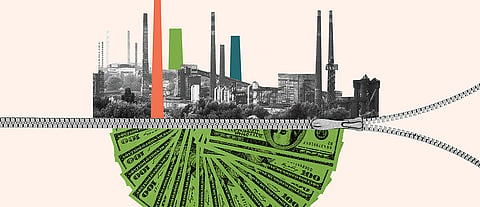
Why GDP may be the wrong yardstick for a resource-hungry world
Must economic growth always mean burning through more resources? Irvan Damon isn't convinced. He points to Dutch builders reusing materials across projects and Japanese firms leasing rather than selling gadgets. Closer to home, Western Cape vineyards are turning to solar irrigation and closed-loop water systems, cushioning themselves against volatile prices. But Damon admits the evidence is promising, not definitive. So what would it take to break the link? His answer starts with how we measure progress.
By Irvan Damon
Can economic growth be truly disentangled from resource consumption, or does this remain the central paradox of modern prosperity and progress?
The conventional paradigm linking economic growth to increased resource consumption is facing unprecedented challenges in a rapidly changing landscape. It would seem that even as nations are rich in natural resources, they yet seem vulnerable to environmental degradation – in this sense, the imperative to decouple these two trajectories has become increasingly paramount. Perhaps the time has come to embrace the practical and theoretical underpinnings of a circular economy, a more plausible framework for sustainable economic development. Empirical evidence abounds of resource-efficient industries and their potential impact on new economic indicators that measure well-being beyond traditional GDP metrics. In this sense, economic prosperity and environmental stewardship are evidently not mutually exclusive. The transition necessitates a shift in investment strategies, incentivising businesses to adopt closed-loop production systems and fostering a culture of resource conservation.

No matter how much we prepare, study, and forecast, the world sometimes gives us problems that just won’t go away. I recall attempting to figure out how resource use and economic growth are connected in a crowded café with a notebook in hand. At first sight, it looked like an easy job. But as I typed, the lines became less clear, and my crisp diagrams started to appear more like a maze of contradictions than a clear path ahead.
At that point, I remembered Dan Millman’s funny saying, “Life has three rules: Paradox, Humour, and Change.” Don’t waste time attempting to figure out the enigma that is life.
This thought, which is both funny and wise, sums up the problem at the heart of our exploration. Is it possible for conservation and progress to happen at the same time, or are we constantly going to be looking for solutions that slip through our fingers like sand? This paradox is a good place to start. I want you to think about whether the separation of resource use and economic development is a puzzle that has to be solved or merely the latest step in humanity’s neverending dance with contradiction.
Theoretical underpinnings: rethinking growth
Deeply ingrained in the industrial revolutions of earlier centuries is the belief that economic growth must inexorably lead to increased resource use. Natural resources were considered the cornerstone of wealth creation by classical economists like David Ricardo and Adam Smith. As John Maynard Keynes wisely noted, “The difficulty lies not so much in developing new ideas as in escaping from old ones.” This realisation is especially important as societies work to adopt more sustainable growth models in place of extractive ones.
Modern economic theory is challenging this dogma more and more. The circular economy, for instance, says that resources may be reused and regenerated to keep creating and maintaining value. In this system, waste is not merely handled; it is carefully planned out of the manufacturing process. To make such a transition happen, we need to rethink ownership, value, and stewardship in addition to embracing new, emergent technologies.
Practical applications: the circular economy in action
It is mostly challenging to migrate from theoretical to practical application. Still, there are many strong instances of companies and countries making real progress towards decoupling. The Netherlands, for example, has a great record of using resources efficiently, even though it doesn’t have many natural resources. Dutch construction companies were the first to employ modular building methods, which make it easier to use resources from one project to another. In Japan, the electronics industry has also used product-as-a-service models, which have lengthened the lives of gadgets and lowered the need for raw materials.
There has been a big surge in green entrepreneurship in South Africa, especially in the Western Cape. Increasingly more vineyards are investing in solar-powered irrigation and closed-loop water systems. These new ideas are good for the environment and good for business, protecting enterprises from the volatility of commodity pricing and regulatory uncertainty.
Beyond GDP: new metrics for well-being
If you really want to decouple, you need to think about how you assess progress again. The standard measure of economic performance, Gross Domestic Product (GDP), doesn’t take into account the costs to the environment or people’s well-being. The search for other metrics and constructs has become more evident, and ideas like the Genuine Progress Indicator (GPI) and the United Nations’ Inclusive Wealth Index are gaining in popularity.
Amartya Sen noted: “the freedoms that members of a society enjoy” should be the main way to judge how well that society is doing. This point of view forces us to observe a paradigm informed by how well we live, fairness, and resilience as opposed to conspicuous consumption and production.
Investment strategies: incentivising the transition
Decoupling needs planned and sustained action through investment and policy. Green bonds and impact investing are two types of financial instruments that have become visible instruments to direct money toward businesses that are good for the environment. These organisations employ closed-loop manufacturing methods, focus on conserving resources, and show demonstrable environmental advantages over the pursuit of short-term profit. Customised financial tools like blended finance and public-private partnerships seem to be driving this transition.
The human element: culture and conservation
A cultural aspect to decoupling must also be accounted for. People’s attitudes and actions impact economic models and investment flows. In order to create a culture of resource conservation, one must embody the need to learn, lead, and accept change.
"We do not inherit the earth from our ancestors; we borrow it from our children.” – African proverb
The above illustrates and captures the idea of intergenerational responsibility that is intrinsic in the pursuit of decoupling.
So, can we really separate economic expansion from intense resource use? The evidence is promising, but not definitive. The way ahead is complicated, intricate and layered. But the fabric of development is made up of brave ideas, practical actions, and the strong belief that the world doesn’t have to suffer for people to be happy.
Paul Samuelson famously opined: “Economics has never been a science, and it is even less so now than it was a few years ago.” Perhaps the seeds of authentic decoupling shall take root along the continuum of certainty and potential. Should we dare to imagine an economy where prosperity and caring for the environment go hand in hand?