
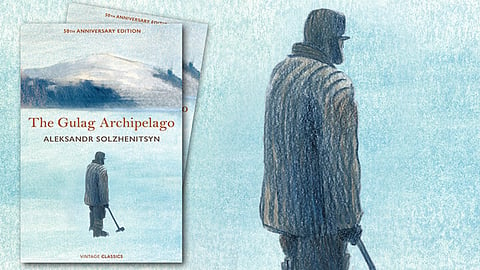
Why the Gulag Archipelago is more relevant than ever
By Rob Neufeld
The Gulag Archipelago is not a book.
It is an earthquake in printed form, a slow-motion detonation that went off in 1973 and has never quite stopped shaking the foundations of respectable opinion. Aleksandr Solzhenitsyn, freshly expelled from the Soviet Union like a bad conscience the regime could no longer stomach, sat down in the West and produced three volumes that weigh, in every sense, more than most libraries. He called it “an experiment in literary investigation,” which is rather like calling the Book of Revelation a pamphlet. What he actually delivered was the longest, darkest, most patient indictment ever levelled against a political system by a single human being who had survived it.
One does not read The Gulag Archipelago; one inhales it in gulps between long pauses to stare at the wall and wonder how the century ever recovered its composure. It is not history in the calm, academic sense. It is testimony, raw and unmediated, from a man who spent eight years in the camps, two more under internal exile, and the rest of his life trying to force the world to look at what it had agreed to forget. The prose is biblical in its fury and its precision. Solzhenitsyn remembers everything: the smell of frozen excrement in a prison train, the sound a skull makes when it meets the edge of an interrogation desk, the exact bureaucratic formula used to sentence a fourteen-year-old boy to ten years for writing a rude poem about Stalin. He remembers because forgetting would be another victory for the regime.
And yet, for years after publication, the polite response in certain quarters was a delicate, almost embarrassed cough. The New York Times, that famous chronicler of all the news that’s fit to print, had spent much of the 1930s retailing Walter Duranty’s assurance that reports of famine in Ukraine were exaggerated, that Stalin was a tough but necessary moderniser. Duranty won a Pulitzer for that series (a prize the paper has never seen fit to return, even after its own subsequent reporting proved him a liar and an accessory). When Solzhenitsyn’s volumes began appearing in English, the same paper gave them respectful, even glowing reviews, but always with the faint air of a host praising a guest who has insisted on describing the host’s cancer at the dinner table. Too much detail, old boy. Distasteful. One might almost say Russian.
The discomfort was understandable. The Gulag Archipelago does not merely document crimes; it implicates everyone who ever looked away. Solzhenitsyn’s central insight (and the reason the book remains radioactive) is that the camps were not an aberration. They were the logical, almost artistic culmination of a system built on the premise that human beings are raw material. The arresting officer, the guard, the informer, the judge who signs the execution list at two in the morning because the quota has not been met; all are cogs, all are victims, all are perpetrators. The famous line about the line between good and evil running through every human heart is not sentimental moralising here. It is forensic observation. Given the right incentives, any of us can be trained to load the cattle trucks.
What makes the book unbearable, and therefore indispensable, is its refusal of consolation. There are no heroes in the ordinary sense, only survivors who know survival is itself a kind of collaboration. Solzhenitsyn quotes prisoners who boast of informing on friends because it bought them an extra bowl of gruel, and he quotes others who refused and died for it. He does not judge the first group more harshly than the second. He simply records that both responses are possible, and that the system was designed to make the first response rational. That is the true abyss: not that evil exists, but that it can be made to seem reasonable, even mandatory.
We like to think the twentieth century settled the argument between freedom and socialism. It did nothing of the sort. It merely changed the packaging. The Gulag Archipelago is the antidote to every sleek new manifesto that promises to get it right this time. Whenever someone tells you that the Venezuelan catastrophe or the Chinese re-education camps or the Cuban gusanos were merely unfortunate detours on the road to paradise, hand them Solzhenitsyn and watch the colour drain from the room. The detour is the road. The camps are the destination toward which any system that believes it owns the future must inevitably travel.
And yet the book is also, strangely, a work of hope. Not the cheap, Hallmark variety, but the hope that comes from seeing the worst and refusing to lie about it. Solzhenitsyn’s famous injunction (“Live not by lies”) is often quoted as a slogan. In context it is a death sentence. To refuse the lie in a society built on lies is to choose martyrdom, or at the very least exile. He knew this better than anyone. He chose it anyway. That choice (the choice to tell the truth when the truth is lethal) is the only victory available in a world of total moral compromise. It is a small victory, but it is absolute
One finishes the three volumes feeling soiled and exalted in equal measure. Soiled because one recognises, with chilling clarity, how little it would take to turn any modern society into a quieter, more efficient version of the Gulag. Exalted because one also recognises that even in the camps there were people who smuggled a crust of bread to a dying stranger, who whispered forbidden poems in the dark, who remembered that a human being is not raw material. The line between good and evil runs through every heart, yes, but so does the line between courage and cowardice, and sometimes courage wins. We need The Gulag Archipelago now more than ever, precisely because the camps have been privatised and rebranded. Today’s gulags have better marketing. They have apps. They promise empowerment while harvesting your data, community while seeding paranoia, safety while building digital cages. The rhetoric is softer, the uniforms have been replaced by terms of service, but the underlying principle is identical: the individual must be subordinated to the system, and the system must never be wrong.
Solzhenitsyn’s great subject was the totalitarian temptation, the belief that history can be forced into obedience by sufficient application of terror and lies. That temptation did not die with the Soviet Union. It merely learned to speak in the soothing tones of public-health mandates and content moderation. The impulse to control what people say, think, and ultimately are, remains the same. The methods have simply grown more polite, which makes them more dangerous, because politeness anaesthetises resistance.
Every generation thinks it has outgrown the need for warnings. Every generation is wrong. The Gulag Archipelago is not a museum piece. It is a mirror. Look into it too casually and you will see only a historical curiosity about some bearded Russians who had a rough time under Stalin. Look longer and you will see your own society reflected back, distorted just enough to be recognisable. The book’s continued relevance is not a tribute to its literary power alone. It is an indictment of our refusal to learn the lesson it paid for in blood.
So read it, if you have the stomach. Read it slowly, because speed is a form of denial. Read it aloud to someone you love, because the words were written to be spoken in defiance. And when you reach the final page (exhausted, shaken, possibly weeping), remember that the author survived the camps, survived cancer, survived exile, and still found the strength to tell the truth when almost everyone else preferred the lie.
That is what literature can do when it remembers its ancient purpose: to bear witness, to shame the devil, and to remind us that even in the darkest century, a single honest voice can make the walls shake. Solzhenitsyn’s voice still does. Long may it continue to disturb the sleep of the complacent.
Sign up for your early morning brew of the BizNews Insider to keep you up to speed with the content that matters. The newsletter will land in your inbox every morning on weekdays. Register here.
Support South Africa's bastion of independent journalism, offering balanced insights on investments, business, and the political economy, by joining BizNews Premium. Register here.
If you prefer WhatsApp for updates, sign up to the BizNews channel here.
