
Timeless ink: How typewriters shaped literature and creativity
Key topics:
Typewriters as timeless tools shaping literature and creativity.
Portable machines enabling writer's mobility and productivity.
Historical impact on iconic authors and literary movements.
Sign up for your early morning brew of the BizNews Insider to keep you up to speed with the content that matters. The newsletter will land in your inbox at 5:30am weekdays. Register here.
Support South Africa’s bastion of independent journalism, offering balanced insights on investments, business, and the political economy, by joining BizNews Premium. Register here.
If you prefer WhatsApp for updates, sign up to the BizNews channel here.
By Haji Mohamed Dawjee
Enter the heart of any city – New York, Paris, London. With their bustling hearts, symphonies of industry at work, and among the honking taxis and hurried footsteps, you will always find one thing: a quaint shop, littered with dust and the scent of history. A place in the present that seems lost in time.
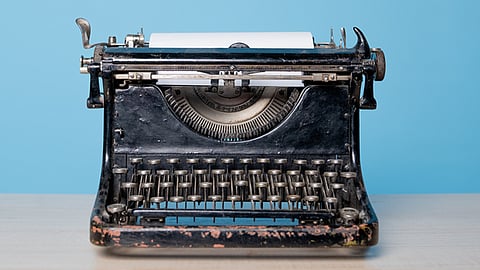
If you look hard enough and shovel through the artefacts of the ages, you will find a machine from a bygone era. You will almost always find one. The typewriter. The comparatively heavy antique storyteller of authors gone by.
The keys are stained with the ink of a thousand stories.
It is often only a place like that that offers the visitor a trip to a different epoch. While you touch and press the keys and may run a finger along the ribbon, you are overwhelmed by air that is heavy with the scent of aged paper and the ink of countless dreams. A portable writing sanctuary for the hands of writers, a haven where the click-clack triggering is the sound of stories unfolding wherever they go.
In Istanbul, in 1965, after many years of borrowing the typewriters of other authors, and while working on his fourth novel, Tell Me How The Train’s Been Gone (eventually published in 1968), James Baldwin finally brought along with him a constant companion of his own. Its name? The Olympia SM7 portable typewriter.
Photographs taken by his Turkish-born photographer and filmmaker friend, Sedat Pakay, as well as Pakey’s film about Baldwin, From Another Place, testify to this. Pakay’s panning camera leads the viewer through the writer’s prolific sanctum: a sparsely furnished study, with a dominant typewriter posed as its centrepiece.
The portable machine transcended its mechanical existence, acquiring a history as fascinating as the stories it helped create.
Long before it became the instrument of literary geniuses, the Remington Company, for example, had an entirely different identity. In the annals of history, it was a renowned weapons and bullets manufacturer, churning out instruments of war with the same precision that would later define its typewriters. There was a poetic irony in the fact that a company once associated with destruction could metamorphose into a harbinger of creativity.
The typewriter was not merely a tool; it was an extension of a writer’s soul. Each keystroke was a heartbeat, every page filled with the essence of the person who created it. The sound of the keys striking the paper was not unlike the ominous click of a handgun being cocked, a sound Remington had become accustomed to in the making of armed weapons, later transformed into a subtle reminder of the power wielded by words.
And when writers wanted to take their words everywhere and compose with quick precision, the typewriter underwent another evolution. The heavy cast-iron machine evolved into a portable and compact device. Its mobility made it a favourite companion for writers on the move.
Imagine, for example, Ernest Hemingway, sipping his rum and intermittently drawing on his cigar in Cuba, beating at the keys. Or F. Scott Fitzgerald in Paris, with the click-clack sound accompanied by the jazz classics of Cole Porter using, his own swift hands on another set of keys.
Then, of course, one has to wonder if the sharp and quick wit of Dorothy Parker, another literary luminary who embraced this marvel of engineering, would be able to write with unparalleled speed, capturing her satirical thoughts as fast as they emerged. The machine became an integral part of their creative process, a conduit through which ideas flowed effortlessly onto the page.
In the hands of writers like Maya Angelou, portables became an instrument not only of literary revolution but of political protest. The ink tattooing the unrest of freedom movements and protests on paper. While Angelou’s method was to capture her poetic elegance on a yellow legal pad, glass of sherry in hand, it was the typewriter that she preferred to edit and elaborate
The humble typewriter helped move the biting critiques of Malcolm X and the moving speeches of Martin Luther King from an oratory space to transcription, leaving an indelible mark on the literary landscape.
The typewriter’s profound impact on literature, the publishing industry and the economics of books cannot be overstated. The typewriter was not only a muse for writers; it was an inspiration to industry. A testament to the power of innovation, the allure of mobility, and, yes, the pure joy experienced by hearing the rhythmic symphony of keys on paper – a fascinating type of magic that attracted many an inquest through time.
Mark Twain once wrote a letter of appeal to the Remington company requesting that they never mention he used one because of the enormous amount of enquiry he would receive about the machine he used to send correspondence. The letter to the company stated that he had decided to stop using the machine because of the overwhelming requests he received asking him to explain exactly what the machine looked like and state what progress he had made by using it. “I don’t like to write letters, and so I don’t want people to know I own this curiosity-breeding little joker”, he wrote. But in spite of the fascination, like all technology that moves to make art easier in a way, there is no writer who has not once experienced the agony of having to retype an entire document or page just to insert a single word, sentence, or paragraph. Then there was the journey through understanding that design process. How to create a book, a pamphlet, or a brochure with just the tab key to keep the words in line and a calculator to add them all up.
Still, even with its challenges, the typewriter is a pivotal piece of engineering that played a profound role in the creation of lasting masterpieces. A compendium of work that will continue to be enjoyed by readers for generations.
The typewriter was an extension of the mind, a formidable tool to capture frenetic energy and a meditative machine that assisted in focusing on the work of writing.
More than just a tool, the typewriter was a talisman. And it will always be one that holds special significance in the craft of literature.
