
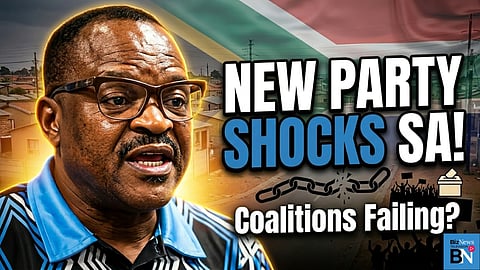
Khulu Radebe - There is a “new animal” in Sasolburg
A new political party has entered the electoral landscape. In this interview with Chris Steyn, co-founder Khulu Radebe describes how The Service Movement for Metsimaholo (SMM) emerged from years of grassroots civic work carried out under the banner of the Metsimaholo Stakeholders Forum (MSF), a non-profit organisation founded in 201&, that tackled environmental, food security, and community welfare challenges in partnership with Sasol and Eskom and Seriti Mines. Radebe says the SMM's unifying civic theme is the “New Animal” because it represents the collective power of residents who refuse to accept broken promises and empty politics. SMM steps into a big political opening in Metsimaholo where no party has commanded the loyalty of voters for over a decade - and where the African National Congress’ (ANC's) dominance has steadily eroded over three elections.
Sign up for your early morning brew of the BizNews Insider to keep you up to speed with the content that matters. The newsletter will land in your inbox at 5:30am weekdays. Register here.
Support South Africa’s bastion of independent journalism, offering balanced insights on investments, business, and the political economy, by joining BizNews Premium. Register here.
If you prefer WhatsApp for updates, sign up to the BizNews channel here.
Watch here
Listen here
READ: The Organisation Profile of the SMM:
Edited transcript of the interview
Chris Steyn (00:01.039)
A new political party has entered the electoral landscape. With me is co-founder Khulu Radebe of the Service Movement for Metsimaholo. Welcome Khulu.
Khulu Radebe (00:14.207)
Thank you, thank you, Chris. Welcome. I'm really excited to be part of this interview. Your viewers on TV, your listeners on radio, and everywhere else.
Chris Steyn (00:28.719)
Your party has morphed from a non-profit organisation founded in 2017 into a political party. What are your foundational objectives?
Khulu Radebe (00:43.566)
Let me just get this thing correct with you. We've been doing work in the community for quite some time. And it has not been the agenda to really contest the elections. We wanted to be a support system to local government because we believe that civil society organisations can play a very important role and support democracy. And unfortunately, things didn't turn the way we planned them.
You know, it's always a problem where people don't really understand the difference between societal activism, democracy, and governance. And that creates a problem in South Africa. I always say to my guys, you know, we made a terrible mistake in 1994 to abandon civil society organisation and thought that democracy by its own nature, having a democratic government, is a solution to every societal problem.
But we only realised later that government can only do this much and civil society can come handy in assisting government.
You talk in terms of your IDP processes. You know, if you have to maintain a sporting facility, you give it to the community and in that you need, you know, an NGO that can take care of that particular infrastructure. It can’t be government 100%. It must always be civil society, whether it's a sporting organisation, whether it's a multi-people centre. Whatever it is, it must be given to society for better management. And government will just ensure that private sector comes handy. Because without that … between private sector and government, it will be difficult for Triple P to really work on the ground.
So this is what we have always said and we realised later that no, we need to take part in this process. If anything fails, let's take this thing by ourselves.
Chris Steyn (02:44.081)
Now your unifying theme is New Animal. What is that a metaphor for?
Khulu Radebe (02:52.62)
Okay, the New Animal, it's a buzzword basically because, you know, with communities, you must get the views of the community before you come up with a name. Now, we said we needed something like a New Animal in Metsimaholo. So let's give it a buzzword, New Animal, and the community must decide what kind of a better name will suit their own situation.
Remember, it is a bottom-up approach. Consult with the communities, have their views. They must give you what they want. They must set up their objectives. The role of leadership is just to coordinate.
And we said then, if the committee says we want this New Animal to be named a Service Movement for Metsimaholo so it be. So you can't separate the two because the other is the foundation of the other.
Now we have the New Animal. It's the first within Metsimaholo. It's the big within Metsimaholo. It's an identity of the new Service Movement in Metsimaholo.
Now when you talk of the New Animal, in the first state, not only in Sasolyrg, in the first state, people are now beginning to say, let's establish new animals, something new for the community.
Chris Steyn (04:03.152)
Now your heartland is the Metsimaholo municipality. Which towns all fall under that municipality.
Khulu Radebe (04:12.92)
Traditionally, it was Denysville, Orangeville, and Sasolburg,... and Zamdela. Now, with the new processes, communities who always want to have their own views, the community of Heilbron is now part of Metsimaholo. Now, we are stretching ourselves towards Heilbron. And let me tell you, we are excited as Metsimaholo to have Heilbron as part of Metsimaholo.
People don't know that Heilbron is 156 years old. And that on its own is the heritage that is going to boos the nature, the tourism character of Metsimaholo is an industrial area. Fusing it with the traditional historical town that is very old, that is en route to the Eastern Free State.
Chris Steyn (04:59.568)
How have other political parties fared in the last three elections in your municipality?
Khulu Radebe (05:08.494)
When you say three political parties, we are referring to the bigger parties. Your ANC, your DA, your EFF. All of them fed below 50%. Hence, we are in a coalition government. And it's not just an ordinary 50%. You know, ANCs are trailing around at 8%. And you know, your EFF and your DA are trailing behind 20%.
Chris Steyn (05:36.016)
And how has this coalition, it sounds like an uncomfortable coalition, affected service delivery in the municipality?
Khulu Radebe (05:45.71)
The reason is that it is not based on sound principles. You know, once coalition arrangements are not based on sound principles, sound agreements, you know, there's a mandate, a theory, where the bigger parties, the national leadership or provincial leadership begin to discuss the issues that affect communities. It takes away, you know, the real value, the real feeling of the communities on the ground.
Because the failure of coalition arrangements, it is that they are drawn elsewhere in the boardroom by higher structures. They are giving lower structures a mandate. In the case of lower structures, determining their own conditions, having their own arrangements, and moving from a premise of common understanding.
So basically what has led to the failure of the coalition arrangement is that they are not built on sound principles, which is what we would not encourage at all. Once we enter into this space and we don't have sound arrangements with political parties in case, because we are aspiring to be above 50%. In case we fell below, definitely we will respect the will of the people. But the same will of the people must be accompanied by their interests. So if it is not accompanied by their interests, we would not be part of that arrangement. It must be based on sound principle.
This is our view, because we have seen coalition failing
Chris Steyn (07:17.7)
Now for almost a decade, you have been involved in community programmes in your municipality. Please tell us what you have been doing.
Khulu Radebe (07:28.525)
Let me tell you, we started the projects in 2013. And in 2013, we realized that the system is not working for all of us. And then we established what was called MICC, the Metsimaholo Interim Coordinating Committee.
But because we were doing this thing as an emergency thing, it didn't work well because we're also approaching the 2014 and the 2016 elections and…. We then said, okay, let's relax everything.
Just after the 2016 elections, we revived the program. We established Metsimaholo Stakeholders Forum. The main focus was unemployment in the beginning. And there were no relationship between the municipality of Metsimaholo with Sasol, with Seriti Mine, with Eskom.
And then we approached. You know, we started with ESKOM. We went to ESKOM. We wrote to ESKOM. We said, can't we have a platform where we are all sitting together to resolve the social contradiction that exists in society? And there was that hassle between the corporate and the communities, because the expectation is that government should be the intermediary between the communities and private sector. But we said, no, no, no. We are doing it ourselves, and please, Eskom, listen to us. And they gave us a chance. A stakeholder forum for Eskom was established, mainly to deal with three things. The CSI part, where private sectors should do community work, the issue of employment, and business opportunities for our people.
In this case, we had a situation in a town called Orangeville, where the services from government level were not necessarily going. I'm talking now province, I'm talking the district, I'm talking the local municipality. It was basically a neglected town of Orangeville, which the entire Metsimaholo is named after because the way to Metsimaholo, it's a township name of Orangeville. So what happened is that there were houses that were burning in Orangeville and then because we already established a stakeholder forum at ESKOM, we then went to appeal to companies within ESKOM, to ESKOM..
Khulu Radebe (09:52.376)
…to provide services in Orangeville. There were three houses that were burned.
The other thing was the issue of health. You know, it's 56 kilometers from Sasolburg, especially where emergency services are located, to a town called Orangeville. By the time an ambulance reaches the town of Orangeville, the person is already dead. In case of fire, if a house burns in Orangeville, by the time the fire extinguisher has arrived at that particular town, the houses already burned. As a result, three houses burned.
And we intervened as Metsimaholo Stakeholders Forum. That's where we established what was called the Urban Renewal of Orangeville. We then invited provincial government to be part of the programme.
And fortunately, with our influence, three houses were renovated. ESKOM donated an ambulance, because we also invited them to the town of Orangeville to have the first feeling. How is this town? And what is life at Orangeville.
Unfortunately, all these things were done outside local government, the municipality, because they were spectators. We invited them, they did not come. Luckily enough, there was a lady who working in the mayor's office … because she's from Orangeville. She participated in the whole issue of getting the services that are needed for her own community.
I must mention that because it's a milestone achievement that we reached. With that particular intervention, ESKOM was able to avail service providers who then said, okay, we have a panel van. With this panel van, let's have this service, let's turn this panel van into an ambulance. It was turned into an ambulance, it was donated to the community during the 2018 Mandela event.
The unfortunate part again is that the provincial government took time to grab the opportunity. We struggled to ensure that the asset is transferred to the provincial government. Finally, they were finally transferred to the provincial government Babcock came on board as well, donated 1.3 million to convert the panel van. The panel van was donated by Lafarge. So Babcock, as a service provider in ESKOM, donated 1.3 million….
Khulu Radebe (12:15.244)
…to turn the panel van into an ambulance. It was, it's a very nice ambulance. Certainly I will send you pictures later to see what kind of an ambulance. It's a Mercedes. You know government is using a vehicle. A private sector donated a Mercedes which has only traveled 10,000 kilos. Basically the new. With standard of Mercedes, when a car you get, a Mercedes car you get at the kilos of 10,000 kilos. It's basically a new Mercedes, it's a new car.
It's a new open event. So that community of Orangeville accepted the donation of an ambulance. Unfortunately, as I'm speaking to you now, it is not servicing that particular community. That is very frustrating on our side. All our efforts went in vain. But because now we are now in the political space of bringing change, the first thing that we're going to do, we're going to ensure that the ambulance goes back where it was donated, servicing the community of Orangeville.
Khulu Radebe (13:16.04)
Second thing that we did, employment. You know, people of Sasolbyrg were not employed as expected in ESKOM. Today, with the stakeholder forum that has been established in ESKOM, employment opportunities are now even between the people …As the standard practice in ESKOM is that they will service a 50-kilometer radius community.
The other achievement is the achievement with Sasol. You know, if I can tell you what we did with Sasol and Metsimaholo I'll take the whole day. During COVID, the Fezi Ngubentombi Hospital was renovated through our influence. In fact, before the COVID, the hospital was renovated because we made our plea very clear to Sasol that you gave birth to a town called Metsimaholo, a town called Sasolburg, a town called ... You can't neglect this community that you proudly produced.
And Sasol contributed immensely in terms of resources to ensure that the hospital is renovated to a better standard. During COVID, PPE were contributed, were donated, and we were also invited.
In all these events, we were invited to say, Metsimaholo Stakeholders Forum, come and see your efforts. And we would come there and do the work and see what our things are done there. All these things forced our communities to say, but use Metsimaholo Stakeholders Forum. We can now change the things around in our community. Why don't you enter the space? We said, no, no, can't enter the political space. We can rather assist the communities to establish something new… So we are still maintaining Metsimaholo Stakeholders Forum. At the very same time, we are also contributing in what the communities are aspiring to which is a force that will change their lives politically in a right manner in Metsimaholo.
And recently, just this past Easter, we organised a sports tournament. The belief that we have is that we can't punish young people because their elders or their parents are not paying for services. It is not their responsibility. Their responsibility is to exercise their full right of being young people. If they have to participate in sports, so it be. So we organised a soccer tournament the past weekend. A very...very successful soccer tournament. It is reverberating in the entire province. Everyone wants to do what we are doing.
During the December holidays, we cut grass. You know, in the main roads, because the main, if you know during December, crime goes high. In the main road, if you don't cut grass, you know, criminals take opportunity of, you know, hiding behind big grass and start robbing the people. So we made.. we made our biggest circle, which is the entrance into the main town and the Free State, a movable area where people can confidently now use the road. So we did so many things, including the green belts. We cut across the green belts. So we're basically not really on holiday. We're at work, hard at work. And we are still hard at work even today.
Chris Steyn (20:17.114)
Thank you. That was, thank you. That was Khulu Radebe, Co-founder of the Service Movement for Metsimaholo Stakeholders Forum Speaking to BizNews, I'm Chris Steyn
