
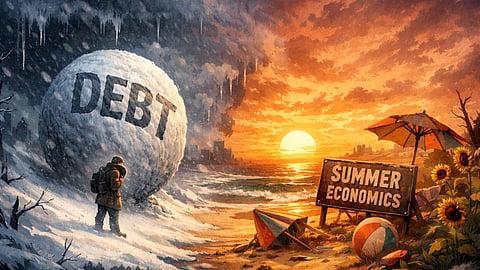
The long winter of debt and the end of summer economics
Key topics:
Economic seasons shift from growth to debt-reduction cycles.
Global economy is in a long “Yin” phase of deleveraging.
Policy tools have limits; confidence and reforms are key.
Sign up for your early morning brew of the BizNews Insider to keep you up to speed with the content that matters. The newsletter will land in your inbox every morning on weekdays. Register here.
Support South Africa's bastion of independent journalism, offering balanced insights on investments, business, and the political economy, by joining BizNews Premium. Register here.
If you prefer WhatsApp for updates, sign up to the BizNews channel here.
By Jon Stilwell
Most things in life have a season to them. We go to bed at night to restore our bodies and minds and wake up in the morning to expend energy and get things done. Our gardens and fields grow in the summer and rest in the winter. Yet some seasons can be so long that they feel permanent. For example, ice ages last tens of thousands of years, and all the generations that experience them will simply think that the world is permanently cold and icy. However, the important point about seasons is that they change and so should our response to them. We should not go to bed at night to be awake or get up in the morning to go to sleep, just as it may be a mistake to sell flip-flops in the next ice age.
There are also seasons in societies. The Springtime of Nations in 1848, the Prague Spring in 1968, the Summer of Love in 1969, the Winter of Discontent in 1978, the Autumn of the People in 1989 and the Arab Spring in 2010 are all names of social and political turning points that would bring about new seasons in the way societies operate and see themselves. These cycles or seasons last for different lengths of time and require new resources and ways of operating in the world. Usually, they also have far-reaching economic causes stretching beyond and below the social changes that appear on the surface.
These economic circumstances also have their seasons, some of which last decades or even centuries. Since the early 2000s, we have been experiencing one of these long-term changes in the economic season, which holds secrets for success and failure in the new world that it is bringing about. The change I’m referring to is not online shopping, ‘working from home’ or ‘Amazonification’, but something more fundamental and even more personal to all of us. The change is to our collective global attitudes to borrowing money.
If you learned anything about business or economics before around 2010, you would probably have learned that in economic theory the objective of a firm is to maximise profit. This assumption has been a cornerstone for many (if not most) economic constructs since the advent of macroeconomics in the early 1900s, including the way institutions like central banks and governments think about the world around them. Inconveniently, since around 2000, more and more firms have stopped trying to maximise profit but instead have decided to focus on a different objective: paying off debt. Today most of the developed world is in this debt-reduction frame of mind, which is turning economics, and economic policy, on their heads as we realise that most of our economic thinking considers only one economic season, when in fact there are at least two.
Read more:

In his book, The Holy Grail of Macroeconomics, Richard Koo describes the economic cycle in terms of two interconnected phases, the ‘Yin’ phase and the ‘Yang’ phase. The Yang phase is a phase of optimism, expending energy, using resources and growing. This phase can be likened to summer, and was the dominant season for most of the 20th century. This also gave rise to economic theory that sees the role of the firm as being simply to maximise profits. However, as Koo explains, the Yang phase is followed by a Yin phase, which is a phase of restoration, conserving energy and storing resources. This phase can be likened to winter and is believed to have started around the turn of the 21st century. This change is one where firms stop trying to maximise profits and instead try to reduce debt. This leads to lower economic growth rates, lower inflation rates and major professional crises for central bankers. In the USA, the change started after the 2008 global financial crisis; in parts of Europe, it started after the IT bubble burst in 2001; in Japan, a similar change started in the 1990s after the commercial property crash; and increasingly studies are recognising that a similar change occurred in the world after the Great Depression in 1929.
In another of his texts, Balance Sheet Recession, Koo describes how managers of firms that experience these transitions experience two fundamentally different parts of a long-run business cycle. In the first part, growth prospects are good, confidence is strong, and credit is easily affordable. This leads profit-maximising firms to borrow money for expansion and growth. This is the part of the cycle that feels good. Forecasts are strong, profits are growing, unemployment is low,
government debt gets paid off, and households buy the second car or go on the bucket list holiday. Then the second part of the business cycle occurs when demand is so strong that prices start going up and central banks lift interest rates to slow the growth in prices. Higher interest rates make it harder to pay for borrowed money and demand for credit (and the things it buys) falls. One or two large businesses fail and earnings fall, taking people’s confidence with them.
Managers experiencing this part of the cycle face a balance sheet where they have borrowed more money than their assets are worth or than their earnings can comfortably sustain. This triggers a change in their incentives in which, instead of trying to maximise profits, they try to reduce debt and personal stress. As a result, they start furiously paying down debt with any available earnings. This leads to much lower borrowing and lower spending in the economy, which in turn results in lower income growth for the managers and households who used to always try to maximise profits.
While everybody is panicking, central bankers become household names. They step in to reassure society that they have the tools and firepower needed to correct the situation and get things back to normal. The only challenge is that in reality they don’t have much firepower at all. In a balance sheet recession, nobody is really spending much, so interest rate cuts often don’t work (because money is not changing hands very much anyway), and interest rates end up at or even below zero. This leads them to try more adventurous policy options like lending huge sums of money directly into the economy through ‘quantitative easing’ programmes or working with government to deposit money directly into citizens’ bank accounts. Unfortunately, given the shift in economic incentives from profit maximisation to debt reduction, these tools are also limited in their ability to spur growth and confidence. What is needed instead is something that can change people’s minds and improve their confidence levels, thereby enticing them to become more active and ambitious economic participants again once their initial debt burdens are reduced. Here good things take time and history has shown that in time people do come around to being more ambitious and optimistic once their incomes compare more favourably to their debt levels. For example, Koo notes that after the Great Depression in 1929, it took almost 30 years for the cycle to turn, but the period after that led to the biggest economic expansions and improvements in global human living conditions in history.
Perhaps not coincidentally, 25 to 30 years is also around the same amount of time that Jared Diamond describes as the interval between major social and political upheavals in his recent book, Upheaval. In Diamond’s way of thinking about this, it takes around a quarter of a century for the politicians, technocrats and businesspeople who were ‘in charge of stuff’ when the crisis occurred to retire. In other words, after a crisis, people rarely change their perspective again so it takes until most of them have retired for an institution to change its perspective. This then naturally puts a premium on ideas, people, processes, policies and technology that can bring about the desired change in less than a quarter of a century.
Here, the well-known American hedge fund manager Ray Dalio has made an interesting contribution. In his analysis called Principles for Navigating Big Debt Crises, he maps out the key characteristics of institutions that succeed in managing the kind of change that we are seeing in the global economy today versus those that fail. One of the key characteristics of success is having institutions that allow inefficient enterprises to fail and close. Dalio’s analysis highlights the importance of highly selective economic resource allocation strategies as a key success factor. By removing the wastefulness of inefficient enterprises, resources can be channelled towards the efficient ones where society gets the best bang for its buck. This leads to a lift in activity and confidence through getting rid of ‘dead-wood’.
Read more:
This is also one of the rarest characteristics of crisis management today because modern societies currently favour onesize- fits-all policy responses rather than anything that smells like discrimination. Seeing as we already know how social and institutional attitudes change, and how often, this leaves people experiencing such a change with two options. Either we give up and start making our own retirement plans, or we focus our energies on where we have the best chances of getting bang for our buck. If it were an ice age, we would probably sell firewood instead of flip-flops.