
Jemmy Button and the lost Yaghan: A tragic encounter in Tierra del Fuego
By Peter Dearlove
Four young people were taken from their tribe in the remote land of Tierra del Fuego as ransom for a stolen boat in 1830, yet they were treated like celebrities and introduced to the British King and Queen in London. When they were taken home it seemed they had everything they needed to bring prosperity and progress to their kith and kin.
No one speaks it any more. The people for whom Yaghan was once an intricate and rather musical home language have all died, killed off unwittingly by the brief contact they made, in the strangest circumstances, with the modern world. They lived at the southern tip of South America in the land called Tierra del Fuego, a cold, inhospitable island archipelago with very little to attract anyone, neither land-hungry nomads nor curious tourists. If it were not for the British Royal Navy, we might never have heard of them. And if they had not stolen a boat, we would have had to find out about evolution from someone other than Charles Darwin.
In the first half of the nineteenth century the Royal Navy was busy mapping uncharted coastlines of the world, and in 1828 sent a ship to South America to get an accurate picture of the very broken shoreline at the tip of the continent. The crew of HMS Beagle, under its captain, Pringle Stokes, laboured many months on a lonely, difficult and demanding task. So depressing was it in fact, that the captain lost the will to live and blew his brains out. His position fell to First Lieutenant, Robert FitzRoy, and it was he who was responsible for the two chapters that have made the story famous. Sometime in the year 1830, a survey team went out in the ship’s whaleboat to plot the coastline of one of the many islands around there. While at work onshore the boat was stolen and they were stranded. To get back to the ship, they fashioned a sort of basket-like coracle out of stout branches and tent cloth.
Captain FitzRoy was incensed by the theft, and angrily demanded the return of the boat from the local tribesmen. When his demand was ignored he took some hostages, telling the tribe he would hold them until the boat came back. Again, he was ignored, and so it was that four of the captives, two men and a younger boy and girl, remained on board Beagle. Realising that his actions had been wholly illegal he changed tack, deciding to keep them as potential translators and ambassadors for the British way of life, and perhaps Christian converts. That seemed to suit the four, particularly since they then stayed on more as privileged visitors than captives. They were treated well, dining often with the Captain, enjoying the freedom of the vessel and learning to speak English, which they did with surprising speed.
They also acquired new names—Jemmy Button, Boat Memory, York Minister and Fuegia Basket. The basket tag was for the girl, then a blossoming ten-year-old, in reference to the basket-coracle the surveyors had cobbled together.
Arriving eventually in London, they had a fine time, feted as celebrities everywhere, and presented to the King and Queen. FitzRoy’s hopes were high. It seemed his protégés had taken to the modern way of life and would surely do all they could when they went home to advance the lives of their people. Things unravelled a bit when the man called Boat Memory, by all accounts the brightest of them all, died of smallpox soon after reaching London, but otherwise all was on course.
Thus far Charles Darwin was not involved. These events had taken place over what became known as The First Voyage of the Beagle. It was only later when it was time to return the three to their homeland that Darwin joined Beagle and encountered Jemmy Button, York Minster and Fuegia Basket. But they, and the missionary travelling with them, were simply fellow passengers. It was really only when he met the tribesmen and women in their native circumstances that he took much notice, and it was not overly kind. He has sometimes been critically rebuked for thinking them more like animals than men. In this he was undoubtedly prejudiced by his difficulty in grasping their language, which he described as a series of sounds of the kind people make when calling chickens or horses to feed. As we know now, however, the language was complex and, to the unprejudiced ear, rather musical. It had more than 30 000 words; its pleasant sounds well demonstrated by the actual names of the three: Jemmy was Orundellico, York Minster was Elleparu, and Basket, Yocushla, all soft, sweet and somewhat lilting.
When it became known in London that the popular three were going home, farewell parties were arranged for them and gifts collected. These included gardening tools, tea sets and abundant cloth and clothing. Everyone expected them to flourish with these new bits and pieces, the knowledge and skills they had acquired, and the blooming good health on show for all to see. One observer commented that young Yocushla “seemed to be growing very quickly in all directions except up”. Back home in the harsh environment of the islands their fresh start looked promising too. Something like field days were held to demonstrate the gardening tools and encourage a bit of arable farming, planting potatoes and the like. The missionary Matthews set up shop among the tribe and began to preach Christian values and his idea of the battle between good and evil, or God and the Devil. They totally rejected his teaching because, they said, there were no devils where they lived.
In fact all three slipped gradually back into their old mould, helped along by the pressure of the tribe and the fact that all their possessions were quickly stolen and divided up.
York Minster took Basket as his wife but was soon in trouble, killing someone and being killed in turn. Basket lived to a fairly ripe old age, coming into view briefly on a number of occasions, once when she was about 50 with a new young husband and a pair of their offspring. It was clear, however, that she had done little to improve herself or anyone else. FitzRoy would have been disappointed, but he too had ended badly, killing himself in a fit of depression in 1865.
Jemmy appeared on this curious canvas several times, once when recently married, later when he was questioned about the murder by the tribe of some missionaries, and finally, shortly before he died in 1866. He alone clung to his English till the end. One of his sons, named Threeboy, was taken to England by the missionary Waite Stirling.
Several other missions and missionaries were sent to the land over the following half-century, but all failed miserably, although they did manage to get the language down on paper. The tribe itself disappeared from the world, partly because their main food sources dwindled, but also, significantly, because of the diseases introduced to their little gene pool by their short brush with the outside world.
In a curious footnote to this altogether curious story, the last speaker of the Yaghan language was the last living full-blooded Yaghan – the Chilean academic and ethnographer, Christina Calderón Harban, who died in February 2022 at the age of 94. Illustrations attached
These likenesses of the Jemmy Button and Fuegia Basket were drawn by Captain FitzRoy himself.
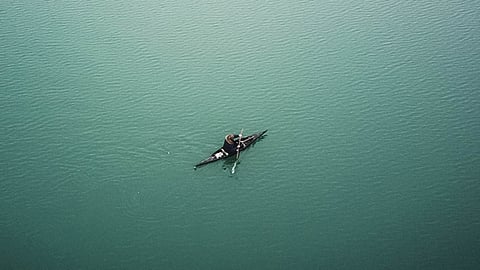
On board the Beagle when the Yaghans were returned was the artist Conrad Martens. This painting of a tribesman hailing Beagle from his canoe was one of his many fine works, giving us, among other things, a touching impression of a simple Yaghan canoe and the more sophisticated survey ship.
Sign up for your early morning brew of the BizNews Insider to keep you up to speed with the content that matters. The newsletter will land in your inbox every morning on weekdays. Register here.
Support South Africa's bastion of independent journalism, offering balanced insights on investments, business, and the political economy, by joining BizNews Premium. Register here.
If you prefer WhatsApp for updates, sign up to the BizNews channel here.
