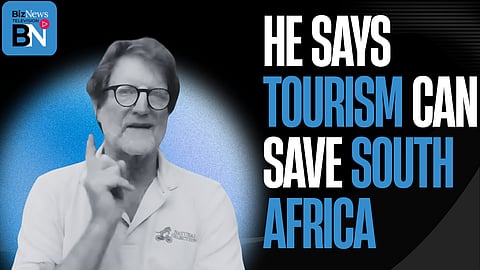
From flipping a coin that landed him in Botswana’s Okavango Delta to co-founding two of Africa’s most successful conservation-driven tourism empires, Colin Bell has built a business model that proves saving nature can also create jobs. In this episode, he tells Alec Hogg how Natural Selection is redefining eco-tourism - empowering communities, restoring wildlife, and showing why the “business of conservation” might be South Africa’s greatest untapped goldmine..Sign up for your early morning brew of the BizNews Insider to keep you up to speed with the content that matters. The newsletter will land in your inbox at 5:30am weekdays. Register here.Support South Africa’s bastion of independent journalism, offering balanced insights on investments, business, and the political economy, by joining BizNews Premium. Register here.If you prefer WhatsApp for updates, sign up to the BizNews channel here..Watch here.Listen here.BizNews Reporter.If you tossed a coin to decide your career, few would land on “build Africa’s most successful conservation-based tourism empire.” But that’s exactly how Colin Bell’s story began. A restless student in the 1970s, he flipped a coin between a mining job in Namibia and a safari outfit in Botswana. The safari won - and in that moment, Africa gained one of its great eco-tourism pioneers.Bell’s tale is part business odyssey, part love letter to the wilderness. From the Okavango Delta to South Africa’s Wild Coast, he has proven again and again that conservation and commerce don’t just coexist - they thrive together.From a coin toss to a conservation revolutionIn 1976, with a battered Volkswagen and little more than youthful bravado, Bell set off into Botswana’s Okavango Delta. What he found there wasn’t just wildlife - it was purpose. “We realised a Johannesburg company was using Botswana’s natural resource, creating no jobs, no money, nothing for locals,” he recalled. “So we said, let’s set up here, employ local people and share the benefits.”He and his partner started Wilderness Safaris with just R2 500 each. What began as two young dreamers became a model for community-based tourism across Africa. Wilderness eventually expanded into seven countries and listed on both the Johannesburg and Gaborone stock exchanges - all while pioneering a business approach that put local communities at the centre.“We learned early that partnerships were everything,” says Bell. “If you could build trust with the people who owned the land, everyone would benefit.”Building a business of conservationAfter selling out of Wilderness in 2006, Bell could have retired comfortably. Instead, over lunch with old friends, he began sketching out a new idea — one that would fuse profitability with purpose. The result was Natural Selection, a company built on a deceptively simple premise: conservation can fund itself if it’s run like a business.“We saw what happens when conservation depends on donations,” he said. “As soon as there’s a crisis —-9/11, COVID - the funding dries up and the projects die. So we said, let’s make conservation a business.”Today, Natural Selection operates more than 30 lodges across Botswana, Namibia, and South Africa, managing 1.5 million hectares of land. The company channels 1.5% of its revenue - before shareholders see a cent - into its own conservation foundation. That’s already over R50 million invested directly into community and wildlife projects.And the payoff is tangible. “The more we give back, the more valuable our business becomes,” Bell said. “Not one of our partners wants to sell. They all want to buy more.”Lessons from Namibia and beyondBell’s philosophy crystallised in Namibia’s rugged northwest, where his team struck one of their earliest community deals in the 1990s. “When we arrived, there wasn’t a single person in that village who had a job,” he said. “We made a deal to bring tourists, pay the community, and make them real partners.”Today, Namibia boasts 35% of its land under community conservancies — home to thriving wildlife populations and zero poaching. “There are now more black rhinos running wild in community areas than in national parks,” Bell said proudly. “That’s what partnership does.”The Wild Coast experimentNow Bell is bringing that same model home. In South Africa’s Eastern Cape, he’s developing Gwegwe, a project two decades in the making. The land was returned to a dispossessed community whose ancestors were evicted to make way for a leper colony. Instead of moving back, they chose to keep it wild - on one condition: that they share in the jobs and revenue.Bell agreed. “They get nine percent of our turnover,” he explained. “We paid our first cheque last year - R477 000. They cried when they saw it.” The community then voted to use the entire sum to rebuild seven local schools.That’s the heart of Bell’s model - conservation as an engine of development. The project also trains and employs local women as rangers, inspired by Kruger’s unarmed “Black Mambas.” His team calls them the Green Griffins.Tourism as South Africa’s hidden goldmineBell believes South Africa is sitting on an economic treasure. “One in six South Africans puts food on the table because of tourism,” he says. “But we’ve only got about two million international visitors a year. Australia has more than ten million - and what have they got? A rock and a reef. We’ve got everything.”To unlock that potential, Bell argues, the country must fix its broken provincial parks through public-private partnerships. “Most of them are bust,” he says. “Eighty percent of budgets go to salaries. There’s no money left for conservation.”But when partnerships are structured right - like his collaboration with CapeNature in the Western Cape - they thrive. “It works,” he said. “Government, private sector and community all benefit.”Conservation that paysAt its core, Bell’s philosophy is brutally practical: conservation without cash is just a conversation. Every part of his business is designed to keep that conversation funded. Tourists pay a separate Community Conservation Reserve fee that supports anti-poaching patrols, alien vegetation clearing, and school projects.“People always want a deal on accommodation,” he laughed, “but no one complains about paying for conservation. Everyone wants to feel their money’s doing good.”From the bush to the boardroomBell’s life reads like a manual for sustainable capitalism. He’s been a guide, a CEO, a conservationist, and an author. His books The Last Elephant and The Last Lions document Africa’s shrinking wildlife populations — and the solutions that already exist.“We’ve got the best rewilding examples in the world right here,” he says. “Private reserves that were once farms are now wildlife havens. We just need to scale it up.”The unfinished businessAfter half a century in eco-tourism, Bell’s mission isn’t over. His dream is to make Mkambati on the Wild Coast a gold-standard model — proof that communities, government and the private sector can co-create a self-sustaining conservation economy.“If we get it right, we can double the park, reintroduce rhinos, and show the world how South Africans can turn biodiversity into prosperity,” he said.For Bell, it all circles back to that coin toss in 1976. He could have gone into mining — digging into the earth for value. Instead, he dug into the soul of Africa and found something far richer.“Nature,” he said with a grin, “is still the best business Africa’s got.”