
NIMBYism is quietly sabotaging the world's climate fight
If humans are to save our future, we need to build big things that cut our carbon output – from wind turbines to subway lines. But the NIMBYs of the world are having none of it. Who can stop them stopping climate action?
By Carlos Amato
The global village is a real thing. But humans tend to care more about their actual villages: the communities that they can see with their own eyes and walk their dogs through.
This is especially true if the village is a nice village, with nice views and nice property values. Then the existing villagers don’t want newcomers to arrive – or any other kind of physical change to take place.
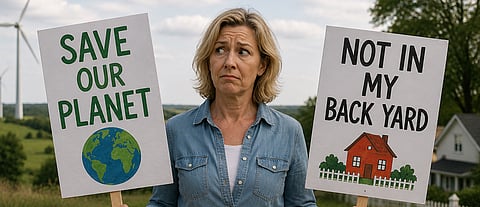
This impulse to hold and conserve a favourable territory – whether it’s a good hunting ground in our primordial past or the Upper West Side of Manhattan – is old and deeply instinctual. The original NIMBY (or Not-In-My-Backyard-er) was likely a rock-brandishing Sterkfontein hominid some 3-million years ago, strongly advising a rival hominid alpha to settle his family in some other cave complex. But when we keep on choosing our territorial interest over the interest of the society at large, the result can be extremely costly – both within and beyond the territory in question.
The local politics of climate-crisis action is a case in point. A growing number of economists and climate researchers are convinced that NIMBYism is a serious obstacle to achieving the pace of infrastructural change that is required to reach net zero and save our future as tenants of a habitable planet.
In most democratic and developed economies, planning regimes that regulate construction allow local communities to lodge objections to carbon-reducing projects that are proposed for their areas: not only renewable power plants and transmission lines, but also public transport links and low-cost housing projects that would make their towns and cities more energy- efficient.
Densely populated cities with fewer private vehicles pump out far less carbon per capita – even in the era of the electric vehicle, because in most rich countries, the grid power supply that charges EVs still includes a large proportion of fossil-fuel energy. And mains power generation will continue to emit plenty of carbon for many years to come – especially if red tape keeps on strangling new green projects. In the EU, it is estimated that at any given point, the potential wind energy capacity that is suspended in lengthy permit processes is four times greater than the wind capacity that is actually being built. Economist Stephen Jarvis at the London School of Economics has calculated that NIMBYism in the United Kingdom pushes up the cost of wind power by as much as 29% – thus throttling the economies of scale that a transformative green energy economy needs to achieve.
The US also has a bad case of NIMBY-climate tension – and a recent side effect of this syndrome was a serious power- supply crunch in 2024, particularly in the green-conscious, tech-savvy western states. A combination of rapid EV take-up and the rapid construction of AI server farms has jacked up demand, while the growth in renewables supply isn’t keeping pace, mainly due to bottlenecks in connecting new wind and solar plants to the existing grid.
Transmission infrastructure generally takes longer to build than wind turbines – not least because it often needs to cross city or private land, where politicians and landowners tend to dislike huge cables and towers traversing their green belts, blocking vistas and votes. To complicate matters, legacy grids are often structured to connect coal-producing regions, dotted with power plants, into the national network – so green grid expansion requires a difficult geographical orientation. For example, in South Africa, Eskom urgently needs to connect the country’s sun-rich western provinces to the grid, replacing decades’ worth of transmission lines from Mpumalanga in the east: a pricy and difficult process even before you start talking to affected landowners.
Green gridlock in the US has now reached the absurd point, says John Podesta, the White House deputy chief of staff, where it is easier to get a new fossil-fuel energy plant approved than it is to get a renewable project approved. There is a strange irony in the fact that NIMBY objections are often motivated by (or at least framed as) a concern for the ecosystems and wildlife of the local landscape, when the motive for the rejected project is a concern for the viability of the entire planet.
This isn’t weird or irrational behaviour. Considering immediate impacts before distant impacts is part of our psychological bedrock – it’s a survival technique that has largely served us well over the millennia. The fates of nearby trees and creatures and rivers are emotionally significant – and for many people, the same can’t be said of the fate of just one renewable investment among countless others, and its tiny contribution to a vast and abstractly planet-friendly process. Throw in a financial motive – safeguarding one’s property value – and the NIMBY deal is sealed, even if the threatened dip in value proves transient or illusory.
Germany has been well populated by wind turbines for decades – by 2019, it was home to 30 000 onshore “asparaguses” (as they are drily nicknamed by citizens.) That has brought widespread public acceptance of turbines as a general energy solution, along with an added dash of wind-phobic NIMBYism. In 2018, some 93 percent of Germans agreed that more turbines should be installed, according to a survey by the country’s Renewable Energies Agency – but only 52% wanted them in their vicinity. There is a perception that turbines emit ‘subsonic’ noise (which is debatable), and also a perception that they kill birds – which is true. But the true scale of that problem is hard to gauge accurately – and scientists estimate that wind turbines kill only a tiny fraction of the number of birds killed when flying into windowpanes across Germany every year, which may exceed 10-million.
One upshot of local resistance to renewables investment and a permitting system that empowers resistance is a hopelessly slow exit from a carbonised civilisation. Of course, NIMBYs are not the only cause, or even the main cause, of this stasis. Because corporate money walks and talks – and despite the big fossil-fuel giants’ trumpeting of their “clean fuel” innovations, they will keep on doing all they can to keep selling all the fossils they can extract from all the deposits they own. Rational investors will keep investing in them, because rational power consumers will keep on choosing the cheapest and most dependable ways to keep warm in winter and cook dinner and visit grandma on Sunday. It’s down to regulators and governments to change the incentives and calculations that drive those rationally self-interested decisions.
The tricky question is whether, at a certain point, rational self-interest becomes an inescapable problem because a brutal atmospheric reality imperils us all. What if the exercise of individual liberty needs to be curbed, instead of gamified and cajoled towards constructive behaviours using new incentives? Alternatively, how does one convince the world’s middle classes and wealthy elites to accept a reduction in the comfort of their surroundings?
Such a mental shift might prove critical to climate progress, but there’s not much historical precedent for reducing the privilege of elites in the absence of authoritarian force or violence, which is not the answer to this problem.
Because the world’s well-off people are steeped in potent cultures of private freedom: cultures that don’t celebrate the altruistic sharing of space or the surrendering of prestige. If they choose to do good, they want to do so by writing cheques of their choosing.
So, it’s fairly easy to convince a hypothetical suburban tax lawyer to buy a sleek, tax-incentivised EV, or to donate money to an environmental campaign. But it’s not so easy to get him to accept the appearance across his street of a ten-story block full of poorer new neighbours arriving from poorer towns or distant countries. Nor will he love the conversion of his leafy local park into a solar and wind farm that nudges the city towards climate neutrality. He won’t cheerfully embrace a year of noise and traffic disruption while a new local subway line is being built.
Until the reflexive defence of peaceful green spaces is challenged, and the building of big structures is normalised, middle- class NIMBYism will keep contributing to the glacial pace of decarbonisation – a pace that is melting glaciers, expanding deserts, and drowning islands.
The stakes are terrifyingly high, but bureaucratic systems don’t care. They are not designed to calculate trade-offs between low stakes and high stakes, and strategise accordingly. Bureaucracy is in one sense a friction machine, whose very purpose is to stop big things happening too fast – and in most contexts, this is a vital benefit to society, preventing looting and destruction.
But in this moment, bureaucracies that preserve the status quo of consumption and emission are effectively sustaining the destruction of everything we like about the world – including our backyards.
