
Ninja: Separating myth from history’s shadow warriors
Key topics:
Historical origins of ninja in Feudal Japan’s warfare and espionage.
Myths vs. reality: ninja powers, Hollywood portrayals, and folklore.
Clans, weapons, and secret techniques of Iga and Koga ninjas.
Sign up for your early morning brew of the BizNews Insider to keep you up to speed with the content that matters. The newsletter will land in your inbox at 5:30am weekdays. Register here.
Support South Africa’s bastion of independent journalism, offering balanced insights on investments, business, and the political economy, by joining BizNews Premium. Register here.
If you prefer WhatsApp for updates, sign up to the BizNews channel here.
By Ali Hayes
The truth is certainly not what Hollywood made it out to be – but it is also not true that they never existed. Elusive, secretive and silent – the ninja assassins and saboteurs of feudal Japan have entered into the public imagination and they are not leaving. How much is fact, how much is fiction – and just how real are some of the purported powers of these legendary warriors?
When you hear the word ‘ninja’, what comes to mind? Cheesy Hollywood movies? Fantastical characters akin to superheroes? Secretive martial artists? That episode of Mythbusters which showed that breathing through a hollow reed while hiding under water was impossible?
The public interest in the figure of the ninja waxes and wanes, and yet the myth is remarkably resilient. The ninja shows up in history and then disappears into the night. It re-emerges in Japanese folklore and then vanishes into the shadows. It is resurrected by low budget action movies, then shapeshifts into comic books, cartoon series, and an international bestselling novel.
For all the caricature that has been made of the ninja as a figure, the real phenomenon is in fact historical and well documented – and it is rooted not in the fake martial arts peddlers selling fantasy to eager, if naïve, practitioners – but in a brutal world of endless military conflict that shaped what was, in fact, history’s very first special forces.
It is hard – if not impossible – for the average person to imagine life in Feudal Japan. Japan before the Meiji Restoration was a closed off world, an isolated land that shunned any foreign or internationalist influences and operated according to strict codes difficult for contemporary people to understand.
Struggle and warfare were incessant. Warlords were constantly jostling for position and power, and very often the ordinary people suffered the most.
There may have been an Emperor in place – but still, his underlings would be involved in skirmishes and full-scale warfare to see who would rule the land on his behalf. Peace seldom lasted a long time.
The feudal system, at first glance, might seem slightly familiar. The emperor ruled the entirety. Beneath him were great warlords. Beneath these great warlords were local warlords. Beneath these local warlord’s – a population – often entirely at the mercy at the caprice of ever-shifting intrigues and alliances.
Japan’s warriors have always been famous. The island nation has brought to the world arguably the largest variety of distinct combat styles: from Karate, Judo, Jujitsu, Kendo, Aikido – among others. These arts are known as traditional martial arts and are today practiced as competitive sport.
The rules of sport and the rules of warfare are diametrically opposed. It is hard to imagine an athlete that gangs up on his opponent, uses weapons when the other side has none, employs subterfuge, sabotage, poisonings and unfair advantages to fare very well in competition. Likewise, someone who sticks to the rules, obeys referees on the sidelines, displays fairness and good sportsmanship, is unlikely to be very successful in war.
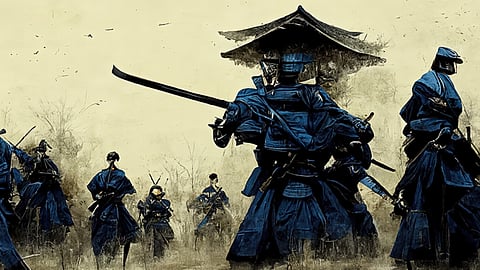
When people think of Japan’s most legendary warriors, the first thing that comes to mind is the samurai. And the ninja stands in stark contrast with them.
The samurai are better known and understood. These families operated like knights. The word literally means ‘one who serves’ – and they served local warlords known as daimyos. They would collect taxes from peasants and protect their lord’s assets. They followed a code of chivalry known as Bushido, which was derived from Buddhism and Shinto. Over time they became wealthy, and they would form family clans known for serving the daimyos, who in turn served the shogun, who managed the realm on behalf of the emperor.
The power of the samurai began to consolidate around 1185, when Minamoto No Yotitomo established the Kamakura Shogunate.
Relative peace – punctuated by flares of violence and skirmishes - reigned for about 400 years. Over that time, the Central government began to steadily weaken. Then came the era in which the ninja was born, a time of ceaseless violence and upheaval known as the Sengoku Jidai (1477-1615).
The documentary evidence we have for the ninja come from the era following this age of upheaval, written down by historians who were contemporaries in the early Edo period, which started around 1603 and lasted until 1868.
In these historical texts, the kanji can be read in two ways: nin-ja, or shinobi-no-mono.

Creative Commons image. The two symbols that make up the word ninja, also read or transcribed as shinobi no mono.
The oldest writings reference two regions. At the time, the capital was Kyoto. Just east of Kyoto was a region crisscrossed by wilderness and rivers known as Koga, and to the southwest, the mountainous region of Iga. In these two regions lived powerful samurai clans renowned for their skill in spying.
Whenever a samurai lost their master, they became ronin – or masterless samurai. It was considered dishonourable, in a culture where honour actually meant a great deal – to have failed your master to the point where you had to earn your living as, essentially, a mercenary. The families of Koga and Iga did not fail their masters, nor were the daimyo of the area dead. But they still presented themselves for hire.
Some of the greatest names in Japanese military history are associated with these clans, including Tobikato, Fuma Kotaro and the legendary Hattori Hanzo. Using techniques passed down in secret, and distinct from each other, the Koga and Iga clans became expert at tasks other samurai would not touch. Inflitration, spying, secret missions – and the use of farming implements as weapons.
The samurai would show up to the battlefield in full armour – with the large katana and somewhat smaller wakazashi swords. The ninja would not show up at all, but circle around, and wreak havoc on the castle behind them, then vanish into the terrains.
Instead of the large, curved blades they had short, straighter swords, perfect for combat in tight and confined spaces. They used implements like the sickle and chain, the kusarigama, a weapon that regular soldiers did not know what to make of and found hard to deter.
As the fortifications became ever more complex, the skills of the ninja clans grew.
The turmoil of the Sengoku Jidai ended as Ieyasu Tokugawa became Shogun in 1603, the first shogun of Tokugawa and one of the great unifiers of Japan. He hired the ninja clans as ‘gardeners’ – who would take care of the palace gardens while secretly being a highly-competent military guard.
It was during this early period that the three documentary sources of ninja history were also compiled: the Bansenshukai, the Shoniki and the Shinobi Hiden. These collections were essentially manuals on espionage, escape, camouflage and invasion – and contained ancient Chinese writings as well as later Japanese innovations.
By then the ninja were feared and many described them as having magical powers. The fear could be explained by the fact that they did not follow the bushido codes, as samurai did. They used poisons and gunpowder and even recruited women as warriors (the kunoichi) – and their vast spy networks had connections throughout the realm and dirt on most of the worldlords.
Much later, Tokugawa Yoshimune created an order of ninja known as the oniwabanshu – comprised of both Iga and Koga elements. Their primary task was to spy on the feudal lords to prevent rebellion and corruption.
This unit remained active for a long time indeed, and there is some documentary evidence that they were deployed as an advance force during the Japanese invasion of Manchuria in 1931.
Perhaps then, the ninja’s best disguise is their ability to hide in plain sight. The movies go overboard and make them superheroes, and so many dismiss them as mythical and deny they ever existed. But make no mistake, the black clad warrior that stalks targets from the shadows, then strikes without warning or mercy, only to disappear back into the night – is not a fantasy but a historical reality.
To this day, around the world and also in South Africa, both Iga and Koga disciples continue to teach practices rooted in the old family teachings – though the most elite skills of Japan’s legendary warriors – are hidden in complete darkness to this very day.