
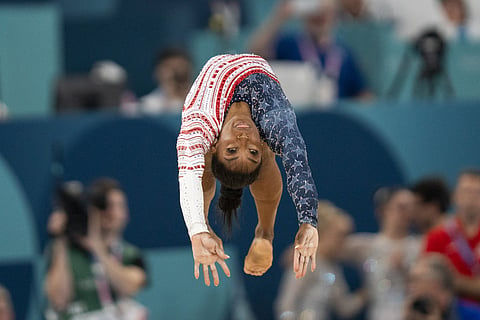
Simone Biles: Redefining greatness through courage and accountability
By Tendani Mulaudzi
Simone Biles is an athletic superstar, after continuously redefining gymnastics and what it means to be an athlete. With 11 Olympic medals and a record-breaking 30 World Championship medals, as well as gymnastic skills that bear her name, Biles has also made huge leaps in the sports world by openly prioritising mental health and advocating for athlete welfare. Hers is an influence that has a far-reaching impact, making her a role model for athletes across disciplines and generations.
Biles is the most decorated gymnast in World Championship history with a total of 30 medals, including 23 golds. However, it doesn’t end there. Biles has proven and cemented her legacy as a gymnastics icon in the Olympics, consistently demonstrating her dominance in the sport. She has revolutionised gymnastics by performing elements so challenging that they have been uniquely named after her. For example, the “Biles” is a floor exercise that was an unprecedented achievement when she first performed it. Similarly, the “Biles II” is so tough that few gymnasts dare to attempt it. Singlehandedly, Biles has pushed the boundaries of gymnastics difficulty, prompting rule makers to reconsider how elements are scored.
Unlike many athletes who peak early in their careers, Biles has continued to dominate well into her twenties, defying the stereotype that gymnasts have to retire young. Competing at an elite level for over a decade, she has remained virtually untouchable.
The courage to prioritize mental health
Her extraordinary physical capabilities aren’t the only thing that makes Biles unlike any other athlete – she has also demonstrated immense mental strength over the years. The Tokyo 2020 Olympic Games marked a pivotal moment in her career because she decided to withdraw from several events due to mental health concerns.
Biles experienced the “twisties”, a condition that affects an athlete’s spatial awareness in mid-air, and made the courageous choice to step back rather than risk serious injury. Her decision was met with both support and criticism but more importantly, it sparked an important conversation about the mental pressures faced by elite athletes. Historically, athletes have been expected to perform, regardless of physical or psychological strain. However, Biles challenged that norm by prioritising her well-being above winning medals. In doing so, she paved the way for other athletes to openly address their mental health struggles without fear of stigma. Tennis star Naomi Osaka, for example, withdrew from the French Open after refusing to participate in press conferences, citing mental health reasons. She later shared that she had been dealing with anxiety and depression since 2018.
Biles later returned to the balance beam final and won a bronze medal. This moment highlighted her resilience, as she redefined success as the ability to prioritise personal well-being.
A voice for athlete welfare
Beyond her contributions to gymnastics, Biles has been a vocal advocate for athlete welfare. In 2018, she publicly revealed that she was among the hundreds of gymnasts abused by former USA Gymnastics doctor Larry Nassar. Her decision to come forward was seen as an act of bravery, as she used her platform to demand accountability from governing bodies that failed to protect young athletes.
Unlike many other athletes who focus solely on their careers, Biles has actively fought for systemic changes to ensure future generations of gymnasts are safeguarded from similar abuse.
Biles has also spoken out about broader issues in sports, including pay disparities, racial inequality and the need for better support systems for athletes. She has famously used her influence to push for change, proving that being an athlete can also mean shaping a better future for those who follow in their footsteps.
The greatest Olympian of all time?
The debate over the greatest Olympian of all time often includes names like Michael Phelps, Usain Bolt and Serena Williams. While all of these athletes are remarkable in their respective sports, Biles’ impact uniquely transcends gymnastics.
Phelps, who has 23 Olympic gold medals, is the most decorated Olympian in history. His dominance in swimming is unquestionable, and he has publicly supported Biles during the Tokyo Games when she took time off, as he has also had his share of mental health issues, which he has openly spoken about in public. Similarly, Bolt’s speed and charisma made him an icon in track and field. However, Biles has introduced new elements to her sport that has reshaped gymnastics and this sets her apart from other Olympic greats.
Biles has also shown a willingness to address issues beyond her sport, including mental health and athlete safety, and has influenced civilians and fellow athletes beyond competition. She has proven that success is not solely defined by medals but by impact.
A legacy
Biles has shown resilience and advocacy that is impressive, especially considering the fact that her journey began in the foster care system. She has redefined the expectations placed on athletes, proving that strength, on the surface, is about physical ability but on a deeper level, it’s about the courage to challenge norms. By prioritizing mental health, demanding accountability and continuing to push the limits of gymnastics, Biles has ensured that her legacy will live on long after she leaves the competition floor.
Sign up for your early morning brew of the BizNews Insider to keep you up to speed with the content that matters. The newsletter will land in your inbox every morning on weekdays. Register here.
Support South Africa's bastion of independent journalism, offering balanced insights on investments, business, and the political economy, by joining BizNews Premium. Register here.
If you prefer WhatsApp for updates, sign up to the BizNews channel here.
