
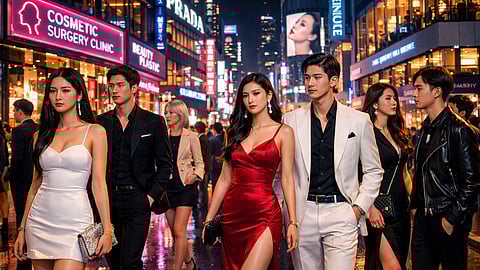
Gangnam Style: South Korea’s plastic surgery phenomenon
Key topics:
South Korea leads globally in plastic surgery, especially among women.
Gangnam is the hub for cosmetic clinics and K-pop celebrity influence.
Beauty standards drive social pressure, jobs, and cosmetic procedures.
Sign up for your early morning brew of the BizNews Insider to keep you up to speed with the content that matters. The newsletter will land in your inbox every morning on weekdays. Register here.
Support South Africa's bastion of independent journalism, offering balanced insights on investments, business, and the political economy, by joining BizNews Premium. Register here.
If you prefer WhatsApp for updates, sign up to the BizNews channel here.
By Athalie Russell Besseling
South Korea has the highest number of plastic surgeries in the world. The rate could be as high as one in five citizens going under the knife, with the greatest number of patients being women. This world leader in plastic surgery is followed by Greece at number two and Italy at number three. Interesting. One would have thought the USA would be right up there.
Gangnam in Korean means south of the Han River; it is a glamorous area at the rich heart of Seoul. The word Gangnam gate-crashed the international lexicon some years ago, via a foot-stomping Korean-pop song. The mesmerising performer was Psy, and the world strutted along to the hypnotic beat and irrepressible energy.
If you had no signal at the time and were reduced to playing solitaire, here’s Psy with Gangnam Style to perk up your day. https://www.youtube.com/watch?v=8ZMCFzq37iQ
The Gangnam area is packed with plastic surgery clinics, pristine state-of-the-art facilities devoted to creating the New You. It’s just another part of the “Korean Wave” washing across the world, along with K-pop and Korean TV shows that are surpassing Hollywood’s in popularity at a speed that should be alarming American producers.
Read more:

So. Why have South Koreans become the most cosmetically augmented people in the world? South Korea’s obsession with beauty is well-known, and it is right up there with the top ten plastic-surgery-fixated countries globally. The prevailing South Korean concept of beauty dictates slenderness, pale skin which is “dewy” and not matte, straight eyebrows and – very importantly – a V-shaped chin. (Skin must of course be smooth and skin whitening is also a popular procedure.)
The eyes are perhaps the most important feature of all. The little fat deposits under one’s eyes that are said to make one look more youthful are called “aegyo-sal” and these are an important augmentation.
Double-eyelid surgery is hugely popular. “Round eyes”, probably because of historical Western influence, are sought after.
Double-eyelid surgery before and after
In South Korea, plastic surgery is not looked down upon or stigmatised. It’s a popular gift for youngsters upon their graduations. The most frequent surgeries are eye surgery and wrinkle-removal prcedures. Americans, Chinese, Russians and other nationalities who flock to South Korea because cosmetic augmentation is cheaper there, have nose jobs first and then eye surgery to remove wrinkles and tighten the skin.
The media influence on Korean ‘beauty’ cannot be overemphasised. Everyone wants to look like K-pop stars, actresses and TV celebrities. Cultural pressure is immense, and more than 33% of women under 30 have had some kind of ‘work’ done. To conform to society is the greatest pressure for Koreans because individuals must obey the dictated norm. This has some tragic consequences, like increasing suicides among the youth, including young rising stars and celebs.
The rapid economic growth after the Korean War and the vast upswing in skills and education have led to intense competition for a limited number of jobs. In this economy and social milieu, beauty is your number one investment. Cosmetics, plastic surgery and, of course, perfect teeth are how one beats the competition – both economically and on the social scale. Beauty standards expected of both young men and women have been shown to massively influence the likelihood of getting a job.
Research into the comparison of beauty ideals in the West and Korea indicates that the Korean obsession with thinness is even greater than in the USA. (Aside: when saying USA, we are not referring to the people of Walmart.) Enormous cultural pressure to be thin, thin, thin is no doubt responsible for the rising body dysmorphia and eating disorders among Korean women and, increasingly, men too.
South Korea is currently ranked in the top twenty economies in the world with continual growth. And with that growth, the anorexia/bulimia and other problems women are experiencing grow too.
There are a lot of factors. Confucianism is still hugely prevalent in South Korea. “Confucius say” goes the silly joke, but the old gent’s philosophy dictates many of the roles and norms in Korea, and some of his teachings have been sustained to this day. Confucius’ world contains dominant men and submissive women. Thus women, being somewhat objectified, feel greatly pressured to look perfect.
Another strange cultural feature, nothing to do with Confucius, is that certain negatively perceived facial attributes are traditionally associated with bad luck, and this could turn people towards plastic surgery.
The cosmetics industry in South Korea is gigantic. Ten years ago, they were exporting $2.64 billion in cosmetics, so one can only imagine it has grown by a billion or more since then. Korean products tend to have ingredients not often found in Western cosmetics, such as seaweed and snail extract.
The ideal feminine skin in Korea is described as “dewy”, which, besides being perfectly smooth and all those other factors, means being shiny or “glowing” and looking “natural”. In the West, makeup is used to alter the facial bone structure’s appearance, highlighting cheekbones and pencilling eyebrows for instance. “Dewy” makeup can be said to attempt the opposite, concentrating massively on the skin’s texture and glow.
Surgery on Koreans involves a great deal of V-line surgery (jaw and chin reduction) and cheekbone reduction surgery to alter the contours of the face, jaw and chin and achieve an “oval” face. A trend has even been noted where people from Western countries go to Gangnam to acquire a face that looks like a K-celebrity.
Korean “idol trainees” have the most plastic surgery of all citizens and the agencies that promote them are known to insist on surgery no matter what the trainee wants. Interviews with plastic surgeons indicate that 90% of K-celeb faces have been surgically redesigned and realigned. Most commonly, they have fat removal and facial adjustments. Bulk discounts for the eyes, nose and facial adjustments are the norm.
Male beauty is as marketable and desirable as female beauty in South Korea, and the cosmetics industry focuses equally on men. Makeup is quite socially acceptable on the males of the species, and they have a plethora of products, lotions and potions to choose from.
So should you be thinking of a makeover any time soon, remember, if it’s your face you want altered, you might want to go Gangnam style. But for breasts and buttocks, the leaders in the field are Greece, the USA and… you guessed it… Brazil. And finally, in Gangnam, there’s even the option of a “petit procedure”, often called a “one shot” or “lunch”. That’s when one books in advance and pops into a Gangnam surgery for “one shot” of face fillers or any modest process that can be done in the time it takes to eat your bibimbap and kimchi.