
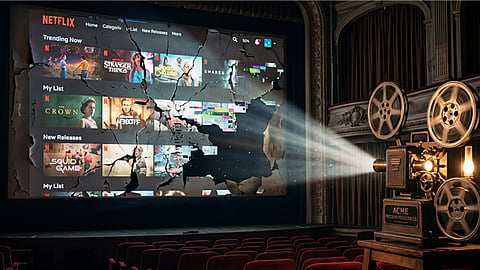
The stream hits the wall: the uncertain future of great TV
By Carlos Amato
With the streaming giants suddenly struggling to justify the cost of creative ambition, the golden age of the small screen might be behind us. But all is not lost.
In 2016, I shared a workspace with a team of gifted TV screenwriters. I would eavesdrop hungrily on the 3-hour-long weekly script meetings that steered their successful South African drama series — hoping to understand the hidden mechanics of the shocking plot twist, or to memorise the trade secrets of constructing crackerjack dialogue.
No such luck. The meetings were good value— full of knotty debate and agile banter— but they tended to circle around the creative mysteries. They were ultimately just a preamble to the real act of storytelling wizardry, which happens in private moments between writer and laptop, unfolding at some desperate hour, beyond the reach of my flapping ears.
That said, my stint as a fly on the writers’ room wall did give me a taste of the atmosphere that surrounds and enables great TV writing. And I can only describe it as an atmosphere of serious play. These were elite storytellers, who were at once delighting in the wild liberty of their jobs and discharging their professional duties — to the viewers, to the actors and crew, to the sheer privilege of confecting a fictional world — with what can only be described as reverence. It was this two-layered creative culture — one part imaginative anarchy, one part deep rigor — that powered the Golden Age of TV.
And that age, I’m afraid, is now behind us. You may have noticed the passing of the Golden Age, also known as Peak TV, in a sudden lack of exceptional new shows or fresh seasons on your streaming services during the past year. There was always a lot of rubbish on our screens, of course — but until recently, the rubbish dump contained a reliable scattering of diamonds. Now the diamonds seem to be gone.
Why is that? One of the reasons is the 2023 Hollywood writer’s strike, which saw the TV production calendar grind to a very grumpy halt for months on end. But the end of the “streaming wars” as a meritocratic creative tussle is the deeper cause of the slump in quality. Like all the big tech players in recent years the streaming TV giants — Netflix, Amazon Prime, Disney+, Hulu, Apple TV+, HBO Max and Paramount+ — are under intense pressure to become profitable. The era of speculative indulgence and ambient optimism that defined the tech boom is behind us. Since 2022, the streaming platforms’ share prices have mostly dipped and their shareholders’ appetite for risk and artistic endeavour has crashed. They want returns, not masterpieces — and they want them yesterday.
That reality has suddenly stunted the industry’s volume of production after more than a decade of constant expansion — 2023 saw a sharp dip in the global output of original scripted TV shows to 481 productions, from the all-time peak of 599 in 2022. But it has also narrowed the content mix: shows with reliable mass-market appeal are in, and niche-market fare is out. Inventive, groundbreaking shows like Succession or The Bear or Fleabag may hoover up awards and critical flowers — but they often win lower audience ratings than successful genre shows — conventional action thrillers or comedies or legal dramas — and are therefore likely to earn less money.
Technological leaps often precede artistic leaps — and most critics place the dawn of the TV Golden Age in the late 1990s and early 2000s, when a boom in cable TV and DVD retail combined to finance a new, dark and cinematic aesthetic on the small screen. The new shows were opulently shot and laden with absorbingly complex heroes and antiheroes. Transgressive wit and sex and unflinching violence flared in the absence of network-imposed censorship. HBO led the way with Oz in 1997 and The Sopranos in 1999. Warner Brothers pitched in with The West Wing that same year.
After the millennium turned, the cult classics kept coming: Six Feet Under (2001), The Wire (2002), Mad Men (2007), Breaking Bad (2008), Game of Thrones (2011), Girls (2012).
In 2012 came the streaming revolution and the dawn of binge-viewing, led by Netflix, which supersized both the cultural reach of TV and the quantum of time that the average consumer devoted to watching it. Investors piled into this sexy new model, backing both Netflix and a growing roster of legacy networks and tech giants who had leapt into the streaming fray. With share prices soaring and interest rates staying low after the financial crisis, all the rivals had credit and money to burn. Inevitably, they made a lot of turkeys — but they also made plenty of golden geese. House of Cards and Orange Is the New Black were the original streaming megahits, but they were rapidly followed by a dizzying flow of singular stories told by writers and producers blessed with creative courage and the financial freedom to use it. Visionary science fiction blossomed with Westworld, Severance and Counterpart. Wild comedies like Killing Eve and Schitt’s Creek leavened the mood.
The contemporary crime tradition grew even darker with the likes of Better Call Saul, True Detective and The Night Of. And the growing currency of subtitled viewing added a feast of foreign-language treats to the Anglophone menu — notably the French hits Lupin and Call My Agent, Denmark’s The Killing and Borgen, South Korea’s Squid Game and Spain’s Money Heist. Meanwhile, British producers expertly mined and exported the cultural capital of their country’s imperial past with shows like The Crown and Bridgerton.
Netflix directly commissioned a big share of this global harvest of hits — including here in South Africa, where its local projects like Blood & Water have travelled well. But the streaming sector’s money crunch has hit expansion plans — the strategic focus is now firmly back on making content in and for the major Western markets. Amazon Prime recently followed Netflix into the African market with much fanfare, recruiting a roster of top South African executives and production houses with promises of lavish funding for original projects, only to pull the plug abruptly in January.
I spoke to a leading local producer who says South African TV’s prospects remain healthy despite the darker global mood, thanks in part to the savvy strategy of Multichoice’s Showmax, which is now Africa’s leading streaming platform despite the well-resourced competition from Netflix.
Spending far less per minute of TV than its invading rivals, Showmax has built a cost-effective model for scripted content by applying the battle-hardened operational savvy of its parent company Multichoice, which has dominated the African pay-TV market for decades with an offering anchored by sport and reality TV — and recently attracted a successful takeover bid from French TV conglomerate Canal+.
In addition to containing costs, Showmax has succeeded by focusing on programming in indigenous languages, in contrast to Netflix’s local operation, which tends to back English-language productions. The priority is always to tell stories that resonate with the particular realities of South African life. “I think there’s a recognition that the South African audience is far less interested in production value than it is in authenticity,” the producer told me.
Not that Showmax isn’t willing to go offshore with a more globally accessible mix of South African content — its successful co-productions like Recipes for Love and Murder and Reyka have won big audiences abroad despite not being major hits at home.
In a sense, Showmax has been following the new streaming rules all along — keeping a tight rein on budgets and backing the right horses. In the long run, it helps any tech business not to be flooded with cheap investor billions during an irrational bull market; you stay in shape for when the market turns. Meanwhile, Showmax’s offshore rivals will surely get a handle on South African audience needs. And given that our TV sector has never had the budget for risky art projects, it’s pretty much business as usual.
As for the threat of robot-generated TV, the word on the corridors of TV power is that AI will soon play a big role in generic niches like low-end 3D animation and soap operas — cheap and rulebound sectors with little room for creative genius which already have a soulless vibe. But it will be harder to satisfy the top end of the market with AI “creativity”, beyond the cheap modelling of sci-fi backdrops and spaceships.
But a magical TV show will always be a fiendishly difficult thing for human beings to create. The people who have done it before believe it will always require money and time and passion. The robots and the bean counters disagree. And the couch potatoes will decide who is right.
Sign up for your early morning brew of the BizNews Insider to keep you up to speed with the content that matters. Register here.
Support South Africa’s bastion of independent journalism, offering balanced insights on investments, business, and the political economy, by joining BizNews Premium. Register here.
If you prefer WhatsApp for updates, sign up to the BizNews channel here.
