
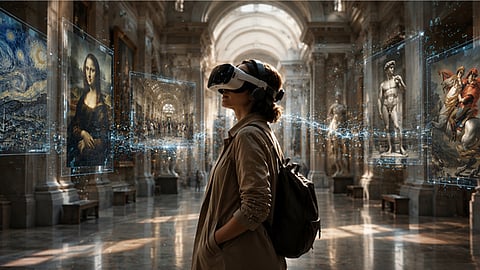
Echoes through time: How technology is preserving art’s legacy
By Ivan Damon
Have you ever wondered why some artists’ legacies endure – their works, a signature, a name, resonates across generations and timelines – while others fade into obscurity?

While artistic merit undeniably plays a role, the answer may lie increasingly in the evolving landscape of art preservation and the innovative means of access, underscored by technological evolution. Or perhaps a dichotomy? In a rapidly expanding digital realm, an unprecedented opportunity has emerged to safeguard and share artistic legacy, merit and culture, ensuring a creative continuum of spirit of past and present, eclipsing constraints of imagination, dimensional space and time.
“There really is no such thing as Art. There are only artists.” Art historian Ernst Gombrich
The above sentiments are couched in the important notion of preserving not just the works of art themselves, but the very essence of the lives lived by the ‘masters’, their context and time-travelled stories. Are technology and innovative expertise, in some sense, the custodians of these chronicles?
Artistes Sans Frontières: expanding access in the digital age
The advent of high-resolution digital archiving ushered in an era allowing for the meticulous safekeeping of fragile works, capturing immersive details invisible to the naked eye, embracing the possibility of reduced physical degradation. And, yes, across time zones, in far-away cities, virtual exhibitions are now accessible to a global, varied audience, democratising art access. Drawing on the legacy of Médecins Sans Frontières, virtual galleries in our digital age and global networks have rendered the traditional boundaries of geography and culture increasingly permeable – we are Artistes Sans Frontières, fostering collaborative creative expression and understanding without geographical boundaries.
The Google Arts & Culture project has partnered with over 2,000 museums globally, from the Rijksmuseum in Amsterdam to the Uffizi Gallery in Florence, to digitise their collections in ultra-high resolution. In 2016, the project’s Art Camera initiative allowed viewers to explore Vermeer’s Girl with a Pearl Earring or Van Gogh’s Starry Night in microscopic detail – revealing secrets previously accessible only to conservators.
Perhaps the most striking example is the Louvre’s creation of a digital twin of the Mona Lisa. Using ultra-high-resolution imaging and 3D modelling, experts have produced a virtual replica of the world’s most famous painting, allowing scholars and the public alike to examine every crack and brushstroke from anywhere in the world. This digital twin not only preserves the artwork for posterity but also enables new forms of research and engagement.
Beyond the frame: Observateurs Sans Frontières
And then there’s the access issue. Once, the world’s great art was the preserve of those who could afford the ticket, the VIP invite, the flight, the luxury of time. Now? A teenager in rural Limpopo or the dusty Cape Flats can virtually immerse themselves in the hallowed spaces of the Louvre with a few screen taps and swipes. In most developing nations, far removed from ground zero of the greats on display, where distance and resources can make a trip to a major gallery a rare luxury, virtual exhibitions are nothing short of revolutionary.
Imagine for a moment, in a classroom in Tembisa, South Africa, your teacher projecting images of Gerard Sekoto’s vibrant townships onto a battered whiteboard. The students, like myself at that age, would certainly never have set foot in a gallery, yet would debate the meaning of colour, provenance, light and identity. Like theirs, my excitement would have been sincere. For them, for me, the use of technology isn’t just levelling the playing field – it’s fading and collapsing the lines altogether – a tweening experience from where we currently are to where you could be – enter the virtual gallery.
During the 2020 pandemic, the British Museum in London and the Musée d’Orsay in Paris launched immersive virtual tours, allowing millions worldwide to stroll through galleries otherwise closed to the public. The Smithsonian Institution in Washington, D.C. went a step further, offering interactive 3D models of artefacts, such as the Apollo 11 command module, for anyone to examine in detail at home.
Increasingly, technology is not only preserving art but also transforming how audiences experience it. In South Africa, innovative platforms are rethinking gallery visitation through immersive audio experiences. By integrating AI-powered podcasts accessible via QR codes, visitors can listen to the stories behind each artwork – directly from the artist or curator – while standing in front of the piece itself. Gone are the days of static PDF gallery-cum-agent downloads.
Blockchain: art’s silver bullet?
Fakes, forgeries, and provenance records lost in the mists of time have, of course, always existed in the art world. The term blockchain, which was first used by cryptocurrency aficionados, is now central to art authentication. Imagine a transparent, unchangeable digital ledger that records each brushstroke from creator to collector. It seems like science fiction, but it is already changing our perceptions of legacy and trust.
A scandal broke out not too long ago when a long-lost masterwork turned out to be a brilliant fake. The backlash was quick and harsh, and reputations were ruined in a matter of hours. These kinds of stories may soon be a thing of the past thanks to blockchain. Artists and buyers alike may sleep a little easier, knowing that their treasures are preserved not just in canvas and paint, but in an unbreakable digital link.
In 2021, Maurizio Cattelan’s works were sold as NFTs (non-fungible tokens) via blockchain platforms. This made sure that the works’ history and authenticity were clear. In the same way, British artist Damien Hirst started The Currency project, where customers could pick between a tangible piece of art and its NFT version. The blockchain would track who owned the art and all transactions.
The double-edged sword
But technology is not a cure-all, although it has a lot of potential. Digital data gets worse over time, servers break, and formats go out of style. There’s a certain irony in keeping eternity on a hard disk that might not last a decade. And then there’s the experience itself. Can a computer scan possibly represent the silence of a gallery, the feel of oil on canvas, the nearly undetectable aroma of old varnish? Walter Benjamin cautioned us about the “aura” that is lost when things are reproduced, perhaps there is some truth to this.
Moreover, the digital divide is real. For every kid that is amazed by online exhibits, there are others who can’t afford to use the internet. The task, then, is not only to digitise, but to democratise – to guarantee that these new technologies don’t create yet another obstacle.
Artificial intelligence is now being used to restore lost or damaged art. A few years ago, researchers applied deep learning algorithms to reconstruct sections of Gustav Klimt’s destroyed paintings, using only black-and-white photographs and written descriptions. The results were so convincing that most experts struggled to distinguish the AI-restored portions from the originals – technology, collapsing, tweening the lines.
From palette knife to pixels: art reimagined
The trajectory is unequivocal. Technology, despite its idiosyncrasies and paradoxes, is transforming art’s narrative. While it does not substitute for the exhilaration of confronting a masterpiece, it serves as a formidable adjunct – enhancing, preserving, and encouraging new perspectives in the discourse. In South Africa, and beyond, the digital renaissance transcends mere preservation of the past. It pertains to envisioning the future. It is about ensuring that the echoes of artistic genius – whether painted, sculpted or coded – continue to reverberate long after we are gone.
The canvas of the future
But as we stand at this crossroads of art and technology, we have to ask ourselves: if technology can preserve reimagined pigments, lost chronicles and visions, what new masterpieces may it produce by embracing them? Maybe the most important thing we leave behind will be how we inspire the artists who come after us, not simply what we decide to remember or safeguard. The future is a blank canvas. Who among us will be brave enough to paint it? “I shall,” echoed the student from Thembisa, nearly 12 400 km from the Louvre.
Sign up for your early morning brew of the BizNews Insider to keep you up to speed with the content that matters. Register here.
Support South Africa’s bastion of independent journalism, offering balanced insights on investments, business, and the political economy, by joining BizNews Premium. Register here.
If you prefer WhatsApp for updates, sign up to the BizNews channel here.